Paper II — Q6
(a) "The success of administrative reforms in a country like India depends upon the political will." Comment. (20 marks) (b) The…
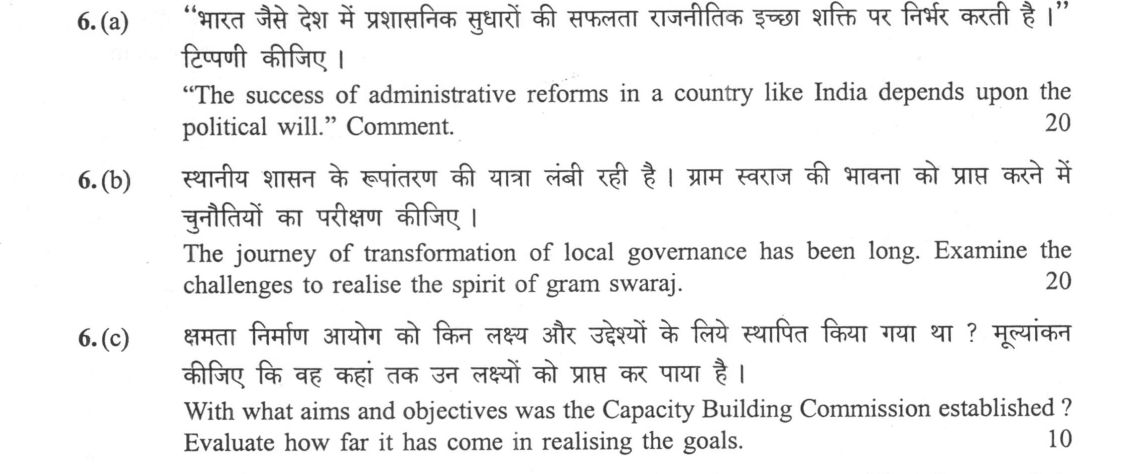
"The success of administrative reforms in a country like India depends upon the political will." Comment. 20 marks
The journey of transformation of local governance has been long. Examine the challenges to realise the spirit of gram swaraj. 20 marks
With what aims and objectives was the Capacity Building Commission established? Evaluate how far it has come in realising the goals. 10 marks
हिंदी में प्रश्न पढ़ें
"भारत जैसे देश में प्रशासनिक सुधारों की सफलता राजनीतिक इच्छा शक्ति पर निर्भर करती है।" टिप्पणी कीजिए। (20 अंक)
स्थानीय शासन के रूपांतरण की यात्रा लंबी रही है। ग्राम स्वराज की भावना को प्राप्त करने में चुनौतियों का परीक्षण कीजिए। (20 अंक)
क्षमता निर्माण आयोग को किन लक्ष्य और उद्देश्यों के लिए स्थापित किया गया था ? मूल्यांकन कीजिए कि वह कहां तक उन लक्ष्यों को प्राप्त कर पाया है। (10 अंक)
Model answer
Written by UPSC Answer Check against this question's marking rubric, to the expected length. UPSC does not publish answers for Mains — this is one way to score well, not an official key.
Administrative transformation in India requires a confluence of political vision, institutional democratization at the grassroots, and professional capability within the state apparatus.
Political Will and Administrative Reforms
Political will is a necessary, but not sufficient, condition for the success of administrative reforms. While executive determination provides the policy mandate, reforms frequently stall due to bureaucratic resistance, status-quo bias, and systemic resource constraints. The Second Administrative Reforms Commission (ARC II) emphasized that an effective political-bureaucratic interface is vital to balance democratic accountability with administrative professionalism, ensuring that policy intent translates into structural change.
Where political commitment has been resolute, complex administrative and structural transformations have succeeded. The pan-India rollout of the Goods and Services Tax (GST) and the transition to Direct Benefit Transfer (DBT) demonstrate how high-level political backing can overcome entrenched administrative inertia and inter-jurisdictional friction. Conversely, where political will is deficient, reforms languish despite clear institutional mandates. The chronic non-implementation of police reforms across states—notwithstanding binding directives from the Supreme Court in the Prakash Singh v. Union of India (2006) case—illustrates how an absence of political commitment stalls vital institutional modernization. Thus, while political will acts as the primary catalyst, enduring administrative success requires overcoming bureaucratic resistance and addressing systemic design flaws.
Challenges in Realising Gram Swaraj
The trajectory of democratic decentralization—progressing from the Balwant Rai Mehta Committee (1957) to the 73rd and 74th Constitutional Amendment Acts (1992) and the Provisions of the Panchayats (Extension to Scheduled Areas) Act (PESA, 1996)—reflects a significant structural-implementation gap. Realising Mahatma Gandhi’s ideal of village self-reliance (Gram Swaraj) is constrained by five structural challenges.
First, fiscal autonomy remains negligible, with Panchayati Raj Institutions (PRIs) generating less than 10% of their revenue internally, leaving them dependent on tied state and central transfers. Second, there is a critical shortage of dedicated functionaries, forcing local bodies to rely on deputed staff lacking local accountability. Third, functional overlap persists because state line departments resist devolving the 29 subjects listed in the Eleventh Schedule, treating PRIs as mere implementation agencies. Fourth, entrenched social hierarchies and dominant caste capture, along with proxy representation such as Sarpanch Pati, undermine genuine grassroots democracy. Fifth, the prevailing digital divide hinders the effective adoption of e-governance platforms such as e-GramSwaraj, keeping decentralization procedural rather than substantive.
Capacity Building Commission: Aims and Evaluation
The Capacity Building Commission (CBC) was constituted in 2021 under Mission Karmayogi, following the recommendations of the Special Purpose Management Group (SPMG). Its core objectives are to standardize civil service training, design competency frameworks (FRAC), and benchmark capacity-building plans across ministries to transition civil servants from a rules-based to a roles-based mindset.
In terms of progress, the CBC has successfully rolled out the integrated digital platform iGOT-Karmayogi and introduced targeted competency modules for functionaries, including District Collectors and frontline personnel. However, its effectiveness is constrained by its creation through an executive order rather than a statutory enactment, limiting its operational authority over recalcitrant departments. State-level adoption remains uneven, and capacity interventions show minimal penetration in Schedule V and Schedule VI tribal areas. For the CBC to sustainably professionalize Indian administration, it requires institutional autonomy and statutory or constitutional backing akin to the Union Public Service Commission.
Administrative reforms achieve enduring success only when sustained political will empowers local self-governing institutions and institutionalizes competency-driven capacity building across the administrative hierarchy.
What "Comment" is asking you to do
Take a position on the statement and support it. Comment usually attaches to a quoted line in the short slots, so the reasoning must be compressed — an opening view, a few load-bearing reasons, and the limit of the claim.
Structure that answers it
Unpack what the statement asserts → your stance → two or three supporting reasons → the qualification that limits it
Where marks are lost
Neutral summary; a comment without a stance has not answered. Equally costly is accepting the quoted line wholesale and never testing where it fails.
How this answer will be evaluated
Approach
Framework: Public Administration, Paper 2. (a) comment: context > arguments both sides > judgment > close | (b) examine: intro > how/why with reasoning > evidence > conclusion | (c) evaluate: criteria > evidence > balanced judgment Full marks: Comprehensive, well-structured, with specific Indian examples and balanced judgment.
Key points expected
- Define 'political will' in administrative context
- Arguments supporting the role of political will
- Arguments against (bureaucratic autonomy, legal constraints)
- Balanced judgment on the interplay of politics and administration
- Context of local governance transformation
- Challenges to realizing gram swaraj (3-4 specific challenges)
- Reasoning for each challenge (how/why)
- Evidence or examples supporting the challenges
Evaluation rubric
Each sub-part is marked on its own, against the marks and word limit printed on the paper.
- (a) Contextualize the claim, present arguments for and against, and offer a balanced judgment. 20 marks
comment— context → arguments both sides → judgment → close
Must cover
- Define 'political will' in administrative context
- Arguments supporting the role of political will
- Arguments against (bureaucratic autonomy, legal constraints)
- Balanced judgment on the interplay of politics and administration
Loses marks
- GS-2 style answer without administrative focus
- Theory with no Indian administrative anchor
- One-sided argument without balanced judgment
Earns more
- Reference to 2nd ARC recommendations on political will
- Examples of reforms stalled due to lack of will
- Distinction between administration and politics
Extra mark
- Reference to specific recent governance reform
- Reference to a specific committee report
- (b) Examine the challenges to realizing the spirit of gram swaraj in local governance. 20 marks
examine— intro → how/why with reasoning → evidence → conclusion
Must cover
- Context of local governance transformation
- Challenges to realizing gram swaraj (3-4 specific challenges)
- Reasoning for each challenge (how/why)
- Evidence or examples supporting the challenges
Loses marks
- GS-2 style answer without administrative focus
- Theory with no Indian administrative anchor
- Listing challenges without reasoning or evidence
Earns more
- Reference to 73rd/74th Constitutional Amendments
- Examples of Panchayati Raj challenges
- Reference to specific state-level initiatives
Extra mark
- Reference to 2nd ARC recommendations on local governance
- Reference to a specific recent governance reform
- (c) State the aims and objectives of the Capacity Building Commission and evaluate its progress. 10 marks
evaluate— criteria → evidence → balanced judgment
Must cover
- Aims and objectives of the Capacity Building Commission
- Criteria for evaluation
- Evidence of progress towards goals
- Balanced judgment on realization of goals
Loses marks
- GS-2 style answer without administrative focus
- Theory with no Indian administrative anchor
- Listing objectives without evaluation
Earns more
- Reference to Mission Karmayogi
- Reference to iGOT-Karmayogi platform
- Reference to Annual HR Report
Extra mark
- Reference to specific data or statistics from iGOT-Karmayogi
- Reference to a specific knowledge partner
Practice this exact question
Write your answer and it is marked point by point against the model answer above — what you covered, what you missed, what you got wrong.
Evaluate my answer →More from Public Administration 2024 Paper II
- Q3 (a) "The role of State Finance Commission in distribution of finances between state and l…
- Q4 (a) Public sector undertakings have been the bedrock of welfareism in India for many deca…
- Q5 Answer the following in about 150 words each: (a) The constitutional stature provided to…
- Q6 (a) "The success of administrative reforms in a country like India depends upon the polit…
- Q7 (a) The separation of police investigation and prosecution has its own benefits and chall…
- Q8 (a) Police-Public relations are poor in India. What measures are required to strengthen t…