Paper II — Q3
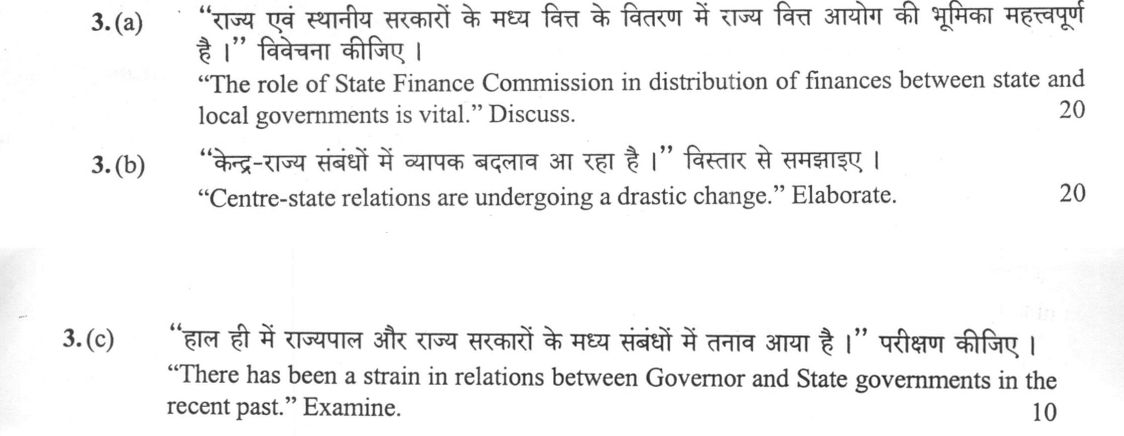
(a) "The role of State Finance Commission in distribution of finances between state and local governments is vital." Discuss. (20…
"The role of State Finance Commission in distribution of finances between state and local governments is vital." Discuss. 20 marks
"Centre-state relations are undergoing a drastic change." Elaborate. 20 marks
"There has been a strain in relations between Governor and State governments in the recent past." Examine. 10 marks
हिंदी में प्रश्न पढ़ें
"राज्य एवं स्थानीय सरकारों के मध्य वित्त के वितरण में राज्य वित्त आयोग की भूमिका महत्वपूर्ण है।" विवेचना कीजिए। (20 अंक)
"केंद्र-राज्य संबंधों में व्यापक बदलाव आ रहा है।" विस्तार से समझाइए। (20 अंक)
"हाल ही में राज्यपाल और राज्य सरकारों के मध्य संबंधों में तनाव आया है।" परीक्षण कीजिए। (10 अंक)
Model answer
Written by UPSC Answer Check against this question's marking rubric, to the expected length. UPSC does not publish answers for Mains — this is one way to score well, not an official key.
Indian federalism operates as a multi-tier constitutional framework where fiscal, political, and administrative relations are constantly renegotiated to balance national unity with regional autonomy.
Role of State Finance Commission (SFC)
Mandated under Articles 243-I and 243-Y, the State Finance Commission is the linchpin of sub-state fiscal federalism. While the Union Finance Commission under Article 280 determines vertical devolution from Centre to States and recommends measures to augment state Consolidated Funds under Article 280(3)(bb) and (c), the SFC performs this constitutional function between the state government and local bodies. It determines the principles governing the distribution of net tax proceeds, assigns specific taxes and duties to Panchayati Raj Institutions (PRIs) and Urban Local Bodies (ULBs), and recommends grants-in-aid from the state's Consolidated Fund.
However, SFCs face acute structural hurdles. Unlike the Union Finance Commission, SFCs suffer from irregular constitution, inadequate data machinery, and limited technical capacity. States often delay tabling SFC reports in legislatures, shelving vertical and horizontal devolution recommendations. Third and Fourth SFC reports across states have consistently highlighted the shrinking proportion of untied grants and urged systemic reforms for augmenting the own revenue generation capacities of local bodies. Without robust SFC-led resource transfers, local self-government remains administrative deconcentration rather than genuine democratic decentralization.
Transformations in Centre-State Relations
Centre-state relations have shifted from cooperative federalism toward competitive and asymmetric dynamics. Institutional redesign is marked by the replacement of the Planning Commission with NITI Aayog and the creation of the GST Council as a shared-sovereignty fiscal body. Concurrently, post-2014 centralization has accelerated, underscored by the uniform enforcement of the Disaster Management Act during COVID-19 and the proliferation of Centrally Sponsored Schemes with rigid conditionalities.
Political asymmetry has intensified frictions, particularly in opposition-ruled states. States express serious grievances over the erosion of fiscal autonomy, delays in GST compensation cess transfers, and stringent net borrowing ceilings. Furthermore, perceived politicization via central investigative agencies like the CBI and Enforcement Directorate (ED), along with historical and modern deployments of central power, has led states to allege an erosion of constitutional space, demanding greater autonomy within the federal compact.
Governor-State Friction
The constitutional office of the Governor under Articles 153 to 167 is central to these federal tensions. While conceived as a bridge between the Union and the States, the Governor's discretionary scope under Article 163(2) has frequently generated institutional conflict. Recent episodes in Maharashtra regarding government formation and floor tests, as well as in Tamil Nadu, Kerala, and West Bengal concerning indefinite delays in granting assent to legislative bills or reserving state bills for Presidential consideration under Article 200, have challenged constitutional norms.
Both the Sarkaria Commission (1988) and the Punchhi Commission (2010) emphasized that the Governor must remain a detached constitutional umpire. They recommended institutional safeguards, including mandatory consultation with the state Chief Minister prior to appointment, a guaranteed five-year tenure, and an objective procedure for removal analogous to impeachment, rather than dismissal at the Union's sole pleasure.
Way Forward
The strains across fiscal federalism (SFCs), political federalism (Centre-State balance), and constitutional federalism (Governor's role) reveal the vulnerabilities of India's asymmetric federal design. Addressing these requires operationalizing the 15th Finance Commission's recommendation to tie state grants to the timely constitution and implementation of SFC reports. Institutional mechanisms such as a revitalized Inter-State Council must be leveraged to depoliticize inter-governmental relations and protect cooperative federalism.
What "Discuss" is asking you to do
Lay the issue out from more than one side — how it arose, what is claimed for it, what is held against it, and where it now stands. UPSC attaches discuss to broad topics with several live dimensions, so coverage of the dimensions earns more than the strength of your opinion.
Structure that answers it
Set the issue up → the case as it is made → the case against → the dimension both sides leave out → where the balance now lies
Where marks are lost
Listing facts with no thread between them, or arguing one side throughout and calling it a discussion.
How this answer will be evaluated
Approach
Framework: Concept > Thinker > Indian institutional application > Reform. (a) discuss: intro > 3-4 dimensions > example > balanced close | (b) explain: definition/context > points in order > small example > short close | (c) examine: intro > how/why with reasoning > evidence > conclusion Full marks: All parts show deep institutional knowledge, specific examples, and balanced analysis.
Key points expected
- Cite Article 243-I and 74(3) constitutional basis
- Explain State FC's role in state-local finance distribution
- Provide a specific State FC example
- Balanced close on challenges and reforms
- Define centre-state relations and their evolution
- Identify key changes in fiscal and administrative relations
- Provide a specific example of change
- Short close on implications
Evaluation rubric
Each sub-part is marked on its own, against the marks and word limit printed on the paper.
- (a) Intro, 3-4 dimensions of State FC role, example, balanced close. 20 marks
discuss— intro → 3-4 dimensions → example → balanced close
Must cover
- Cite Article 243-I and 74(3) constitutional basis
- Explain State FC's role in state-local finance distribution
- Provide a specific State FC example
- Balanced close on challenges and reforms
Loses marks
- GS-2 style answer without institutional detail
- Theory with no Indian administrative anchor
- Confusing State FC with Finance Commission
Earns more
- Mention 14th/15th Finance Commission linkage
- Reference 2nd ARC recommendations
- Distinguish State FC from Finance Commission
- Cite specific state FC recommendations
Extra mark
- Name a specific State FC report
- Cite a specific state's FC recommendation
- (b) Definition/context, points in order, small example, short close. 20 marks
explain— definition/context → points in order → small example → short close
Must cover
- Define centre-state relations and their evolution
- Identify key changes in fiscal and administrative relations
- Provide a specific example of change
- Short close on implications
Loses marks
- GS-2 style answer without institutional detail
- Theory with no Indian administrative anchor
- Failing to show the gap between theory and field reality
Earns more
- Reference 73rd Amendment and Panchayati Raj
- Mention GST and its impact on centre-state relations
- Cite specific committee or commission
- Distinguish administration from politics
Extra mark
- Name a specific committee or commission
- Cite a specific governance reform
- (c) Intro, how/why with reasoning, evidence, conclusion. 10 marks
examine— intro → how/why with reasoning → evidence → conclusion
Must cover
- Explain the role of Governor in state governance
- Identify reasons for strain between Governor and State governments
- Provide evidence of recent strain
- Conclusion on the way forward
Loses marks
- GS-2 style answer without institutional detail
- Theory with no Indian administrative anchor
- Failing to show the gap between theory and field reality
Earns more
- Reference specific instances of Governor-State conflict
- Mention constitutional provisions for Governor's role
- Distinguish administration from politics
- Cite a specific committee or commission
Extra mark
- Name a specific committee or commission
- Cite a specific governance reform
Practice this exact question
Write your answer and it is marked point by point against the model answer above — what you covered, what you missed, what you got wrong.
Evaluate my answer →More from Public Administration 2024 Paper II
- Q1 Answer the following in about 150 words each: (a) "Ethics in Public services has been the…
- Q2 (a) The National Data and Analysis Platform (NDAP) of NITI Aayog facilitates a robust eco…
- Q3 (a) "The role of State Finance Commission in distribution of finances between state and l…
- Q4 (a) Public sector undertakings have been the bedrock of welfareism in India for many deca…
- Q5 Answer the following in about 150 words each: (a) The constitutional stature provided to…
- Q6 (a) "The success of administrative reforms in a country like India depends upon the polit…