Paper II — Q8
(a) Police-Public relations are poor in India. What measures are required to strengthen these relations? (20 marks) (b) The…
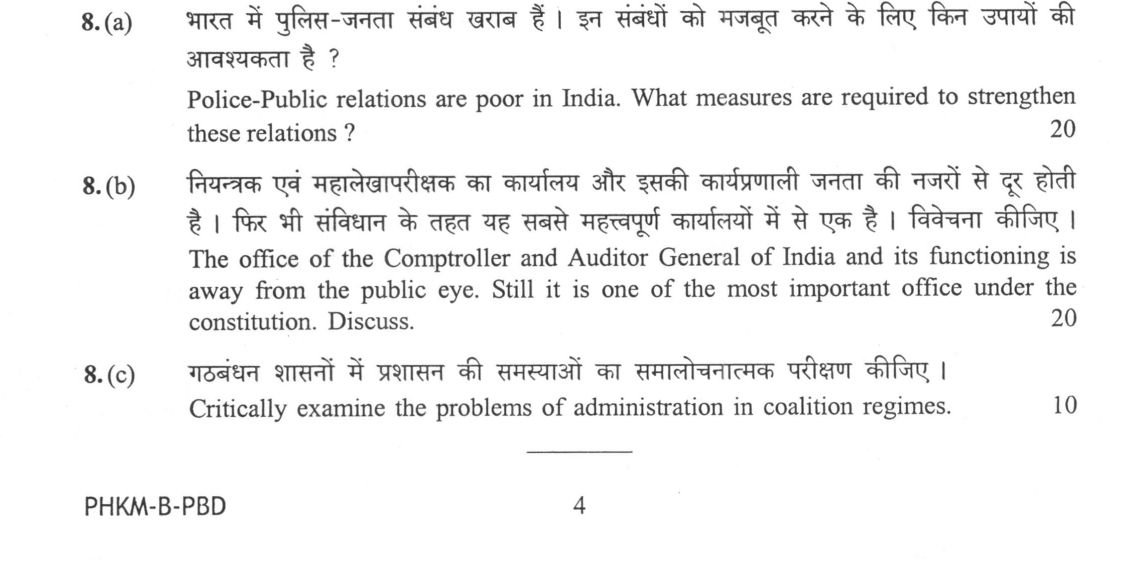
Police-Public relations are poor in India. What measures are required to strengthen these relations? 20 marks
The office of the Comptroller and Auditor General of India and its functioning is away from the public eye. Still it is one of the most important office under the constitution. Discuss. 20 marks
Critically examine the problems of administration in coalition regimes. 10 marks
हिंदी में प्रश्न पढ़ें
भारत में पुलिस-जनता संबंध खराब हैं। इन संबंधों को मजबूत करने के लिए किन उपायों की आवश्यकता है ? (20 अंक)
नियंत्रक एवं महालेखापरीक्षक का कार्यालय और इसकी कार्यप्रणाली जनता की नजरों से दूर होती है। फिर भी संविधान के तहत यह सबसे महत्वपूर्ण कार्यालयों में से एक है। विवेचना कीजिए। (20 अंक)
गठबंधन शासनों में प्रशासन की समस्याओं का समालोचनात्मक परीक्षण कीजिए। (10 अंक)
Model answer
Written by UPSC Answer Check against this question's marking rubric, to the expected length. UPSC does not publish answers for Mains — this is one way to score well, not an official key.
Police–public relations The claim that police–public relations are poor in India is broadly valid, though not absolute. The colonial legacy of the police as the ruler’s instrument persists in attitudes, laws and practice; the 1861 Police Act still reinforces hierarchical control, and the public often sees the police as a coercive agency rather than a service. Structural problems deepen the deficit—overwork, understaffing, politicization, weak accountability and VIP culture that diverts resources from ordinary citizens. This is not merely a law-and-order issue; it is a legitimacy issue. When citizens perceive the police as unaccountable, cooperation falls, crime reporting declines and the state’s capacity to protect weakens. Psychological barriers matter: fear psychosis makes people reluctant to report crimes, while police may respond with suspicion rather than empathy. Reforms must be both institutional and attitudinal. Community policing models such as Janamaithri in Karnataka and Mohalla committees in Punjab can rebuild trust by involving residents in local safety. SMART policing, citizen feedback, online FIRs, CCTV and data-driven deployment can improve transparency and responsiveness. Police Act reforms are needed to depoliticize transfers, strengthen Police Complaints Authorities and make accountability credible. Training in soft skills, human rights and grievance redressal is essential. Yet reforms alone cannot succeed unless the police are seen as public servants, not an instrument of power.
CAG’s constitutional importance The CAG’s office is indeed less visible than the executive, but it is one of the most important constitutional offices. Its work is technical, often post-facto, and mediated through Parliament, which keeps it away from the public eye. Articles 148–151 establish the CAG, define duties, and regulate accounts and reports. The CAG is appointed by the President, removed only on grounds similar to a Supreme Court judge, and salary is charged on the Consolidated Fund of India, protecting financial independence. The CAG’s independence is essential because it audits the government that spends public money; without it, parliamentary control becomes formal. Unlike the UK Comptroller, who historically controlled expenditure before it was released, the Indian CAG is an auditor, not a controller; it examines whether money has been spent according to law and public purpose. Its audits—financial, compliance, and performance/efficiency—provide the evidence base for parliamentary scrutiny, especially through the Public Accounts Committee constituted under parliamentary rules, not under Articles 150–151. Recent high-impact reports on Rafale, demonetization, GST implementation and COVID-19 procurement have increased public visibility and shown the CAG’s role in checking misuse. Still, its functioning has limits: audits are largely post-facto, recommendations are not enforceable, and governments may ignore or delay action. Real-time audit, faster reporting and greater media engagement can strengthen its accountability role.
Coalition administration Coalition regimes create distinctive administrative problems. Conflicting party manifestos can lead to policy paralysis, as ministries pull in different directions. Ministerial instability disrupts bureaucratic continuity, while pork-barrel politics and regional fragmentation can weaken national planning. Administrative capacity suffers when ministries negotiate every major decision, and bureaucratic morale declines due to frequent changes in policy direction. Federal tensions rise when regional parties enter national governance, seeking resources and symbols for their states. The anti-defection law has limited efficacy because it restricts individual defection but cannot resolve ideological or policy conflicts within coalitions. Compared with Westminster stability, Indian coalitions often trade speed for consensus. However, this is not wholly negative: coalitions can broaden representation, moderate majoritarian impulses, and improve federal accommodation. The critical finding is that coalition administration is not inherently defective, but it demands stronger institutional discipline, clear policy priorities and cooperative federalism.
Overall, strengthening police–public trust, reinforcing CAG accountability, and managing coalition constraints are all aspects of democratic accountability. India needs citizen-centric policing, an empowered CAG, and coalition governance that balances consensus with decisive administration.
What "Critically examine" is asking you to do
Test the proposition the question puts to you and return a finding on how far it holds. Examine stems carry a claim, or ask whether something has happened, and expect evidence weighed both ways before the extent is stated — often with remedial measures attached. “Critically” is not a section added at the end: name the yardstick you are judging by — the evidence, the stated objective, a constitutional principle, a rival explanation — and let a verdict close each part of the body. Where the question quotes a claim, that verdict must land on the claim itself, accepted, qualified or rejected, and not on the theme in general.
Structure that answers it
Restate the claim as the question frames it → evidence that supports it → evidence that undercuts it → the conditions under which it holds → verdict on how far it stands
Where marks are lost
Merits in one paragraph, demerits in the next, and a conclusion calling for a balanced and holistic approach. That is a survey with the judgement left out and it holds the answer in the middle band. The opposite error is reading “critically” as permission to attack — and with the odd pairings, critically describe or critically explain, the exposition still carries most of the marks, the judgement being a layer on it rather than a substitute for it.
How this answer will be evaluated
Approach
Framework: Public Administration Paper II (Institutional & Governance). (a) suggest: the problem in one line > implementable measures > who acts > conclusion | (b) discuss: intro > 3-4 dimensions > example > balanced close | (c) critique: the claim > its strengths > its weaknesses > your judgment Full marks: Comprehensive, well-structured, with specific examples, legal references, and critical analysis.
Key points expected
- Identify specific causes of poor relations (e.g., lack of accountability, force use)
- Suggest institutional reforms (e.g., Police Complaints Authority, Citizen's Police Liaison Committee)
- Reference legal framework (e.g., Police Act 1861, 2006 Model Police Act)
- Propose operational measures (e.g., community policing, technology integration)
- Explain CAG's constitutional status (Article 148, 149)
- Detail CAG's functions (audit of Union and State accounts, performance audit)
- Analyze why CAG is 'away from public eye' (technical nature, parliamentary reporting)
- Justify CAG's importance (financial accountability, democratic oversight)
Evaluation rubric
Each sub-part is marked on its own, against the marks and word limit printed on the paper.
- (a) Implementable measures to strengthen Police-Public relations in India. 20 marks
suggest— the problem in one line → implementable measures → who acts → conclusion
Must cover
- Identify specific causes of poor relations (e.g., lack of accountability, force use)
- Suggest institutional reforms (e.g., Police Complaints Authority, Citizen's Police Liaison Committee)
- Reference legal framework (e.g., Police Act 1861, 2006 Model Police Act)
- Propose operational measures (e.g., community policing, technology integration)
Loses marks
- Generic statements without specific measures
- Ignoring the legal framework
- Focusing only on police misconduct without addressing systemic issues
Earns more
- Mention 2nd ARC recommendations on police reform
- Reference specific state initiatives (e.g., Kerala's Citizen's Police Liaison Committee)
- Discuss the role of technology (e.g., e-police stations, mobile apps)
- Mention the importance of police training and sensitization
Extra mark
- Cite specific data on police complaints or public trust surveys
- Reference a specific Supreme Court judgment on police accountability
- (b) Discuss the constitutional importance of CAG despite its lack of public visibility. 20 marks
discuss— intro → 3-4 dimensions → example → balanced close
Must cover
- Explain CAG's constitutional status (Article 148, 149)
- Detail CAG's functions (audit of Union and State accounts, performance audit)
- Analyze why CAG is 'away from public eye' (technical nature, parliamentary reporting)
- Justify CAG's importance (financial accountability, democratic oversight)
Loses marks
- Confusing CAG with other audit bodies (e.g., State Audit Departments)
- Failing to explain CAG's constitutional independence
- Ignoring the 'away from public eye' aspect of the question
Earns more
- Mention specific CAG reports (e.g., 2G spectrum, coal allocation)
- Discuss the role of Public Accounts Committee (PAC) in CAG reports
- Reference the Comptroller and Auditor General's (Conditions of Service) Act
- Mention the CAG's role in auditing autonomous bodies and PSUs
Extra mark
- Cite a specific CAG report that led to significant policy change
- Reference a specific Supreme Court judgment on CAG's independence
- (c) Critically examine the problems of administration in coalition regimes. 10 marks
critique— the claim → its strengths → its weaknesses → your judgment
Must cover
- Identify key problems (e.g., policy paralysis, cabinet expansion, ministerial accountability)
- Explain the impact on administrative efficiency
- Provide examples from Indian coalition governments (e.g., UPA, NDA)
- Offer a balanced view (e.g., regional representation, consensus building)
Loses marks
- Focusing only on political aspects, ignoring administrative impact
- Failing to provide specific examples
- One-sided criticism without acknowledging any benefits
Earns more
- Mention the 'Cabinet Expansion' problem
- Discuss the 'Policy Paralysis' issue
- Reference the 'Ministerial Accountability' challenge
- Mention the 'Regional Representation' aspect
Extra mark
- Cite a specific example of policy delay due to coalition dynamics
- Reference a specific study or report on coalition governance
Practice this exact question
Write your answer and it is marked point by point against the model answer above — what you covered, what you missed, what you got wrong.
Evaluate my answer →More from Public Administration 2024 Paper II
- Q5 Answer the following in about 150 words each: (a) The constitutional stature provided to…
- Q6 (a) "The success of administrative reforms in a country like India depends upon the polit…
- Q7 (a) The separation of police investigation and prosecution has its own benefits and chall…
- Q8 (a) Police-Public relations are poor in India. What measures are required to strengthen t…