Paper II — Q4
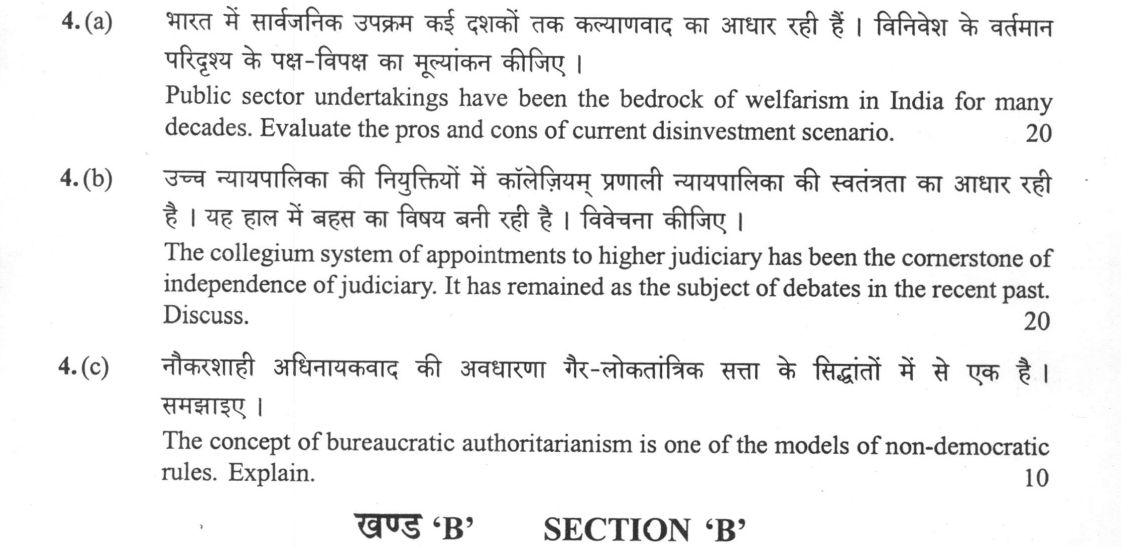
(a) Public sector undertakings have been the bedrock of welfareism in India for many decades. Evaluate the pros and cons of…
Public sector undertakings have been the bedrock of welfareism in India for many decades. Evaluate the pros and cons of current disinvestment scenario. 20 marks
The collegium system of appointments to higher judiciary has been the cornerstone of independence of judiciary. It has remained as the subject of debates in the recent past. Discuss. 20 marks
The concept of bureaucratic authoritarianism is one of the models of non-democratic rules. Explain. 10 marks
हिंदी में प्रश्न पढ़ें
भारत में सार्वजनिक उपक्रम कई दशकों तक कल्याणवाद का आधार रही हैं। विनिवेश के वर्तमान परिदृश्य के पक्ष-विपक्ष का मूल्यांकन कीजिए। (20 अंक)
उच्च न्यायपालिका की नियुक्तियों में कॉलेजियम प्रणाली न्यायपालिका की स्वतंत्रता का आधार रही है। यह हाल में बहस का विषय बनी रही है। विवेचना कीजिए। (20 अंक)
नौकरशाही अधिनायकवाद की अवधारणा गैर-लोकतांत्रिक सत्ता के सिद्धांतों में से एक है। समझाइए। (10 अंक)
Model answer
Written by UPSC Answer Check against this question's marking rubric, to the expected length. UPSC does not publish answers for Mains — this is one way to score well, not an official key.
(a) Public Sector Undertakings and the Current Disinvestment Scenario
Post-independence, Public Sector Undertakings (PSUs) served as the bedrock of welfareism in India, institutionalising state-led development through employment generation, affirmative action, balanced regional equity, and self-reliance in core strategic sectors. However, mounting fiscal stress, public sector inefficiencies, and the demands of competitive federalism prompted a structural shift under DIPAM towards strategic disinvestment, distinguishing between minimal presence in strategic sectors and complete exit from non-strategic sectors.
Pros and Cons: Disinvestment unlocks public capital trapped in commercial enterprises, redirecting resources toward public infrastructure and capital expenditure. Successful transactions, such as the LIC IPO and the privatisation of Air India, demonstrate enhanced market capitalization, non-tax revenue mobilization, and improved corporate efficiency.
Conversely, rapid disinvestment strains the welfare mandate. It directly contracts organized public employment, eroding constitutional reservation benefits for marginalized communities. Selling profitable assets generates concerns regarding asset stripping and undervaluation, while stalled transactions like the BPCL strategic sale expose vulnerability to market volatility. Furthermore, unchecked divestment in sensitive domains poses national security concerns and weakens sovereign supply chains during crises.
Verdict: Disinvestment is an effective fiscal and managerial tool, but it must not become a short-term revenue-balancing mechanism. A balanced approach requires safeguarding strategic national assets, ensuring transparent valuation, and ring-fencing disinvestment proceeds exclusively for human development and social capital.
(b) The Collegium System: Independence versus Accountability
The appointment of higher judiciary judges transitioned from executive primacy under Articles 124(2) and 217(1) to judicial primacy through the Second Judges Case (Supreme Court Advocates-on-Record Association, 1993) and the Third Judges Case (1998). This established the collegium mechanism comprising the Chief Justice of India and four senior-most judges to insulate the judiciary from political interference and preserve the basic structure.
Contemporary Debates: While the collegium has fortified institutional independence, it has attracted severe debate over transparency, accountability, and the absence of a constitutional check. The executive's effort to replace it via the National Judicial Appointments Commission (NJAC, 99th Amendment Act, 2014) was struck down by the Supreme Court in 2015 to protect judicial primacy.
This has resulted in recurring friction between the executive and judiciary over the Memorandum of Procedure (MoP), delay in clearing reiterated collegium recommendations, and selective acceptance of intelligence inputs. Consequently, high judicial vacancies persist, aggravating the national pendency crisis.
Way Forward: Safeguarding independence does not preclude institutional transparency. Establishing a permanent institutional secretariat, publishing objective selection matrices, and formalizing fixed timelines within the MoP will reconcile judicial independence with administrative accountability.
(c) Bureaucratic Authoritarianism as a Model of Non-Democratic Rule
Formulated by political scientist Guillermo O’Donnell to explain military-led regimes in Latin America (such as Argentina and Brazil in the 1960s-1970s), the 'Bureaucratic-Authoritarian' (BA) state is a distinct model of non-democratic rule. It is characterized by an institutional coalition between high-ranking military officials and civilian technocrats.
Key Characteristics and Distinctions: The BA model enforces the political and economic exclusion of the popular sector, systematically depoliticising civil society and labour unions. Governance is driven by technocratic rationality, where orthodox economic stabilization, austerity, and capital accumulation are prioritized over democratic distributive claims and social justice.
Unlike personal dictatorships driven by charismatic despots, military juntas focused purely on coercive rule, or totalitarian regimes that enforce mass ideological mobilization, the BA state governs through depoliticized administrative insulation and bureaucratic institutionalism. In modern public administration, the concept explains the perils of technocratic overreach, where participatory democracy and constitutional accountability are sidelined in the pursuit of administrative and economic efficiency.
What "Evaluate" is asking you to do
Judge how well something has performed against the standard it set for itself — its stated aim, mandate or promise — and commit to a verdict. Name the yardstick before you judge; an unanchored judgement reads as opinion.
Structure that answers it
Name the yardstick — stated aim, mandate or benchmark → performance against it → shortfall against it → why the gap exists → verdict
Where marks are lost
Presenting both sides and then declining to decide, or delivering a verdict against a standard you never stated, which makes it look arbitrary.
How this answer will be evaluated
Approach
Framework: Public Administration Paper II (Indian Administrative Context). (a) evaluate: criteria > evidence > balanced judgment | (b) discuss: intro > 3-4 dimensions > example > balanced close | (c) explain: definition/context > points in order > small example > short close Full marks: Comprehensive, well-structured, with specific Indian examples and references to key committees/judgments.
Key points expected
- Define disinvestment and its role in Indian public sector
- Pros: fiscal consolidation, efficiency, private sector participation
- Cons: loss of state control, social welfare impact, job losses
- Reference to specific PSUs or policy shifts (e.g., 2016 disinvestment policy)
- Define Collegium system and its origin (SPC cases)
- Arguments for: judicial independence, expertise, insulation from politics
- Arguments against: lack of transparency, elitism, accountability
- Current debates: NJAC, 99th Amendment, recent appointments
Evaluation rubric
Each sub-part is marked on its own, against the marks and word limit printed on the paper.
- (a) Balanced assessment of disinvestment pros and cons in the context of Indian welfare state. 20 marks
evaluate— criteria → evidence → balanced judgment
Must cover
- Define disinvestment and its role in Indian public sector
- Pros: fiscal consolidation, efficiency, private sector participation
- Cons: loss of state control, social welfare impact, job losses
- Reference to specific PSUs or policy shifts (e.g., 2016 disinvestment policy)
Loses marks
- Generic economic theory without Indian context
- Ignoring the 'welfareism' aspect of the question
- One-sided argument (only pros or only cons)
Earns more
- Mention of 2nd ARC recommendations on public sector
- Reference to specific PSUs (e.g., BHEL, SAIL, Air India)
- Discussion of 'welfareism' vs 'developmental state' transition
- Mention of strategic vs minority stake sales
Extra mark
- Reference to specific disinvestment targets (e.g., 2022-23 target)
- Mention of specific committee reports on PSU reform
- (b) Analysis of Collegium system's role in judicial independence and current debates. 20 marks
discuss— intro → 3-4 dimensions → example → balanced close
Must cover
- Define Collegium system and its origin (SPC cases)
- Arguments for: judicial independence, expertise, insulation from politics
- Arguments against: lack of transparency, elitism, accountability
- Current debates: NJAC, 99th Amendment, recent appointments
Loses marks
- Ignoring the 'independence' aspect of the question
- Factual errors about the Collegium's composition or powers
- Generic discussion of judiciary without specific focus on appointments
Earns more
- Reference to NJAC (National Judicial Appointments Commission)
- Mention of 99th Constitutional Amendment Act
- Reference to specific Supreme Court judgments (e.g., NJAC case)
- Discussion of 'transparency' vs 'independence' trade-off
Extra mark
- Mention of specific recent appointment controversies
- Reference to 2nd ARC recommendations on judicial appointments
- (c) Explanation of bureaucratic authoritarianism as a non-democratic model. 10 marks
explain— definition/context → points in order → small example → short close
Must cover
- Define bureaucratic authoritarianism (Linz, O'Donnell)
- Key features: technocratic rule, limited political participation, state control
- Distinction from other non-democratic models (e.g., military, one-party)
- Indian context: 'bureaucratic state' or 'developmental state' aspects
Loses marks
- Confusing with 'bureaucratic state' or 'developmental state'
- Ignoring the 'authoritarian' aspect of the model
- Generic discussion of bureaucracy without specific focus on authoritarianism
Earns more
- Reference to specific thinkers (e.g., Guillermo O'Donnell, Juan Linz)
- Mention of 'technocratic' decision-making
- Discussion of 'limited pluralism' or 'controlled participation'
- Reference to Indian examples (e.g., Planning Commission, NITI Aayog transition)
Extra mark
- Reference to specific Latin American examples (e.g., Brazil, Argentina)
- Mention of 'state corporatism' or 'corporatist' elements
Practice this exact question
Write your answer and it is marked point by point against the model answer above — what you covered, what you missed, what you got wrong.
Evaluate my answer →More from Public Administration 2024 Paper II
- Q1 Answer the following in about 150 words each: (a) "Ethics in Public services has been the…
- Q2 (a) The National Data and Analysis Platform (NDAP) of NITI Aayog facilitates a robust eco…
- Q3 (a) "The role of State Finance Commission in distribution of finances between state and l…
- Q4 (a) Public sector undertakings have been the bedrock of welfareism in India for many deca…
- Q5 Answer the following in about 150 words each: (a) The constitutional stature provided to…
- Q6 (a) "The success of administrative reforms in a country like India depends upon the polit…
- Q7 (a) The separation of police investigation and prosecution has its own benefits and chall…