Paper I — Q1
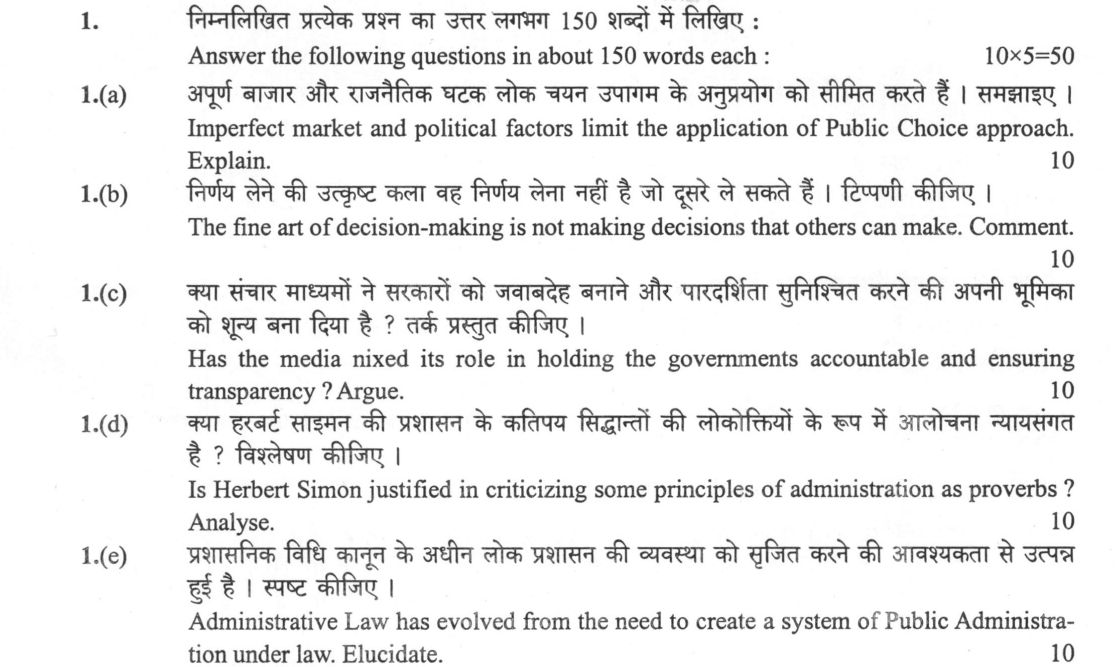
Answer the following questions in about 150 words each: (a) Imperfect market and political factors limit the application of…
Answer the following questions in about 150 words each: Imperfect market and political factors limit the application of Public Choice approach. Explain. 10 marks
The fine art of decision-making is not making decisions that others can make. Comment. 10 marks
Has the media nixed its role in holding the governments accountable and ensuring transparency? Argue. 10 marks
Is Herbert Simon justified in criticizing some principles of administration as proverbs? Analyse. 10 marks
Administrative Law has evolved from the need to create a system of Public Administration under law. Elucidate. 10 marks
हिंदी में प्रश्न पढ़ें
निम्नलिखित प्रत्येक प्रश्न का उत्तर लगभग 150 शब्दों में लिखिए : अपूर्ण बाजार और राजनीतिक घटक लोक चयन उपागम के अनुप्रयोग को सीमित करते हैं । समझाइए । (10 अंक)
निर्णय लेने की उत्कृष्ट कला वह निर्णय लेना नहीं है जो दूसरे ले सकते हैं । टिप्पणी कीजिए । (10 अंक)
क्या संचार माध्यमों ने सरकारों को जवाबदेह बनाने और पारदर्शिता सुनिश्चित करने की अपनी भूमिका को शून्य बना दिया है ? तर्क प्रस्तुत कीजिए । (10 अंक)
क्या हरबर्ट साइमन की प्रशासन के कतिपय सिद्धांतों की लोकोक्तियों के रूप में आलोचना न्यायसंगत है ? विश्लेषण कीजिए । (10 अंक)
प्रशासनिक विधि कानून के अधीन लोक प्रशासन की व्यवस्था को सुजित करने की आवश्यकता से उत्पन्न हुई है । स्पष्ट कीजिए । (10 अंक)
Model answer
Written by UPSC Answer Check against this question's marking rubric, to the 150-word length. UPSC does not publish answers for Mains — this is one way to score well, not an official key.
(a) Imperfect market and political factors limit the application of Public Choice approach
The Public Choice approach, pioneered by James Buchanan and Gordon Tullock, applies microeconomic rationality to public administration, assuming that political actors and bureaucrats act purely to maximize individual utility. However, imperfect market conditions and political realities severely constrain its practical application.
In public administration, market failure occurs because public goods are non-excludable and non-rivalrous, preventing efficient price-mechanism allocation. Information asymmetry between citizens and administrators leads to rent-seeking behavior and regulatory capture rather than competitive efficiency. Furthermore, bounded rationality prevents actors from possessing complete market information, invalidating the premise of perfect utility maximization.
In the political marketplace, political market failures such as vote-trading (logrolling), short-term electoral cycles, and the concentration of benefits among organized interest groups at the expense of dispersed taxpayers distort resource allocation. Consequently, replacing public welfare administration with market-driven mechanisms often exacerbates socioeconomic inequalities, demonstrating that public goods allocation requires equity-driven interventions rather than pure market logic.
(b) The fine art of decision-making is not making decisions that others can make
Chester Barnard, in The Functions of the Executive, identified decision-making as an executive art centered on discretion, timing, and structural restraint. He argued that the executive must avoid deciding unpertinent questions prematurely, making ineffective choices, or absorbing decisions that subordinates possess the operational capacity to resolve.
Effective organizational functioning relies on the distinction between routine, programmed decisions and strategic, non-programmed decisions. When senior administrators centralize routine operational choices, they experience severe decision fatigue and stifle subordinate initiative, disrupting workflow. Delegating programmed decisions downwards ensures responsiveness at the point of implementation while preserving executive cognitive capacity for strategic planning, crisis management, and policy formulation.
In modern public governance, this principle operationalizes decentralization and subsidiarity. Executive decision-making is optimized not through omnipresent control, but by building competent delegations where executives reserve judgment exclusively for non-programmed, systemic choices.
(c) Media accountability and transparency role
The media, as the Fourth Estate, is constitutionally and socially positioned to act as a public watchdog, enforcing institutional transparency and accountability. Historically, investigative journalism, Right to Information (RTI) activism, and exposure of administrative corruption have catalyzed systemic reforms and judicial action.
However, structural transformations have substantially compromised this role. The concentration of corporate ownership, dependence on state advertising revenue, and the sensationalism driven by Television Rating Points (TRPs) have fostered partisan coverage and the phenomenon of 'paid news'. Furthermore, the unchecked proliferation of algorithmic social media echo chambers and unverified digital content has displaced rigorous policy scrutiny with polarizing rhetoric.
Nevertheless, the media has not entirely abandoned its watchdog mandate. Independent digital platforms, investigative consortiums, and regional reporters continue to uncover bureaucratic leakages, human rights violations, and governance deficits. While commercialization and political capture have weakened mainstream media's institutional vigilance, ethical journalism remains indispensable for maintaining administrative accountability.
(d) Herbert Simon's critique of administrative principles as proverbs
Herbert Simon was justified in critiquing classical principles of administration—formulated by theorists like Fayol, Gulick, and Urwick—as mere "proverbs" because they occur in mutually contradictory pairs without objective criteria determining which principle should take precedence.
In Administrative Behavior (1947), Simon demonstrated that classical maxims lack empirical scientific validity. For instance, the principle urging a "narrow span of control" directly contradicts the principle advocating a "minimum number of hierarchical levels," as narrowing the span inevitably multiplies administrative tiers, distorting communication. Similarly, specialization based on purpose inherently conflicts with specialization based on process, area, or clientele. Classical theorists treated these situational trade-offs as universal scientific laws.
Simon rightly established that administrative principles are context-dependent rather than immutable rules. His critique shifted the disciplinary paradigm from mechanical structural dogmas to empirical decision-making analysis grounded in bounded rationality.
(e) Evolution of Administrative Law and Public Administration under law
Administrative Law evolved out of the imperative to check arbitrary state power and establish an accountable public administration operating strictly within the parameters of law.
Historically, A.V. Dicey rejected specialized administrative law (droit administratif), asserting that ordinary courts and uniform law were sufficient to maintain the Rule of Law. However, the transformation of the nightwatchman state into a modern socio-economic welfare state led to a vast expansion of executive discretion, delegated legislation, and quasi-judicial powers, necessitating a distinct legal framework to curb bureaucratic arbitrariness.
In India, Administrative Law developed to reconcile executive flexibility with constitutional morality. It operates through constitutional judicial review under Articles 32 and 226, enforcing principles of natural justice and proportionality. This is reinforced by administrative tribunals under Part XIV-A (Articles 323A and 323B), the Right to Information Act, 2005, and the Lokpal and Lokayuktas Act, 2013, which institutionalize transparency and subject public administration to statutory discipline.
What "Explain" is asking you to do
Make the working of something clear — what sets it off, what follows from what, and what it produces. Explain is the Commission's mechanism word: it dominates the technical papers and the “explain why” stems, where the marks sit in the causal chain and not in the label.
Structure that answers it
State what it is → the initiating condition → the chain of cause, step by step → an instance where it plays out → what the chain produces
Where marks are lost
Describing what something looks like instead of why it works that way. Naming the stages without linking them reads as description too.
How this answer will be evaluated
Approach
Framework: Public Administration Theory & Indian Institutional Application. (a) explain: definition/context > points in order > small example > short close | (b) comment: intro > 3-4 dimensions > example > balanced close | (c) explain: definition/context > points in order > small example > short close | (d) explain: definition/context > points in order > small example > short close | (e) explain: definition/context > points in order > small example > short close Full marks: Precise theory + Indian anchor + critical analysis
Key points expected
- Public Choice limits (market/political)
- Decision-making complexity (Simon)
- Media accountability (RTI, bias)
- Simon's critique of principles
- Administrative Law evolution (judicial review)
Evaluation rubric
Each sub-part is marked on its own, against the marks and word limit printed on the paper.
- (a) Explain how market imperfections and political factors limit Public Choice theory. 10 marks · 150 words
explain— definition/context → points in order → small example → short close
Must cover
- Define Public Choice approach (economics in politics)
- Explain market imperfections (monopoly, externalities) as limits
- Explain political factors (voter ignorance, interest groups) as limits
- Link to Indian context (e.g., policy failure)
Loses marks
- Describing Public Choice without explaining limits
- Ignoring the 'political factors' aspect
Earns more
- Mention Buchanan/Tullock
- Cite specific Indian market failure (e.g., subsidies)
Extra mark
- Reference 2nd ARC on market regulation
- (b) Comment on the uniqueness and complexity of administrative decision-making. 10 marks · 150 words
comment— intro → 3-4 dimensions → example → balanced close
Must cover
- Interpret 'fine art' (intuition, judgment)
- Contrast with routine/programmed decisions
- Highlight complexity (uncertainty, value conflicts)
- Provide Indian administrative example
Loses marks
- Treating all decisions as equal
- Ignoring the 'art' (subjective) aspect
Earns more
- Reference Herbert Simon (bounded rationality)
- Mention 'discretion' in Indian bureaucracy
Extra mark
- Cite a specific high-stakes Indian decision
- (c) Explain the media's role in accountability and transparency. 10 marks · 150 words
explain— definition/context → points in order → small example → short close
Must cover
- Define media's watchdog role
- Explain mechanisms (RTI, investigative journalism)
- Discuss challenges (bias, commercialization)
- Conclude on effectiveness
Loses marks
- One-sided praise without critique
- Ignoring the 'transparency' aspect
Earns more
- Mention RTI Act 2005
- Cite specific Indian media exposure (e.g., 2G scam)
Extra mark
- Reference 2nd ARC on media ethics
- (d) Explain Simon's critique of administrative principles as proverbs. 10 marks · 150 words
explain— definition/context → points in order → small example → short close
Must cover
- Define 'principles of administration' (classical)
- Explain Simon's 'proverb' critique (vague, untestable)
- Contrast with scientific management
- Assess validity of critique
Loses marks
- Defending classical principles without critique
- Ignoring Simon's specific argument
Earns more
- Name Herbert Simon explicitly
- Mention 'Administrative Behavior' book
Extra mark
- Reference 2nd ARC on administrative reform
- (e) Explain the evolution of Administrative Law in public administration. 10 marks · 150 words
explain— definition/context → points in order → small example → short close
Must cover
- Define Administrative Law
- Explain need for 'administration under law'
- Discuss evolution (judicial review, natural justice)
- Link to Indian constitutional framework
Loses marks
- Describing law without linking to administration
- Ignoring the 'evolution' aspect
Earns more
- Mention Article 32/226 (writs)
- Cite specific Indian case law
Extra mark
- Reference 2nd ARC on legal framework
Practice this exact question
Write your answer and it is marked point by point against the model answer above — what you covered, what you missed, what you got wrong.
Evaluate my answer →More from Public Administration 2025 Paper I
- Q1 Answer the following questions in about 150 words each: (a) Imperfect market and politica…
- Q2 (a) New Public Management has actually been a transitory state in evolution from traditio…
- Q3 (a) In conflict situations in organizations, leadership migrates to the aggressive and re…
- Q4 (a) "Delegated legislation should be clear and should confine to the limits determined by…