Paper I — Q3
(a) In conflict situations in organizations, leadership migrates to the aggressive and relegates the emotionally matured to the…
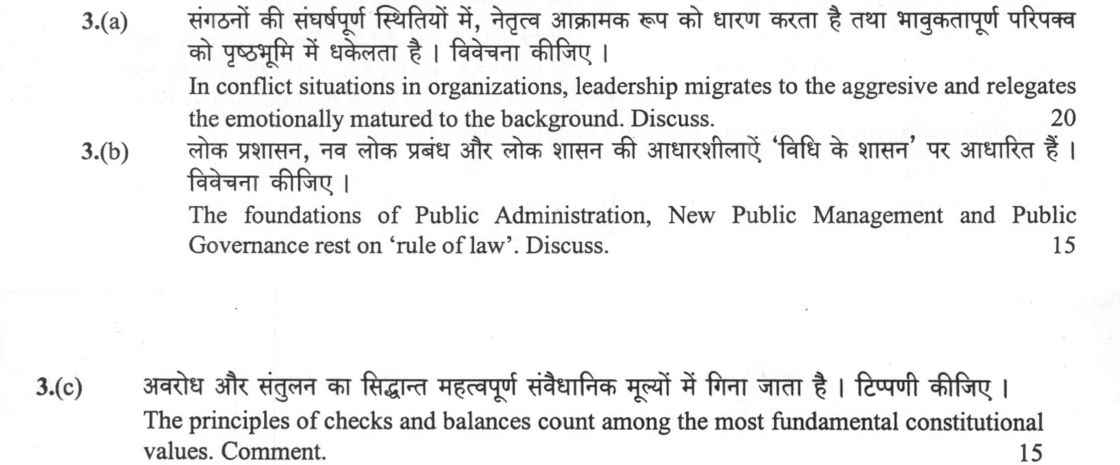
In conflict situations in organizations, leadership migrates to the aggressive and relegates the emotionally matured to the background. Discuss. 20 marks
The foundations of Public Administration, New Public Management and Public Governance rest on 'rule of law'. Discuss. 15 marks
The principles of checks and balances count among the most fundamental constitutional values. Comment. 15 marks
हिंदी में प्रश्न पढ़ें
संगठनों की संघर्षपूर्ण स्थितियों में, नेतृत्व आक्रामक रूप को धारण करता है तथा भावुकतापूर्ण परिपक्व को पृष्ठभूमि में धकेलता है । विवेचना कीजिए । (20 अंक)
लोक प्रशासन, नव लोक प्रबंध और लोक शासन की आधारशिलाएँ 'विधि के शासन' पर आधारित हैं । विवेचना कीजिए । (15 अंक)
अवरोध और संतुलन का सिद्धान्त महत्वपूर्ण संवैधानिक मूल्यों में गिना जाता है । टिप्पणी कीजिए । (15 अंक)
Model answer
Written by UPSC Answer Check against this question's marking rubric, to the expected length. UPSC does not publish answers for Mains — this is one way to score well, not an official key.
Organizational crises and constitutional architectures both test how power is exercised, checked, and stabilized. In public systems, the interaction between human behavior, administrative paradigms, and institutional checks determines whether authority remains legitimate and effective.
Leadership Dynamics in Organizational Conflict
Conflict situations often trigger primitive fight-or-flight responses and zero-sum perceptions, propelling aggressive actors to the forefront. Under acute crisis or high hierarchical pressure, organizations exhibit a visibility bias: aggressive posturing is frequently misconstrued as decisiveness and strength. Consequently, emotionally mature individuals—who prioritize deliberation and systemic coherence—are sidelined.
However, aggressive command rarely achieves enduring conflict resolution. As Daniel Goleman’s emotional intelligence framework and transformational leadership theories demonstrate, sustainable problem-solving requires empathy, self-regulation, and integrative bargaining (echoing Mary Parker Follett’s concept of constructive conflict). While aggressive leaders dominate the immediate spotlight, emotionally mature leaders operate backstage, managing institutional memory, facilitating mediation, and repairing social capital. While short-term triage may favor assertive command, long-term organizational health depends on emotional maturity to prevent systemic fragmentation.
Rule of Law Across Administrative Paradigms
The rule of law serves as the normative foundation across the major evolutions of administrative thought. Traditional Public Administration rests on A.V. Dicey’s conception and Max Weber’s legal-rational authority, emphasizing procedural fairness, predictability, and administrative law to eliminate arbitrariness.
New Public Management (NPM) reframed the rule of law through the lens of market discipline, substituting rigid procedural codes with legally enforceable performance contracts, consumer charters, and rigorous audit mechanisms. Public Governance further broadens this foundation to multi-actor networks, replacing top-down hierarchy with networked accountability, administrative transparency, and co-regulation.
This evolution produces structural tensions: NPM’s emphasis on managerial autonomy often clashes with traditional legal accountability, while the informal networks of governance risk bypassing statutory standards. These tensions converge in the modern "regulatory state," where independent regulatory authorities reconcile market-driven flexibility with statutory rule of law.
Checks and Balances as a Constitutional Value
Emanating from Montesquieu’s separation of powers, the principle of checks and balances prevents the concentration of absolute power by ensuring that state organs continuously restrain one another. In Indian jurisprudence, this balance is an intrinsic component of constitutional morality and the Basic Structure doctrine (Kesavananda Bharati, 1973).
The Indian framework extends checks and balances beyond the legislature, executive, and judiciary to independent integrity institutions, notably the Comptroller and Auditor General (Article 148) and the Election Commission (Article 324). In the NJAC Case (2015), the Supreme Court reaffirmed that the mutual independence of these organs is indispensable.
Contemporary practice, however, faces significant friction. Executive dominance via ordinances and delegated legislation, alongside the "tribunalization" of justice, challenges traditional separation of powers, while judicial overreach risks encroaching on administrative domain. The imperative is not institutional paralysis, but a dynamic equilibrium where procedural accountability does not sacrifice governance efficiency.
Synthesizing Way Forward
These dimensions form an interconnected continuum: emotionally mature leadership within administrative hierarchies upholds the rule of law, which in turn reinforces constitutional checks and balances. The way forward requires institutionalizing emotionally intelligent conflict management in public bodies, strengthening independent regulatory watchdogs, and preserving structural checks, ensuring that administrative dynamism remains anchored in constitutional ethics.
What "Discuss" is asking you to do
Lay the issue out from more than one side — how it arose, what is claimed for it, what is held against it, and where it now stands. UPSC attaches discuss to broad topics with several live dimensions, so coverage of the dimensions earns more than the strength of your opinion.
Structure that answers it
Set the issue up → the case as it is made → the case against → the dimension both sides leave out → where the balance now lies
Where marks are lost
Listing facts with no thread between them, or arguing one side throughout and calling it a discussion.
How this answer will be evaluated
Approach
Framework: Concept > Thinker > Indian institutional application > Reform. (a) discuss: intro > 3-4 dimensions > example > balanced close | (b) discuss: intro > 3-4 dimensions > example > balanced close | (c) comment: context > arguments both sides > judgment > close Full marks: Demonstrates deep understanding of all three concepts with precise Indian institutional examples, clear distinctions between frameworks, and references to specific constitutional provisions or judgments.
Key points expected
- Define the paradox of aggressive vs. mature leadership in conflict
- Explain why aggression often dominates in high-stress organizational settings
- Provide an Indian administrative or corporate conflict example
- Discuss the long-term costs of relegating emotional maturity
- Define 'rule of law' in the context of public administration
- Link rule of law to traditional Public Administration foundations
- Explain the role of rule of law in New Public Management
- Connect rule of law to modern Public Governance frameworks
Evaluation rubric
Each sub-part is marked on its own, against the marks and word limit printed on the paper.
- (a) Analyze the shift from emotional maturity to aggression in organizational conflict leadership. 20 marks
discuss— intro → 3-4 dimensions → example → balanced close
Must cover
- Define the paradox of aggressive vs. mature leadership in conflict
- Explain why aggression often dominates in high-stress organizational settings
- Provide an Indian administrative or corporate conflict example
- Discuss the long-term costs of relegating emotional maturity
Loses marks
- Treating aggression as a positive leadership trait without critique
- Ignoring the 'background' role of emotionally mature leaders
- Generic management theory without Indian administrative context
Earns more
- Reference to specific conflict management theories (e.g., Thomas-Kilmann)
- Mention of Indian administrative culture or bureaucracy
- Distinction between short-term tactical aggression and long-term strategy
- Reference to 2nd ARC on administrative culture
Extra mark
- Citing a specific Supreme Court judgment on workplace conduct
- Reference to a specific Indian corporate crisis case study
- (b) Explain how 'rule of law' underpins Public Administration, NPM, and Public Governance. 15 marks
discuss— intro → 3-4 dimensions → example → balanced close
Must cover
- Define 'rule of law' in the context of public administration
- Link rule of law to traditional Public Administration foundations
- Explain the role of rule of law in New Public Management
- Connect rule of law to modern Public Governance frameworks
Loses marks
- Failing to distinguish rule of law's role in each framework
- Confusing rule of law with rule by law
- Ignoring the Indian constitutional context entirely
Earns more
- Reference to A.V. Dicey's principles of rule of law
- Mention of Indian constitutional provisions (e.g., Article 14)
- Distinction between rule by law and rule of law
- Reference to judicial review mechanisms in India
Extra mark
- Citing a specific Supreme Court case on rule of law
- Reference to a specific Indian administrative reform based on rule of law
- (c) Evaluate the significance of checks and balances as a constitutional value. 15 marks
comment— context → arguments both sides → judgment → close
Must cover
- Define checks and balances in constitutional context
- Explain how checks and balances prevent concentration of power
- Provide Indian constitutional examples of checks and balances
- Assess the effectiveness of checks and balances in practice
Loses marks
- Treating checks and balances as merely theoretical
- Ignoring the Indian constitutional context
- Failing to distinguish between different branches of government
Earns more
- Reference to separation of powers doctrine
- Mention of specific Indian constitutional provisions (e.g., Article 123, 213)
- Discussion of judicial, legislative, and executive checks
- Reference to 2nd ARC recommendations on institutional checks
Extra mark
- Citing a specific Supreme Court judgment on separation of powers
- Reference to a specific Indian constitutional crisis resolved by checks and balances
Practice this exact question
Write your answer and it is marked point by point against the model answer above — what you covered, what you missed, what you got wrong.
Evaluate my answer →More from Public Administration 2025 Paper I
- Q1 Answer the following questions in about 150 words each: (a) Imperfect market and politica…
- Q2 (a) New Public Management has actually been a transitory state in evolution from traditio…
- Q3 (a) In conflict situations in organizations, leadership migrates to the aggressive and re…
- Q4 (a) "Delegated legislation should be clear and should confine to the limits determined by…
- Q5 Answer the following questions in about 150 words each: (a) E-advocacy model of e-governa…
- Q6 (a) F. W. Riggs's 'industria'-interdependent economy is a precursor for some features of…