Paper I — Q2
(a) New Public Management has actually been a transitory state in evolution from traditional Public Administration to what is…
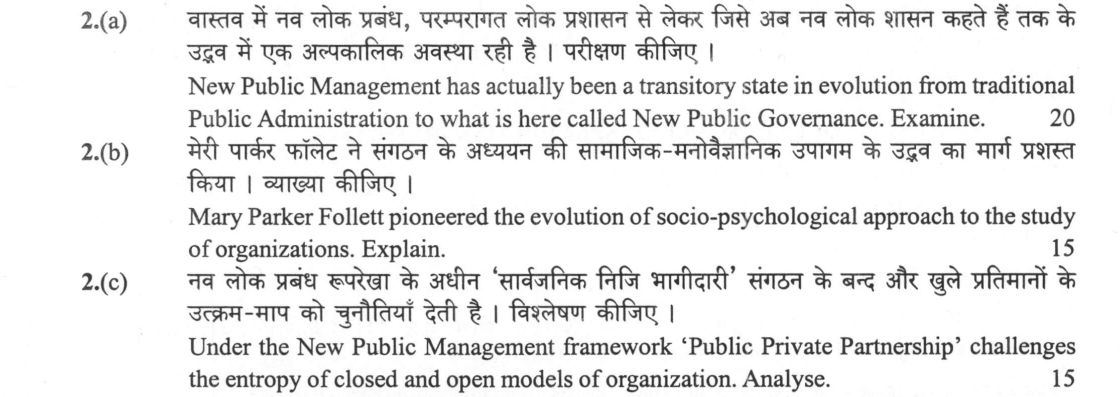
New Public Management has actually been a transitory state in evolution from traditional Public Administration to what is here called New Public Governance. Examine. 20 marks
Mary Parker Follett pioneered the evolution of socio-psychological approach to the study of organizations. Explain. 15 marks
Under the New Public Management framework 'Public Private Partnership' challenges the entropy of closed and open models of organization. Analyse. 15 marks
हिंदी में प्रश्न पढ़ें
वास्तव में नव लोक प्रबंध, परंपरागत लोक प्रशासन से लेकर जिसे अब नव लोक शासन कहते हैं तक के उद्भव में एक अल्पकालिक अवस्था रही है । परीक्षण कीजिए । (20 अंक)
मेरी पार्कर फॉलेट ने संगठन के अध्ययन की सामाजिक-मनोवैज्ञानिक उपागम के उद्भव का मार्ग प्रशस्त किया । व्याख्या कीजिए । (15 अंक)
नव लोक प्रबंध रूपरेखा के अधीन 'सार्वजनिक निज भागीदारी' संगठन के बंद और खुले प्रतिमानों के उत्क्रम-माप को चुनौतियाँ देती है । विश्लेषण कीजिए । (15 अंक)
Model answer
Written by UPSC Answer Check against this question's marking rubric, to the expected length. UPSC does not publish answers for Mains — this is one way to score well, not an official key.
New Public Management as a Transitory State to New Public Governance
Traditional Public Administration (TPA), rooted in Weberian bureaucracy and Wilsonian dichotomy, prioritized procedural compliance and hierarchical stability. By the late 1970s, fiscal crises and state inefficiencies led Christopher Hood to formulate New Public Management (NPM), marked by doctrines of disaggregation, private-sector management practices, market competition, explicit performance standards, and cost discipline.
However, NPM proved to be a transitory phase rather than a durable paradigm. Its core limitation lay in excessive managerialism and the commercialization of public service. Agencification and marketization created institutional fragmentation (siloization), eroded equity, inflated transaction costs, and reduced the democratic citizen to a mere transactional 'customer'.
To correct these pathologies, Stephen Osborne and Kerry Brown conceptualized New Public Governance (NPG). Grounded in institutional network theory, NPG shifts the focus from NPM’s intra-organizational competition to inter-organizational collaborative governance. It conceptualizes the state not as a firm, but as a coordinator within a complex ecosystem, viewing citizens as co-producers of public value (Mark Moore). In India, this transition is evident as administrative practice moves away from narrow NPM-style service metrics (Sevottam framework) toward NPG-aligned collaborative ecosystems, such as the convergence model of the Aspirational Districts Programme and Mission Karmayogi’s emphasis on networked, competency-driven governance.
Mary Parker Follett: Pioneer of the Socio-Psychological Approach
Mary Parker Follett served as a vital bridge between classical administrative mechanics and modern behavioral theory by placing human psychology and social relationships at the center of organizational study. Rejecting the rigid command-and-control structures of classical theorists, Follett posited the 'group process' as the fundamental building block of administration.
Follett introduced seminal concepts that revolutionized organizational dynamics. She advocated 'power-with' (coactive, joint power) over 'power-over' (coercive domination) and framed conflict as a normal, energetic process to be resolved through 'integration', where conflicting desires are synthesized without compromise or defeat. Her doctrine of the 'law of the situation' and 'circular response' established that authority and communication are reciprocal, situational, and functional rather than strictly vertical.
These concepts directly laid the groundwork for subsequent organizational theorists. Follett’s group dynamics anticipated Elton Mayo’s Hawthorne studies on informal organization, while her concepts of authority and cooperation directly influenced Chester Barnard’s 'acceptance theory of authority'. Her humanistic vision prefigured Douglas McGregor’s Theory Y assumptions, and her view of the organization as an interconnected, situational whole anticipated open-systems and contingency theories.
Public-Private Partnerships and Organizational Entropy
Organizational entropy denotes the universal tendency of administrative systems toward decay, disorder, and functional obsolescence. Closed models (Weberian bureaucracy) suffer from internal entropy through rigid rule-orientation, procedural inertia, and goal displacement. Conversely, open models, while adaptive, face external entropy through environmental volatility, vulnerability to market fluctuations, and severe resource dependency.
Under the NPM framework, Public-Private Partnerships (PPPs) challenge both forms of entropy by establishing a hybrid organizational model. PPPs mitigate closed-system entropy by dismantling bureaucratic monopolies, injecting private capital, operational agility, and technological innovation. Simultaneously, PPPs arrest open-system entropy by embedding unstable market transactions within formal public oversight, legal safeguards, and long-term relational contracting. Through structured risk-sharing, PPPs achieve a balance between market efficiency and democratic accountability.
In India, this hybrid mechanism is demonstrated by the National Highways Authority of India’s (NHAI) Hybrid Annuity Model (HAM), which insulates highway development from private revenue shocks while eliminating bureaucratic project delays. Similar entropy-reducing hybridity is visible in the execution of the Delhi Metro, the Mumbai-Pune Expressway, and the multi-stakeholder governance driving the Smart Cities Mission.
Ultimately, contemporary administrative evolution reflects a continuous quest to overcome systemic entropy—transitioning from rigid closed structures through humanistic insights and NPM’s hybrid contractualism, toward the resilient, collaborative networks of New Public Governance.
What "Examine" is asking you to do
Test the proposition the question puts to you and return a finding on how far it holds. Examine stems carry a claim, or ask whether something has happened, and expect evidence weighed both ways before the extent is stated — often with remedial measures attached.
Structure that answers it
Restate the claim as the question frames it → evidence that supports it → evidence that undercuts it → the conditions under which it holds → verdict on how far it stands
Where marks are lost
Stopping at description. An examination has to reach a finding, and “examine with justification” means the extent must be stated, not implied.
How this answer will be evaluated
Approach
Framework: New Public Management (NPM) to New Public Governance (NPG) transition. (a) examine: intro > how/why with reasoning > evidence > conclusion | (b) explain: definition/context > points in order > small example > short close | (c) analyse: intro > causes > effects > stakeholders/linkages > way forward Full marks: Comprehensive analysis with clear distinctions, Indian examples, and strong theoretical grounding.
Key points expected
- Define NPM's market-oriented features (efficiency, privatization).
- Identify NPM's limitations (fragmentation, lack of accountability).
- Define NPG (collaboration, network governance, citizen participation).
- Argue NPM as a transitory state leading to NPG.
- Define socio-psychological approach (focus on human behavior).
- Explain Follett's key concepts (integration, power-with).
- Contrast with traditional command-and-control models.
- Link to modern organizational behavior/HRM.
Evaluation rubric
Each sub-part is marked on its own, against the marks and word limit printed on the paper.
- (a) Analyze the transition of NPM as a bridge between traditional PA and NPG. 20 marks
examine— intro → how/why with reasoning → evidence → conclusion
Must cover
- Define NPM's market-oriented features (efficiency, privatization).
- Identify NPM's limitations (fragmentation, lack of accountability).
- Define NPG (collaboration, network governance, citizen participation).
- Argue NPM as a transitory state leading to NPG.
Loses marks
- Treating NPM and NPG as identical.
- Ignoring the 'transitory' aspect of the question.
- No mention of the shift from hierarchy to network.
Earns more
- Mention Indian context (e.g., e-governance, citizen charters).
- Reference specific reforms (e.g., 2nd ARC recommendations).
- Distinguish between 'management' and 'governance' paradigms.
Extra mark
- Cite specific Indian policy documents (e.g., National e-Governance Plan).
- Reference specific scholars (e.g., Denhardt, Hood).
- (b) Explain Follett's contribution to the socio-psychological approach to organizations. 15 marks
explain— definition/context → points in order → small example → short close
Must cover
- Define socio-psychological approach (focus on human behavior).
- Explain Follett's key concepts (integration, power-with).
- Contrast with traditional command-and-control models.
- Link to modern organizational behavior/HRM.
Loses marks
- Confusing Follett with other thinkers (e.g., Mayo).
- Failing to explain the 'socio-psychological' aspect.
- No link to organizational study.
Earns more
- Mention her work on conflict resolution.
- Reference her views on leadership (situational).
- Connect to Indian administrative training (e.g., LBSNAA).
Extra mark
- Cite specific works (e.g., 'Dynamic Administration').
- Mention her influence on modern management theory.
- (c) Analyze how PPP challenges the entropy of closed and open organizational models. 15 marks
analyse— intro → causes → effects → stakeholders/linkages → way forward
Must cover
- Define 'entropy' in organizational context (disorder/decay).
- Explain closed vs. open models of organization.
- Analyze PPP as a mechanism to reduce entropy.
- Discuss challenges of PPP (accountability, transparency).
Loses marks
- Failing to define 'entropy' correctly.
- Treating PPP as just privatization.
- No analysis of the 'challenge' aspect.
Earns more
- Mention specific Indian PPP projects (e.g., infrastructure).
- Reference regulatory frameworks (e.g., PPP Policy).
- Discuss the role of private sector in public service delivery.
Extra mark
- Cite specific PPP failures or successes in India.
- Reference specific regulatory bodies (e.g., NITI Aayog).
Practice this exact question
Write your answer and it is marked point by point against the model answer above — what you covered, what you missed, what you got wrong.
Evaluate my answer →More from Public Administration 2025 Paper I
- Q1 Answer the following questions in about 150 words each: (a) Imperfect market and politica…
- Q2 (a) New Public Management has actually been a transitory state in evolution from traditio…
- Q3 (a) In conflict situations in organizations, leadership migrates to the aggressive and re…
- Q4 (a) "Delegated legislation should be clear and should confine to the limits determined by…
- Q5 Answer the following questions in about 150 words each: (a) E-advocacy model of e-governa…