Paper I — Q6
(a) F. W. Riggs's 'industria'-interdependent economy is a precursor for some features of post-modern Public Administration…
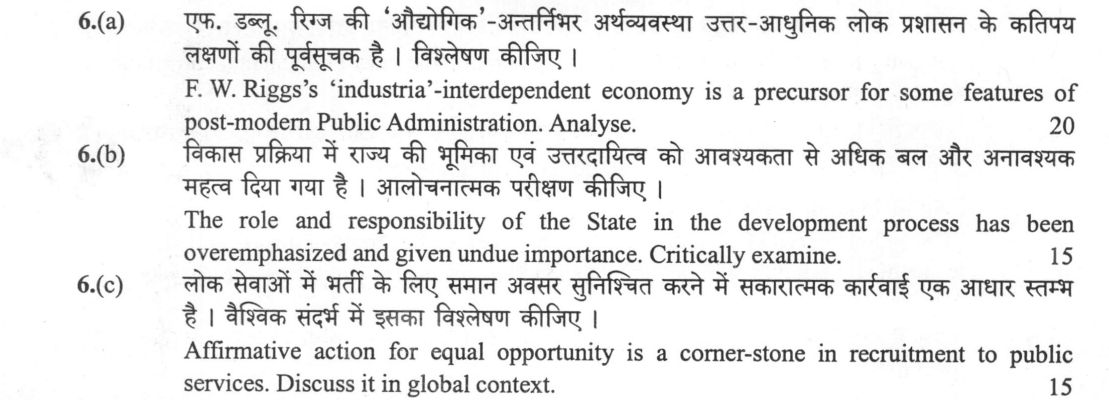
F. W. Riggs's 'industria'-interdependent economy is a precursor for some features of post-modern Public Administration. Analyse. 20 marks
The role and responsibility of the State in the development process has been overemphasized and given undue importance. Critically examine. 15 marks
Affirmative action for equal opportunity is a corner-stone in recruitment to public services. Discuss it in global context. 15 marks
हिंदी में प्रश्न पढ़ें
एक. डब्लू. रिग्स की 'औद्योगिक'-अन्तर्निर्भर अर्थव्यवस्था उत्तर-आधुनिक लोक प्रशासन के कतिपय लक्षणों की पूर्वसूचक है । विश्लेषण कीजिए । (20 अंक)
विकास प्रक्रिया में राज्य की भूमिका एवं उत्तरदायित्व को आवश्यकता से अधिक बल और अनावश्यक महत्व दिया गया है । आलोचनात्मक परीक्षण कीजिए । (15 अंक)
लोक सेवाओं में भर्ती के लिए समान अवसर सुनिश्चित करने में सकारात्मक कार्रवाई एक आधार स्तम्भ है । वैश्विक सन्दर्भ में इसका विश्लेषण कीजिए । (15 अंक)
Model answer
Written by UPSC Answer Check against this question's marking rubric, to the expected length. UPSC does not publish answers for Mains — this is one way to score well, not an official key.
Riggs’s prismatic model treats the industria sector as the differentiated, achievement-oriented, market-exchange part of a society, where functions are specialized and actors pursue goals through impersonal, contractual relations. In a fused or prismatic state, this sector coexists with ascriptive and diffuse sectors, producing interdependence rather than clean separation. This is a precursor to post-modern public administration because it anticipates governance beyond a single hierarchical core: networked governance, public-private partnerships and co-production all rest on the same logic of multiple specialized actors whose outputs depend on one another. *Industria*’s functional specialization foreshadows the fragmentation of policy delivery into agencies, regulators, contractors and community providers; its achievement orientation foreshadows performance management, outcomes and citizen choice; its market-based exchange foreshadows contracting out and collaborative governance. More importantly, the interdependence of prismatic sectors prefigures complexity theory and heterarchical structures, where authority is distributed, feedback is non-linear, and administration must coordinate rather than command. In 21st-century India, this appears in smart cities, PPPs in infrastructure and health, and co-produced services where citizens and private actors participate in design and delivery.
State, Market and Development The claim that the state has been overemphasized draws on Hayek and Friedman, who warn that excessive state control distorts prices, crowds out initiative and creates rent-seeking. India’s pre-1991 licensing regime, industrial stagnation and bureaucratic delays support this critique. Yet the opposite view, associated with Keynes and Sen, stresses that markets require public goods, regulation, social protection and capability expansion. East Asian developmental states such as Japan and South Korea show that capable, selective state intervention can mobilize savings, discipline firms and upgrade industries. India’s mixed economy after 1991 illustrates the balance: liberalization raised growth, investment and competition, but also exposed inequality, weak social infrastructure and regional disparities. The debate is not state versus market but which failures are more correctable. State failures include inefficiency, red tape and capture; market failures include externalities, inequality and under-provision of health and education. The “bringing the state back in” literature, associated with Evans, Rueschemeyer and Skocpol, argues that the state is not merely a variable to be minimized but a capacity-bearing institution. Evans’s later idea of embedded autonomy further suggests that effective states are both autonomous from narrow interests and embedded in society.
Affirmative Action in Global Context Affirmative action is a cornerstone of public recruitment because equal opportunity requires correcting historical exclusion. India’s constitutional framework provides reservations under Article 16(4) for backward classes and Article 16(4A) for SCs and STs; Indian courts have generally treated such reservations as reasonable classifications, subject to Article 335, which requires that efficiency of administration not suffer. This allows representation without surrendering competence, and creamy-layer exclusion for OBCs prevents advantage from passing to already privileged sections. In the United States, Executive Order 11246 required federal contractors to take affirmative action, but strict judicial scrutiny has applied: Regents v. Bakke rejected rigid quotas, Grutter allowed race-conscious admissions as a temporary means to diversity, and SFFA v. Harvard ended race-based preferences in college admissions. South Africa’s Broad-Based Black Economic Empowerment and Malaysia’s New Economic Policy use similar goals—redressing racial and economic disadvantage—but differ in legal intensity and duration. The global debate pits merit against representation. Class-based preferences, universal access policies and targeted skills training are emerging alternatives, yet they do not fully address caste, race or gender exclusion. A defensible position is that affirmative action should be time-bound, evidence-based, linked to efficiency, and reviewed as structural barriers decline.
Together, these themes show that post-modern administration is neither a retreat from the state nor a blind faith in markets. It requires a capable, embedded state that coordinates networks, corrects market failures and uses affirmative action to make public service recruitment genuinely representative.
What "Analyse" is asking you to do
Break the subject into its working parts and show how they act on each other. The marks are in the interconnections — which factor drives which, and what the resulting structure explains — not in the inventory of factors.
Structure that answers it
Define the whole → separate it into its parts → show which part drives which → what that interaction produces → what the structure implies
Where marks are lost
A flat list of causes with no account of which drives which. An answer of neatly separated headings, each self-contained, scores as description.
How this answer will be evaluated
Approach
Framework: F. W. Riggs's Ecological Model (SAMS). (a) analyse: intro > causes > effects > stakeholders/linkages > way forward | (b) critique: the claim > its strengths > its weaknesses > your judgment | (c) discuss: intro > 3-4 dimensions > example > balanced close Full marks: Deep analysis of Riggs' model with strong Indian examples; balanced critique of State role; comprehensive global discussion of affirmative action.
Key points expected
- Define 'industria' as interdependent economy
- Identify specific post-modern PA features
- Explain the causal link/precursor relationship
- Provide Indian administrative instance
- State the claim of overemphasis
- Arguments for State's essential role (market failure)
- Arguments for private/NGO sector role
- Balanced judgment on State's actual necessity
Evaluation rubric
Each sub-part is marked on its own, against the marks and word limit printed on the paper.
- (a) Link Riggs' 'industria' economy to post-modern PA features (networking, decentralization). 20 marks
analyse— intro → causes → effects → stakeholders/linkages → way forward
Must cover
- Define 'industria' as interdependent economy
- Identify specific post-modern PA features
- Explain the causal link/precursor relationship
- Provide Indian administrative instance
Loses marks
- Generic description of post-modern PA
- Ignoring the 'interdependent' aspect
- No Indian anchor
Earns more
- Mention SAMS model context
- Reference New Public Management (NPM)
- Discuss shift from hierarchy to network
- Mention e-governance or digital integration
Extra mark
- Reference 2nd ARC on e-governance
- Mention specific Indian IT policy
- (b) Critically examine the claim that the State's role in development is overemphasized. 15 marks
critique— the claim → its strengths → its weaknesses → your judgment
Must cover
- State the claim of overemphasis
- Arguments for State's essential role (market failure)
- Arguments for private/NGO sector role
- Balanced judgment on State's actual necessity
Loses marks
- One-sided argument (pro or con)
- Ignoring the 'development process' context
- No critical evaluation
Earns more
- Reference 'Laissez-faire' vs 'Welfare State'
- Mention Public-Private Partnership (PPP)
- Reference Indian 5th/12th Plan shifts
- Discuss 'Developmental State' concept
Extra mark
- Reference 2nd ARC on governance
- Mention specific Indian privatization case
- (c) Discuss affirmative action for equal opportunity in public service recruitment globally. 15 marks
discuss— intro → 3-4 dimensions → example → balanced close
Must cover
- Define affirmative action in recruitment
- Explain its role as a 'corner-stone'
- Provide global context (US, UK, etc.)
- Provide Indian context (Reservations)
Loses marks
- Ignoring the 'global context'
- Focusing only on Indian reservations
- No discussion of 'equal opportunity'
Earns more
- Reference US Civil Rights Act
- Reference Indian Constitution (Art 16)
- Discuss 'merit' vs 'equity' debate
- Mention global trends in diversity
Extra mark
- Reference specific Supreme Court case
- Mention specific global policy
Practice this exact question
Write your answer and it is marked point by point against the model answer above — what you covered, what you missed, what you got wrong.
Evaluate my answer →More from Public Administration 2025 Paper I
- Q3 (a) In conflict situations in organizations, leadership migrates to the aggressive and re…
- Q4 (a) "Delegated legislation should be clear and should confine to the limits determined by…
- Q5 Answer the following questions in about 150 words each: (a) E-advocacy model of e-governa…
- Q6 (a) F. W. Riggs's 'industria'-interdependent economy is a precursor for some features of…
- Q7 (a) The objective of Liberalization, Privatization and Globalization and of New Public Ma…
- Q8 (a) The effectiveness of civil society in development process is only when state institut…