Paper I — Q4
(a) "Delegated legislation should be clear and should confine to the limits determined by the legislature." In light of the…
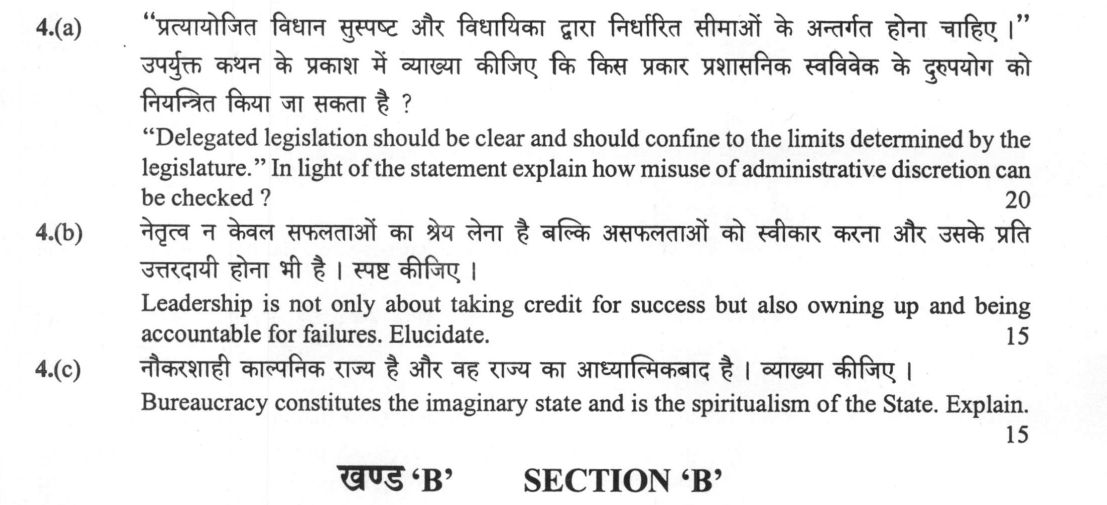
"Delegated legislation should be clear and should confine to the limits determined by the legislature." In light of the statement explain how misuse of administrative discretion can be checked? 20 marks
Leadership is not only about taking credit for success but also owning up and being accountable for failures. Elucidate. 15 marks
Bureaucracy constitutes the imaginary state and is the spiritualism of the State. Explain. 15 marks
हिंदी में प्रश्न पढ़ें
"प्रत्यायोजित विधान सुस्पष्ट और विधायिका द्वारा निर्धारित सीमाओं के अन्तर्गत होना चाहिए ।" उपर्युक्त कथन के प्रकाश में व्याख्या कीजिए कि किस प्रकार प्रशासनिक स्वविवेक के दुरुपयोग को नियंत्रित किया जा सकता है ? (20 अंक)
नेतृत्व न केवल सफलताओं का श्रेय लेना है बल्कि असफलताओं को स्वीकार करना और उसके प्रति उत्तरदायी होना भी है । स्पष्ट कीजिए । (15 अंक)
नौकरशाही काल्पनिक राज्य है और वह राज्य का आध्यात्मिकबाद है । व्याख्या कीजिए । (15 अंक)
Model answer
Written by UPSC Answer Check against this question's marking rubric, to the expected length. UPSC does not publish answers for Mains — this is one way to score well, not an official key.
Checks on Delegated Legislation and Administrative Discretion
Delegated legislation empowers the executive to formulate detailed rules and regulations under statutory authority. The expansion of delegated legislation is driven by parliamentary overburden, administrative urgency, socio-technical complexities, and the need for operational flexibility. Constitutionally, delegated rules derive validity from parent statutes and fall under the definition of law under Article 13(3), operating distinct from emergency executive ordinances promulgated under Articles 123 and 213.
To prevent the misuse of administrative discretion and prevent executive aggrandizement, a robust tripartite control system operates:
Procedural and Legislative Checks: Parent Acts mandate prior publication, inter-departmental consultation, and mandatory laying of rules before Parliament. The Lok Sabha Committee on Subordinate Legislation vigorously examines statutory instruments to verify they stay within delegated boundaries. Post-2014 preventive frameworks have reinforced standardized rule-making by mandating pre-legislative consultative policies and regulatory impact assessments.
Substantive and Judicial Checks: Courts apply the doctrine of substantive ultra vires to strike down subordinate laws exceeding statutory limits. In landmark rulings such as State of Rajasthan v. Krishna Bus Service, the judiciary affirmed that the legislature cannot abdicate essential legislative functions and must articulate clear policy and standards in the parent Act. Discretionary administrative actions are subject to judicial review under Articles 32 and 226, checked against Wednesbury unreasonableness, procedural impropriety, and proportionality.
Leadership Accountability and Owning Failures
Leadership transcends transactional credit-taking, requiring absolute accountability for systemic and operational failures. Transactional leadership relies on reciprocal rewards and self-preserving credit allocation. In contrast, James MacGregor Burns' transformational leadership theory establishes that genuine leadership elevates institutional ethics and collective responsibility. Ronald Heifetz’s adaptive leadership emphasizes that leaders must manage systemic distress and accept accountability for institutional deficits. Similarly, Warren Bennis’s framework of authentic leadership underscores that integrity is forged when leaders take ownership of crises rather than deflecting blame to subordinates.
In Indian administration, this ethos is reinforced through statutory mechanisms and governance norms. Civil servant conduct and probity are legally enforced under provisions like Section 7 of the Prevention of Corruption Act, while the Right to Information Act 2005 mandates transparency in decision-making. During operational crises, such as COVID-19 resource allocations and post-disaster rehabilitation failures, ethical administrative leadership necessitates owning execution deficits to initiate structural rectifications rather than evading institutional liability.
Bureaucracy as the Imaginary State and Spiritual Ethos
The conception of bureaucracy as the "imaginary state" and the "spiritualism of the State" originates in Karl Marx’s Critique of Hegel’s Philosophy of Right. G.W.F. Hegel viewed bureaucracy as the "universal class" mediating between private interests of civil society and the general interest of the State. Marx inverted this thesis, asserting that bureaucracy establishes a corporatist monopoly over state power. Bureaucracy treats the state's actual purpose as its private property, rendering the general interest an illusion. Formal hierarchical procedure becomes its "spiritualism"—a dogmatic self-veneration that alienates the bureaucratic apparatus from society.
Max Weber offered a rationalist alternative, framing ideal-type bureaucracy as an indispensable, technically superior instrument of rational-legal authority against arbitrary patrimonialism. In India, the post-colonial "steel frame" maintained this administrative apparatus, often grappling with the dilemma between civil service neutrality and bureaucratic insularity. To overcome the pathology of an isolated bureaucratic state, the 2nd Administrative Reforms Commission recommended revitalizing the bureaucratic ethos through Citizen’s Charters, strict RTI adherence, and e-governance reforms.
Democratic governance relies on containing administrative discretion within legislative limits, practicing ethical leadership that shoulders institutional failures, and restructuring bureaucratic systems into transparent instruments of public accountability.
What "Explain" is asking you to do
Make the working of something clear — what sets it off, what follows from what, and what it produces. Explain is the Commission's mechanism word: it dominates the technical papers and the “explain why” stems, where the marks sit in the causal chain and not in the label.
Structure that answers it
State what it is → the initiating condition → the chain of cause, step by step → an instance where it plays out → what the chain produces
Where marks are lost
Describing what something looks like instead of why it works that way. Naming the stages without linking them reads as description too.
How this answer will be evaluated
Approach
Framework: Public Administration Paper 1 (Concept > Thinker > Indian Application > Reform). (a) explain: definition/context > points in order > small example > short close | (b) explain: definition/context > points in order > small example > short close | (c) explain: definition/context > points in order > small example > short close Full marks: Comprehensive, well-structured, with specific Indian examples and critical analysis.
Key points expected
- Judicial review via writs (Art 32/226)
- Legislative control (Parliamentary committees)
- Administrative control (LDA, Ombudsman)
- Delegation doctrine (essential functions)
- Definition of accountable leadership
- Distinction between credit-taking and responsibility
- Indian administrative example of accountability
- Impact on organizational culture
Evaluation rubric
Each sub-part is marked on its own, against the marks and word limit printed on the paper.
- (a) Explain mechanisms to check misuse of administrative discretion within delegated legislation limits. 20 marks
explain— definition/context → points in order → small example → short close
Must cover
- Judicial review via writs (Art 32/226)
- Legislative control (Parliamentary committees)
- Administrative control (LDA, Ombudsman)
- Delegation doctrine (essential functions)
Loses marks
- General theory without Indian context
- Ignoring the 'limits determined by legislature' aspect
- GS-2 style policy suggestions
Earns more
- Doctrine of proportionality
- Reasoned administrative action
- Public interest litigation (PIL)
- 2nd ARC recommendations on discretion
Extra mark
- Specific case law (e.g., State of MP v. Shantibai)
- Specific 2nd ARC report citation
- (b) Elucidate the concept of leadership accountability for failures and success. 15 marks
explain— definition/context → points in order → small example → short close
Must cover
- Definition of accountable leadership
- Distinction between credit-taking and responsibility
- Indian administrative example of accountability
- Impact on organizational culture
Loses marks
- Vague generalities without examples
- Focusing only on success, ignoring failure
- Lack of administrative context
Earns more
- Reference to 'Servant Leadership'
- Example of a leader owning failure
- Link to public trust
Extra mark
- Specific historical example (e.g., Nehru, Gandhi)
- Reference to a specific reform initiative
- (c) Explain the concept of bureaucracy as the 'imaginary state' and 'spiritualism of the State'. 15 marks
explain— definition/context → points in order → small example → short close
Must cover
- Definition of 'imaginary state' (bureaucracy as state)
- Definition of 'spiritualism of the State' (values/ethos)
- Role of bureaucracy in state continuity
- Critique of bureaucratic dominance
Loses marks
- Confusing bureaucracy with government
- Ignoring the 'spiritualism' (values) aspect
- Lack of critical analysis
Earns more
- Reference to Weber's ideal bureaucracy
- Reference to Indian Administrative Service (IAS) ethos
- Discussion of 'bureaucratic state' vs 'political state'
Extra mark
- Reference to a specific scholar (e.g., Weber, Crozier)
- Reference to a specific Indian reform (e.g., 2nd ARC)
Practice this exact question
Write your answer and it is marked point by point against the model answer above — what you covered, what you missed, what you got wrong.
Evaluate my answer →More from Public Administration 2025 Paper I
- Q1 Answer the following questions in about 150 words each: (a) Imperfect market and politica…
- Q2 (a) New Public Management has actually been a transitory state in evolution from traditio…
- Q3 (a) In conflict situations in organizations, leadership migrates to the aggressive and re…
- Q4 (a) "Delegated legislation should be clear and should confine to the limits determined by…
- Q5 Answer the following questions in about 150 words each: (a) E-advocacy model of e-governa…
- Q6 (a) F. W. Riggs's 'industria'-interdependent economy is a precursor for some features of…
- Q7 (a) The objective of Liberalization, Privatization and Globalization and of New Public Ma…