Paper I — Q5
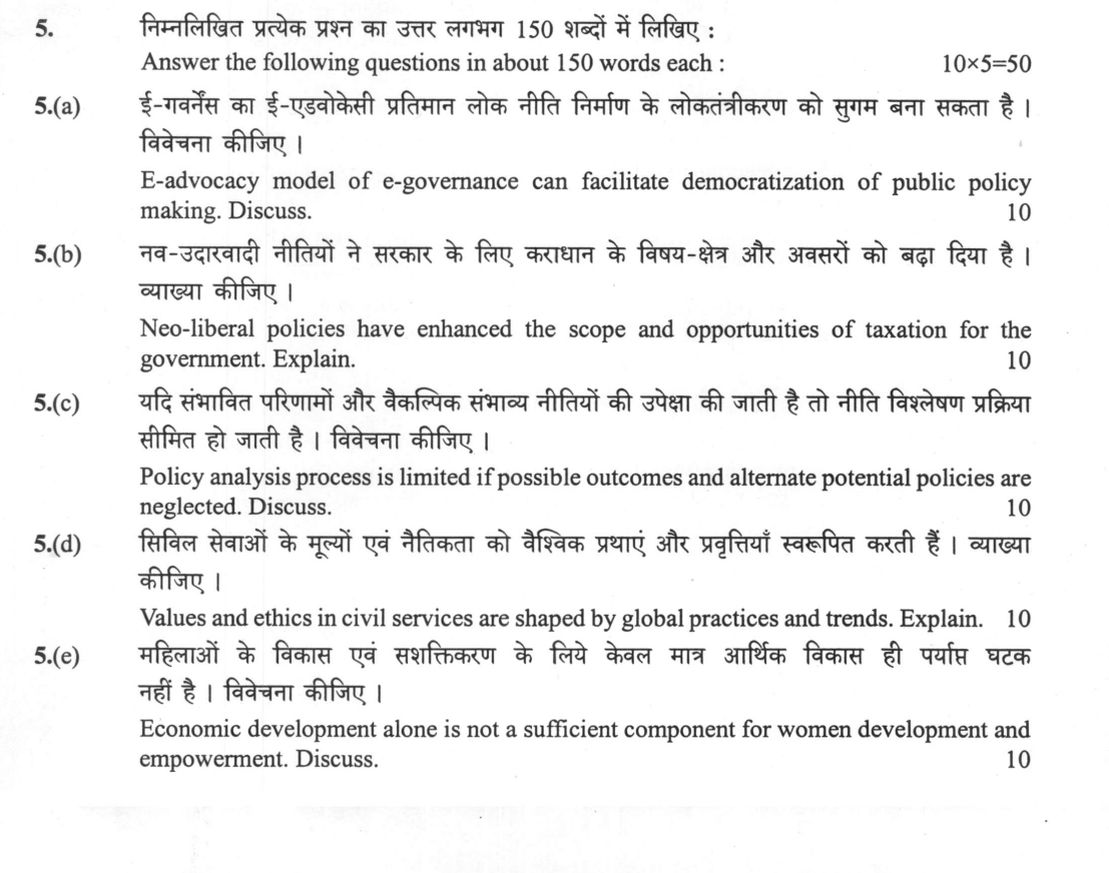
Answer the following questions in about 150 words each: (a) E-advocacy model of e-governance can facilitate democratization of…
Answer the following questions in about 150 words each: E-advocacy model of e-governance can facilitate democratization of public policy making. Discuss. 10 marks
Neo-liberal policies have enhanced the scope and opportunities of taxation for the government. Explain. 10 marks
Policy analysis process is limited if possible outcomes and alternate potential policies are neglected. Discuss. 10 marks
Values and ethics in civil services are shaped by global practices and trends. Explain. 10 marks
Economic development alone is not a sufficient component for women development and empowerment. Discuss. 10 marks
हिंदी में प्रश्न पढ़ें
निम्नलिखित प्रत्येक प्रश्न का उत्तर लगभग 150 शब्दों में लिखिए : ई-गवर्नेंस का ई-एडवोकैसी प्रतिमान लोक नीति निर्माण के लोकतंत्रीकरण को सुगम बना सकता है । विवेचना कीजिए । (10 अंक)
नव-उदारवादी नीतियों ने सरकार के लिए कराधान के विषय-क्षेत्र और अवसरों को बढ़ा दिया है । व्याख्या कीजिए । (10 अंक)
यदि संभावित परिणामों और वैकल्पिक संभाव्य नीतियों की उपेक्षा की जाती है तो नीति विश्लेषण प्रक्रिया सीमित हो जाती है । विवेचना कीजिए । (10 अंक)
सिविल सेवाओं के मूल्यों एवं नैतिकता को वैश्विक प्रथाएँ और प्रवृत्तियाँ स्वरूपित करती हैं । व्याख्या कीजिए । (10 अंक)
महिलाओं के विकास एवं सशक्तिकरण के लिये केवल मात्र आर्थिक विकास ही पर्याप्त घटक नहीं है । विवेचना कीजिए । (10 अंक)
Model answer
Written by UPSC Answer Check against this question's marking rubric, to the 150-word length. UPSC does not publish answers for Mains — this is one way to score well, not an official key.
(a) E-Advocacy and Democratisation of Policy Making
The e-advocacy model of e-governance transforms traditional one-way administrative communication into interactive Citizen-to-Government (C2G) engagement, fundamentally expanding the democratic base of public policy making. By utilizing digital platforms, it creates participatory feedback loops where civil society organizations, advocacy networks, and citizens directly contribute to legislative drafting, policy evaluation, and agenda-setting. In India, digital instruments such as the MyGov portal facilitate public consultations and crowdsourced inputs, while the PRAGATI platform enhances accountability through integrated feedback on policy implementation. However, e-advocacy faces structural constraints, including the digital divide, algorithm-driven echo chambers, and elite capture by digitally literate urban demographics. To democratize policy making substantively, digital advocacy must be integrated with offline, grassroots deliberative forums to ensure inclusive policy outcomes.
(b) Neo-Liberal Policies and the Scope of Taxation
Neo-liberal economic reforms, centered on market deregulation, trade liberalization, and financialization, have restructured rather than diminished the state's fiscal apparatus. Following India’s post-1991 economic reforms, the state transitioned from direct physical controls and narrow wealth levies toward taxing expanded financial assets, cross-border capital transactions, and a rapidly expanding services sector. Furthermore, neo-liberal emphasis on market integration and removal of internal trade barriers led to structural tax rationalizations, best exemplified by the Goods and Services Tax (GST) as a broad-based consumption tax. While neo-liberal frameworks typically promote moderate corporate tax rates to incentivize private investment, digital surveillance, supply-chain formalization, and broader tax bases have expanded the overall tax-to-GDP ratio over the long term. Nevertheless, heavy reliance on indirect consumption taxes creates regressive burdens, requiring balanced progressive direct taxation.
(c) Bounded Policy Analysis and Alternative Outcomes
Policy analysis is inherently flawed if it fails to project diverse future outcomes and evaluate alternate policy options. Herbert Simon illustrated this limitation through the theory of bounded rationality, demonstrating that administrators rarely achieve comprehensive rationality due to informational asymmetries, cognitive limits, and time constraints, settling instead for 'satisficing' solutions. Neglecting alternative policy designs frequently leads to unintended negative externalities and costly policy lock-ins. To overcome these analytical shortcomings, contemporary policy formulation utilizes systemic methodologies such as Multi-Criteria Decision Analysis (MCDA) and scenario planning. These techniques enable policy analysts to forecast socioeconomic trade-offs, evaluate counterfactuals, and simulate crisis responses across various alternative paths, thereby shifting public administration from reactive decision-making to evidence-based, resilient governance.
(d) Global Practices Shaping Civil Service Values and Ethics
Values and ethics in modern civil services are increasingly shaped by international norms, benchmark standards, and global governance paradigms. The Seven Principles of Public Life formulated by the Nolan Committee in the United Kingdom—selflessness, integrity, objectivity, accountability, openness, honesty, and leadership—alongside the United Nations International Code of Conduct for Public Officials, have provided universally recognized normative frameworks for public integrity. Simultaneously, national administrative systems adapt these international trends to their domestic socio-political realities. In India, institutional mechanisms like the Right to Information (RTI) Act, 2005, and citizen charters serve as an indigenous counter-trend to global homogenization, translating universal principles of transparency into actionable, demand-driven accountability tools that address local bureaucratic challenges.
(e) Multidimensionality of Women's Development and Empowerment
Economic growth and rising aggregate income are insufficient indicators of women’s empowerment when pursued in isolation. Drawing upon Amartya Sen’s 'development as freedom' and Martha Nussbaum’s capabilities approach, human development requires expanding substantive freedoms and institutional capabilities rather than merely tracking GDP growth. While economic participation provides material resources, it does not automatically dismantle entrenched patriarchal structures, eliminate gender-based violence, or redistribute the disproportionate burden of unpaid care work. Comprehensive empowerment necessitates institutional progress across social, political, and legal domains, including secure property rights, reproductive autonomy, and political representation through measures like the Nari Shakti Vandan Adhiniyam. Consequently, public policy must integrate economic opportunities with social reforms and legal entitlements to achieve genuine gender equity.
What "Discuss" is asking you to do
Lay the issue out from more than one side — how it arose, what is claimed for it, what is held against it, and where it now stands. UPSC attaches discuss to broad topics with several live dimensions, so coverage of the dimensions earns more than the strength of your opinion.
Structure that answers it
Set the issue up → the case as it is made → the case against → the dimension both sides leave out → where the balance now lies
Where marks are lost
Listing facts with no thread between them, or arguing one side throughout and calling it a discussion.
How this answer will be evaluated
Approach
Framework: Concept > Thinker > Indian institutional application > Reform. (a) discuss: intro > 3-4 dimensions > example > balanced close | (b) explain: definition/context > points in order > small example > short close | (c) discuss: intro > 3-4 dimensions > example > balanced close | (d) explain: definition/context > points in order > small example > short close | (e) discuss: intro > 3-4 dimensions > example > balanced close Full marks: Comprehensive, well-structured, with specific Indian examples and theoretical depth.
Key points expected
- Define e-advocacy as a specific e-governance model
- Explain how it facilitates citizen participation in policy
- Provide an Indian example (e.g., MyGov, RTI portal)
- Conclude with a balanced view on its impact
- Define neo-liberal policies (liberalization, privatization)
- Link these policies to the expansion of the tax base
- Mention specific tax instruments (e.g., GST, service tax)
- Provide a short example of a new tax opportunity
Evaluation rubric
Each sub-part is marked on its own, against the marks and word limit printed on the paper.
- (a) Link e-advocacy to the democratization of public policy making. 10 marks · 150 words
discuss— intro → 3-4 dimensions → example → balanced close
Must cover
- Define e-advocacy as a specific e-governance model
- Explain how it facilitates citizen participation in policy
- Provide an Indian example (e.g., MyGov, RTI portal)
- Conclude with a balanced view on its impact
Loses marks
- Confusing e-advocacy with general e-services
- Ignoring the 'democratization' aspect of the prompt
- Providing no Indian administrative context
Earns more
- Mention specific digital platforms for policy feedback
- Reference the 'Digital India' initiative
- Discuss the shift from top-down to bottom-up policy
Extra mark
- Cite a specific Supreme Court judgment on digital rights
- Reference a specific 2nd ARC recommendation on e-governance
- (b) Explain how neo-liberal policies expanded the scope of taxation. 10 marks · 150 words
explain— definition/context → points in order → small example → short close
Must cover
- Define neo-liberal policies (liberalization, privatization)
- Link these policies to the expansion of the tax base
- Mention specific tax instruments (e.g., GST, service tax)
- Provide a short example of a new tax opportunity
Loses marks
- Focusing only on tax rates rather than scope
- Ignoring the 'neo-liberal' context of the prompt
- Failing to link policy to government revenue
Earns more
- Reference the 1991 LPG reforms
- Mention the shift from direct to indirect taxation
- Discuss the role of the formalization of the economy
Extra mark
- Cite a specific Finance Commission recommendation
- Reference a specific tax reform committee report
- (c) Discuss the limitations of policy analysis when alternatives are ignored. 10 marks · 150 words
discuss— intro → 3-4 dimensions → example → balanced close
Must cover
- Define the policy analysis process
- Explain why considering alternatives is crucial
- Discuss the consequences of neglecting possible outcomes
- Provide an example of a policy failure due to this neglect
Loses marks
- Focusing only on the definition of policy analysis
- Ignoring the 'limitations' aspect of the prompt
- Failing to provide a concrete example
Earns more
- Mention the 'rational model' of policy making
- Reference the 'post-mortem' analysis of a policy
- Discuss the role of 'ex-ante' and 'ex-post' evaluation
Extra mark
- Cite a specific policy failure (e.g., NREGA implementation issues)
- Reference a specific policy evaluation framework
- (d) Explain how global practices shape values and ethics in civil services. 10 marks · 150 words
explain— definition/context → points in order → small example → short close
Must cover
- Define the core values of civil services
- Explain the influence of global trends (e.g., transparency)
- Provide an example of a global practice adopted in India
- Conclude with the impact on administrative ethics
Loses marks
- Focusing only on traditional Indian values
- Ignoring the 'global practices' aspect of the prompt
- Failing to link global trends to specific administrative ethics
Earns more
- Mention the 'New Public Management' (NPM) movement
- Reference the 'Good Governance' principles
- Discuss the role of international organizations (e.g., UN, World Bank)
Extra mark
- Cite a specific global code of conduct for civil servants
- Reference a specific Indian reform inspired by global trends
- (e) Discuss why economic development is insufficient for women's empowerment. 10 marks · 150 words
discuss— intro → 3-4 dimensions → example → balanced close
Must cover
- Define women's development and empowerment
- Explain the limitations of economic development alone
- Discuss other factors (e.g., social, political, cultural)
- Provide an example of a non-economic barrier to empowerment
Loses marks
- Focusing only on economic indicators
- Ignoring the 'insufficient' aspect of the prompt
- Failing to provide a balanced view of other factors
Earns more
- Mention the 'Gender and Development' (GAD) approach
- Reference the 'Women's Empowerment' index
- Discuss the role of education and health in empowerment
Extra mark
- Cite a specific government scheme for women's empowerment
- Reference a specific study on women's economic participation
Practice this exact question
Write your answer and it is marked point by point against the model answer above — what you covered, what you missed, what you got wrong.
Evaluate my answer →More from Public Administration 2025 Paper I
- Q2 (a) New Public Management has actually been a transitory state in evolution from traditio…
- Q3 (a) In conflict situations in organizations, leadership migrates to the aggressive and re…
- Q4 (a) "Delegated legislation should be clear and should confine to the limits determined by…
- Q5 Answer the following questions in about 150 words each: (a) E-advocacy model of e-governa…
- Q6 (a) F. W. Riggs's 'industria'-interdependent economy is a precursor for some features of…
- Q7 (a) The objective of Liberalization, Privatization and Globalization and of New Public Ma…
- Q8 (a) The effectiveness of civil society in development process is only when state institut…