Paper I — Q7
(a) The objective of Liberalization, Privatization and Globalization and of New Public Management was to limit government…
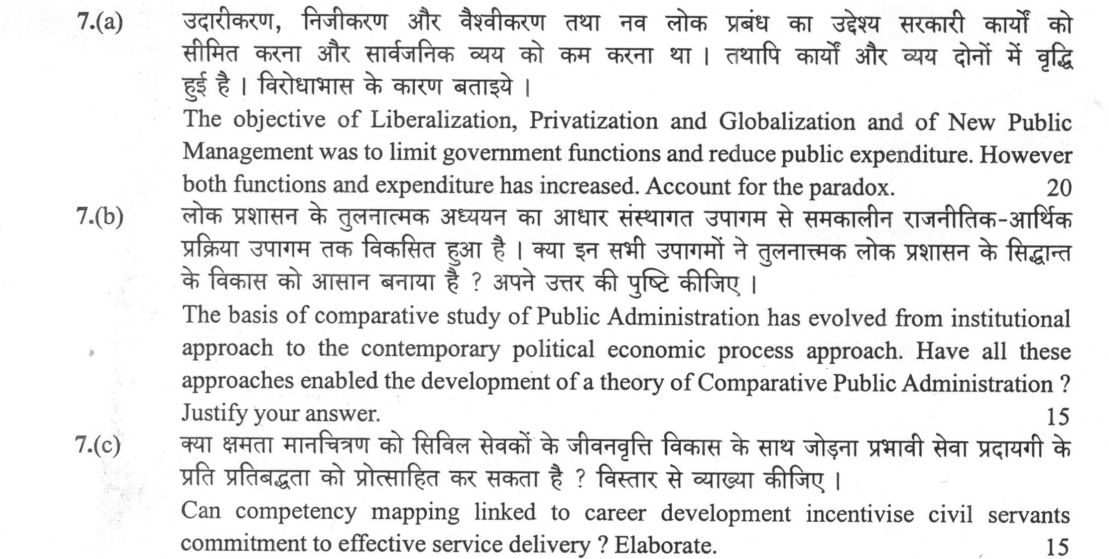
The objective of Liberalization, Privatization and Globalization and of New Public Management was to limit government functions and reduce public expenditure. However both functions and expenditure has increased. Account for the paradox. 20 marks
The basis of comparative study of Public Administration has evolved from institutional approach to the contemporary political economic process approach. Have all these approaches enabled the development of a theory of Comparative Public Administration? Justify your answer. 15 marks
Can competency mapping linked to career development incentivise civil servants commitment to effective service delivery? Elaborate. 15 marks
हिंदी में प्रश्न पढ़ें
उदारीकरण, निजीकरण और वैश्वीकरण तथा नव लोक प्रबन्ध का उद्देश्य सरकारी कार्यों को सीमित करना और सार्वजनिक व्यय को कम करना था । तथापि कार्यों और व्यय दोनों में वृद्धि हुई है । विरोधाभास के कारण बताइये । (20 अंक)
लोक प्रशासन के तुलनात्मक अध्ययन का आधार संस्थागत उपागम से समकालीन राजनीतिक-आर्थिक प्रक्रिया उपागम तक विकसित हुआ है । क्या इन सभी उपागमों ने तुलनात्मक लोक प्रशासन के सिद्धान्त के विकास को आसान बनाया है ? अपने उत्तर की पुष्टि कीजिए । (15 अंक)
क्या क्षमता मानचित्रण को सिविल सेवकों के जीवनवृत्ति विकास के साथ जोड़ना प्रभावी सेवा प्रदायगी के प्रति प्रतिबद्धता को प्रोत्साहित कर सकता है ? विस्तार से व्याख्या कीजिए । (15 अंक)
Model answer
Written by UPSC Answer Check against this question's marking rubric, to the expected length. UPSC does not publish answers for Mains — this is one way to score well, not an official key.
The LPG-NPM Paradox: State Expansion and Expenditure
The New Public Management (NPM) paradigm and Liberalization, Privatization, and Globalization (LPG) reforms prescribed rolling back the state, downsized bureaucracies, and reduced public expenditure through market mechanisms. However, the subsequent decades witnessed an expansion in both state functions and public budgets.
This paradox is explained by the transformation of the state rather than its diminution. First, as captured by the "hollow state" thesis, contracting out and public-private partnerships do not eliminate state responsibility; instead, they replace direct administration with complex, resource-intensive networks of contract management, audit, and oversight. Second, the shift from direct provision to "regulatory capitalism" necessitated the creation of specialized regulatory bodies across sectors, expanding administrative machinery. Third, globalization generated domestic vulnerabilities, necessitating compensatory welfare interventions. In India, despite sustained disinvestment policies, public expenditure expanded due to rising subsidy obligations in food, fuel, and fertilizer, alongside rights-based welfare architectures such as the National Food Security Act and MGNREGA.
Furthermore, the modern state must finance new collective goods, notably digital public infrastructure such as the India Stack, cybersecurity, and green transitions. Rather than shrinking, the state has absorbed higher capital and revenue outlays to build systemic capacity and govern market externalities.
Evolution and Theoretical Status of Comparative Public Administration
The basis of Comparative Public Administration (CPA) shifted across decades to capture administrative realities across diverse political contexts. Early CPA relied on rigid, Western-centric institutional approaches. In response, Fred Riggs introduced the ecological and structural-functional approach, formulating the prismatic-sala model to analyze developing polities, while Ferrel Heady advanced developmental administration to evaluate public bureaucracies against nation-building goals.
Despite these frameworks, CPA long remained pre-theoretical. Riggsian typologies, while conceptually rich, were largely descriptive, static, and culturally deterministic, failing to yield falsifiable, predictive general laws across differing political systems.
The contemporary political-economic process approach addressed these gaps by situating public administration within the wider matrix of state power, global markets, and social classes. Theorists such as Peter Evans, Dietrich Rueschemeyer, and Theda Skocpol spearheaded the "Bringing the State Back In" perspective, conceptualizing state capacity through structural linkages. Evans' formulation of "embedded autonomy" successfully generated robust, middle-range theories explaining divergent developmental trajectories across East Asia and Latin America. While a singular, universal theory of CPA remains unrealized due to context-dependent governance ecologies, the political-economic approach has provided CPA with rigorous, empirically testable middle-range frameworks.
Competency Mapping and Service Delivery in Civil Services
Competency mapping identifies the specific domain knowledge, functional skills, and behavioural indicators required for designated public roles. Moving beyond generalist assumptions, linking competency assessments to career progression incentivizes civil servants toward effective, citizen-centric service delivery.
In India, the Second Administrative Reforms Commission (ARC-II) recommended institutionalizing competency frameworks for placement and promotion. This transition has been operationalized through Mission Karmayogi and its Framework of Roles, Activities, and Competencies (FRAC), governed by a Special Purpose Vehicle (Karmayogi Bharat). By continuously assessing competencies and aligning them with dynamic role requirements, this architecture seeks to create an intrinsic incentive structure where domain specialization and demonstrated performance drive career advancement.
However, several institutional rigidities constrain this mechanism. The persistence of the seniority principle over performance in promotions dampens individual motivation to upgrade competencies. Rigid rank-in-corps structures preserve cadre monopolies over specific posts regardless of merit, while pervasive political executive interference in appointments and arbitrary transfers disrupts the objective matching of assessed competency with administrative placement.
Transforming civil service delivery requires reconciling market-era state responsibilities with embedded institutional capacity, supported by an HR architecture that translates competency frameworks from formal compliance into merit-based career progression.
What "Elaborate" is asking you to do
Give the full detailed account the question has compressed into a line — every dimension of it, with specifics. Elaborate rewards completeness and detail rather than clarification or argument: the examiner is checking whether you can fill out a topic without being told what its parts are.
Structure that answers it
State the proposition → first dimension in detail → second dimension in detail → the part the statement leaves implicit → the consolidated picture
Where marks are lost
Repeating the statement at greater length instead of adding substance. Elaborate also punishes narrowness: omitting a whole dimension costs more here than anywhere else in this family.
How this answer will be evaluated
Approach
Framework: UPSC Public Administration Paper 1. (a) account for: state the phenomenon > the causes in order of weight > conclusion | (b) justify: claim > 3-4 reasons > evidence > conclusion | (c) explain: definition/context > points in order > small example > short close Full marks: Precise definitions, strong Indian anchors, clear analytical link to the specific command word, and balanced conclusion.
Key points expected
- Define LPG and New Public Management (NPM) objectives
- Identify causes of rising government functions (e.g., welfare, security)
- Identify causes of rising expenditure (e.g., subsidies, debt)
- Link theory to Indian administrative reality
- Define Institutional Approach vs Political-Economic Process Approach
- Evaluate the contribution of each to theory development
- Provide examples of comparative studies (e.g., India vs US)
- Conclude on the existence/validity of a unified theory
Evaluation rubric
Each sub-part is marked on its own, against the marks and word limit printed on the paper.
- (a) Explain the paradox of rising functions/expenditure despite LPG/NPM goals. 20 marks
account for— state the phenomenon → the causes in order of weight → conclusion
Must cover
- Define LPG and New Public Management (NPM) objectives
- Identify causes of rising government functions (e.g., welfare, security)
- Identify causes of rising expenditure (e.g., subsidies, debt)
- Link theory to Indian administrative reality
Loses marks
- Generic definition of LPG without Indian context
- Ignoring the 'paradox' aspect (only listing causes)
- GS-2 style policy suggestions without administrative analysis
Earns more
- Mention specific Indian reforms (e.g., GST, e-governance)
- Reference 2nd ARC recommendations on efficiency
- Distinguish between 'functions' and 'expenditure' drivers
Extra mark
- Cite specific data on public expenditure trends
- Reference specific NPM failures in India
- (b) Justify if comparative approaches enabled a theory of Comparative Public Administration. 15 marks
justify— claim → 3-4 reasons → evidence → conclusion
Must cover
- Define Institutional Approach vs Political-Economic Process Approach
- Evaluate the contribution of each to theory development
- Provide examples of comparative studies (e.g., India vs US)
- Conclude on the existence/validity of a unified theory
Loses marks
- Describing approaches without evaluating their theoretical impact
- Ignoring the 'political-economic' dimension of the contemporary approach
- Vague conclusion without a clear 'yes/no' justification
Earns more
- Mention key thinkers (e.g., Riggs, Heady)
- Reference specific comparative models (e.g., Prismatic Society)
- Discuss the shift from 'what' to 'how' in administration
Extra mark
- Cite specific comparative studies (e.g., India vs China)
- Reference recent comparative governance frameworks
- (c) Elaborate on how competency mapping linked to career development incentivizes civil servants. 15 marks
explain— definition/context → points in order → small example → short close
Must cover
- Define competency mapping and its link to career development
- Explain the incentive mechanism (e.g., promotions, training)
- Connect to 'effective service delivery' (outcome-based)
- Provide Indian administrative examples (e.g., 2nd ARC, CDS)
Loses marks
- Generic discussion of 'motivation' without administrative context
- Ignoring the 'service delivery' outcome
- No link to Indian institutional application
Earns more
- Mention 2nd ARC recommendations on performance management
- Reference specific Indian schemes (e.g., CDS, e-governance training)
- Discuss the gap between policy and field reality
Extra mark
- Cite specific competency frameworks used in India
- Reference recent reforms in civil service evaluation
Practice this exact question
Write your answer and it is marked point by point against the model answer above — what you covered, what you missed, what you got wrong.
Evaluate my answer →More from Public Administration 2025 Paper I
- Q4 (a) "Delegated legislation should be clear and should confine to the limits determined by…
- Q5 Answer the following questions in about 150 words each: (a) E-advocacy model of e-governa…
- Q6 (a) F. W. Riggs's 'industria'-interdependent economy is a precursor for some features of…
- Q7 (a) The objective of Liberalization, Privatization and Globalization and of New Public Ma…
- Q8 (a) The effectiveness of civil society in development process is only when state institut…