Paper I — Q8
(a) The effectiveness of civil society in development process is only when state institutions are receptive to inputs from the…
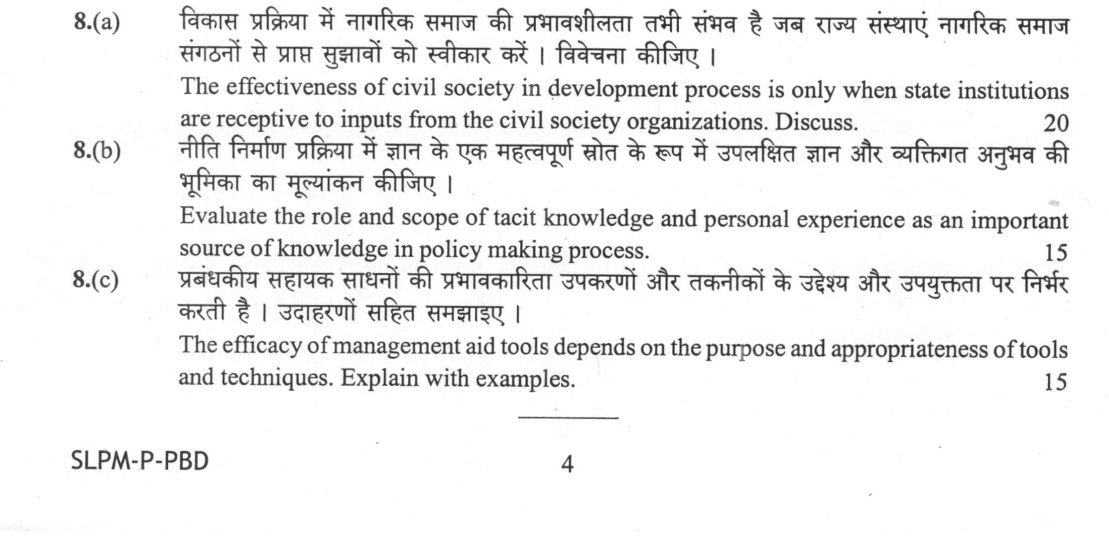
The effectiveness of civil society in development process is only when state institutions are receptive to inputs from the civil society organizations. Discuss. 20 marks
Evaluate the role and scope of tacit knowledge and personal experience as an important source of knowledge in policy making process. 15 marks
The efficacy of management aid tools depends on the purpose and appropriateness of tools and techniques. Explain with examples. 15 marks
हिंदी में प्रश्न पढ़ें
विकास प्रक्रिया में नागरिक समाज की प्रभावशीलता तभी संभव है जब राज्य संस्थाएं नागरिक समाज संगठनों से प्राप्त सुझावों को स्वीकार करें । विवेचना कीजिए । (20 अंक)
नीति निर्माण प्रक्रिया में ज्ञान के एक महत्वपूर्ण स्रोत के रूप में उपलब्धिज्ञान और व्यक्तिगत अनुभव की भूमिका का मूल्यांकन कीजिए । (15 अंक)
प्रबन्धकीय सहायक साधनों की प्रभावकारिता उपकरणों और तकनीकों के उद्देश्य और उपयुक्तता पर निर्भर करती है । उदाहरणों सहित समझाइए । (15 अंक)
Model answer
Written by UPSC Answer Check against this question's marking rubric, to the expected length. UPSC does not publish answers for Mains — this is one way to score well, not an official key.
The synergy between state apparatuses, societal actors, and administrative techniques determines the quality of public governance. Contemporary policy challenges require examining how state receptivity, practitioner wisdom, and administrative tools operate collectively.
State Receptivity and Civil Society Effectiveness
Theoretical perspectives on the state-civil society interface offer contrasting views on institutional synergy. Robert Putnam posited that robust civil society and high social capital make institutional democracy work efficiently by fostering civic engagement and accountability. Conversely, Antonio Gramsci conceptualised civil society as an arena of ideological hegemony, where state dominance is negotiated, contested, or reinforced.
In practice, the development impact of civil society organizations (CSOs) remains contingent upon state receptivity. The Mazdoor Kisan Shakti Sangathan (MKSS) struggle in Rajasthan demonstrates this dynamic: grassroots mobilisation and Jan Sunwais (public hearings) generated civic demand, but their structural impact was realised only when state institutions proved receptive, culminating in the institutionalisation of the Right to Information Act, 2005, and social audits under MGNREGA.
For civil society engagement to be effective, states must establish institutionalised consultation mechanisms, statutory advisory bodies, and robust transparency frameworks. Where institutional receptivity is replaced by mutual trust deficits, bureaucratic hostility, or shrinking civic space through rigid regulatory restrictions, civil society efforts are relegated to adversarial friction rather than constructive developmental co-production.
Tacit Knowledge and Experiential Wisdom in Policymaking
Michael Polanyi differentiated between codified knowledge (formal, documented data) and tacit knowledge—the unwritten, intuitive understanding derived from lived experience ("we know more than we can tell"). In public administration, street-level bureaucrats possess vast tacit knowledge accumulated through daily frontline public service delivery.
This experiential wisdom is crucial in bridging the perennial implementation gap. Frontline practitioners understand informal community networks, behavioral incentives, and ground-level administrative bottlenecks that formal econometric models and abstract policy designs overlook.
However, tacit knowledge has distinct limitations: it is inherently subjective, vulnerable to cognitive bias, and difficult to standardize or transfer across diverse administrative jurisdictions. Hence, modern governance requires hybrid knowledge systems. Rational evidence-based policymaking must integrate empirical data and codified research with the tacit wisdom of frontline administrators to produce context-sensitive, actionable interventions.
Purpose and Appropriateness of Management Aid Tools
Management aid tools enhance administrative capability only when there is strict congruence between the tool’s design, institutional purpose, and organizational environment. Network techniques such as the Critical Path Method (CPM) and Project Evaluation and Review Technique (PERT) are purpose-built for managing complex, time-bound infrastructure projects like PM GatiShakti. Similarly, Management Information Systems (MIS) serve centralized monitoring functions, while Total Quality Management (TQM) targets continuous process improvements in public service delivery.
Deploying tools without assessing organizational appropriateness creates administrative dysfunction. Introducing overly complex, digitized MIS architectures in resource-starved, digitally excluded Gram Panchayats often leads to data fabrication and operational paralysis rather than genuine decentralized accountability. Likewise, transplanting private-sector TQM frameworks into underfunded, overburdened district government hospitals fails when imposed without cultural readiness, staff capacity, and requisite resource autonomy, reducing quality assurance to mere cosmetic compliance.
Towards Knowledge Pluralism in Governance
To achieve resilient and adaptive governance, administrative systems must move beyond technocratic insularity. The state must institutionalise knowledge pluralism by systematically synthesising democratic feedback from civil society, the tacit experiential wisdom of frontline practitioners, and purpose-appropriate management aid tools. This integrated epistemic approach ensures that policy formulation remains evidence-based, culturally grounded, and administratively executable.
What "Discuss" is asking you to do
Lay the issue out from more than one side — how it arose, what is claimed for it, what is held against it, and where it now stands. UPSC attaches discuss to broad topics with several live dimensions, so coverage of the dimensions earns more than the strength of your opinion.
Structure that answers it
Set the issue up → the case as it is made → the case against → the dimension both sides leave out → where the balance now lies
Where marks are lost
Listing facts with no thread between them, or arguing one side throughout and calling it a discussion.
How this answer will be evaluated
Approach
Framework: Public Administration Paper 1 (SLPM-P-PBD). (a) discuss: intro > 3-4 dimensions > example > balanced close | (b) evaluate: criteria > evidence > balanced judgment | (c) explain: definition/context > points in order > small example > short close Full marks: Comprehensive analysis with Indian institutional anchors, specific examples, and balanced judgment
Key points expected
- Define the role of civil society in development
- Explain the necessity of state receptivity
- Provide Indian examples of state-civil society interaction
- Conclude with a balanced assessment
- Define tacit knowledge and personal experience
- Explain their role in policy making
- Provide evidence of their importance
- Offer balanced judgment on their scope
Evaluation rubric
Each sub-part is marked on its own, against the marks and word limit printed on the paper.
- (a) Analyze the conditional relationship between state receptivity and civil society effectiveness in development. 20 marks
discuss— intro → 3-4 dimensions → example → balanced close
Must cover
- Define the role of civil society in development
- Explain the necessity of state receptivity
- Provide Indian examples of state-civil society interaction
- Conclude with a balanced assessment
Loses marks
- Theory without Indian administrative instance
- GS-2 style answer without administrative focus
- No distinction between administration and politics
Earns more
- Mention specific Indian development programs
- Reference 2nd ARC recommendations
- Cite specific NGO-state partnerships
- Discuss recent governance reforms
Extra mark
- Name specific committees or commissions
- Cite specific Article of Constitution
- (b) Assess the role and scope of tacit knowledge and personal experience in policy making. 15 marks
evaluate— criteria → evidence → balanced judgment
Must cover
- Define tacit knowledge and personal experience
- Explain their role in policy making
- Provide evidence of their importance
- Offer balanced judgment on their scope
Loses marks
- No distinction between tacit and explicit knowledge
- No Indian administrative context
- No balanced evaluation
Earns more
- Mention specific policy making instances
- Reference Indian administrative practices
- Discuss limitations of tacit knowledge
- Cite specific policy examples
Extra mark
- Name specific policy committees
- Reference specific policy documents
- (c) Explain how management aid tools' efficacy depends on purpose and appropriateness with examples. 15 marks
explain— definition/context → points in order → small example → short close
Must cover
- Define management aid tools
- Explain purpose-dependency of tools
- Explain appropriateness of techniques
- Provide specific examples
Loses marks
- No specific examples provided
- No distinction between different tools
- No Indian administrative context
Earns more
- Mention specific management tools
- Reference Indian administrative applications
- Discuss tool selection criteria
- Cite specific administrative examples
Extra mark
- Name specific management techniques
- Reference specific administrative reforms
Practice this exact question
Write your answer and it is marked point by point against the model answer above — what you covered, what you missed, what you got wrong.
Evaluate my answer →More from Public Administration 2025 Paper I
- Q5 Answer the following questions in about 150 words each: (a) E-advocacy model of e-governa…
- Q6 (a) F. W. Riggs's 'industria'-interdependent economy is a precursor for some features of…
- Q7 (a) The objective of Liberalization, Privatization and Globalization and of New Public Ma…
- Q8 (a) The effectiveness of civil society in development process is only when state institut…