Paper II — Q1
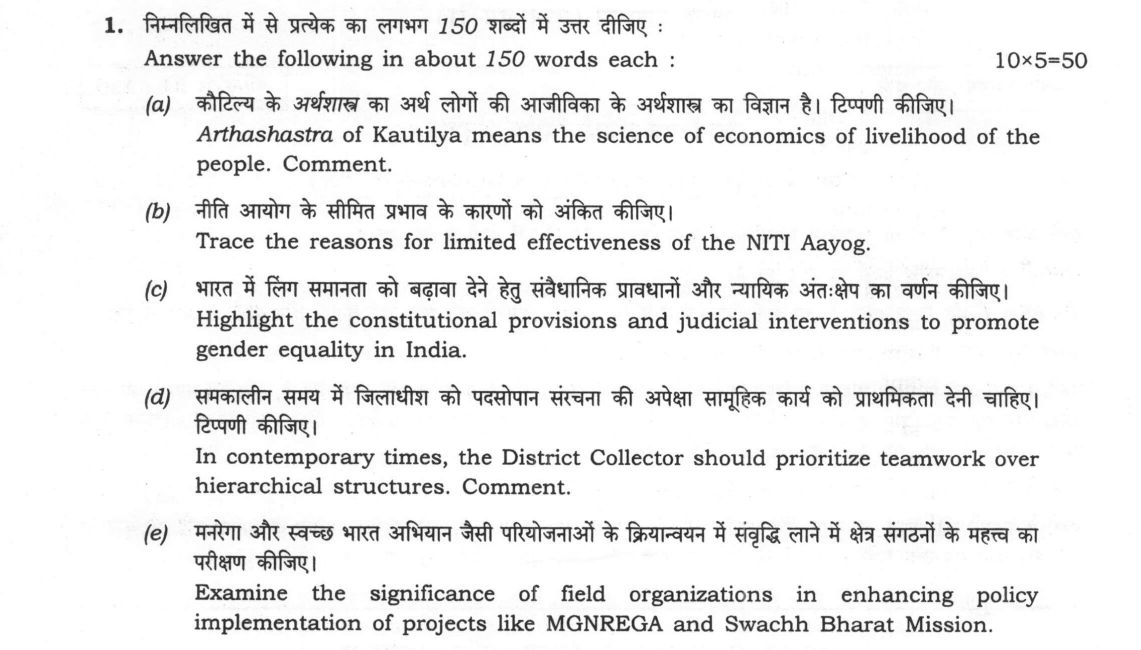
Answer the following in about 150 words each: (a) Arthashastra of Kautilya means the science of economics of livelihood of the…
Answer the following in about 150 words each:
Arthashastra of Kautilya means the science of economics of livelihood of the people. Comment. 10 marks
Trace the reasons for limited effectiveness of the NITI Aayog. 10 marks
Highlight the constitutional provisions and judicial interventions to promote gender equality in India. 10 marks
In contemporary times, the District Collector should prioritize teamwork over hierarchical structures. Comment. 10 marks
Examine the significance of field organizations in enhancing policy implementation of projects like MGNREGA and Swachh Bharat Mission. 10 marks
हिंदी में प्रश्न पढ़ें
निम्नलिखित में से प्रत्येक का लगभग 150 शब्दों में उत्तर दीजिए :
कौटिल्य के अर्थशास्त्र का अर्थ लोगों की आजीविका के अर्थशास्त्र का विज्ञान है। टिप्पणी कीजिए। (10 अंक)
नीति आयोग के सीमित प्रभाव के कारणों को अंकित कीजिए। (10 अंक)
भारत में लिंग समानता को बढ़ावा देने हेतु संवैधानिक प्रावधानों और न्यायिक अंतःक्षेप का वर्णन कीजिए। (10 अंक)
समकालीन समय में जिलाधीश को पदसोपान संरचना की अपेक्षा सामूहिक कार्य को प्राथमिकता देनी चाहिए। टिप्पणी कीजिए। (10 अंक)
मनरेगा और स्वच्छ भारत अभियान जैसी परियोजनाओं के क्रियान्वयन में संतृप्ति लाने में क्षेत्र संगठनों के महत्व का परीक्षण कीजिए। (10 अंक)
Model answer
Written by UPSC Answer Check against this question's marking rubric, to the 150-word length. UPSC does not publish answers for Mains — this is one way to score well, not an official key.
(a) Arthashastra and the Science of Livelihood
Kautilya’s Arthashastra defines 'Artha' not merely as narrow economics or finance, but as the material well-being, sustenance, and livelihood (vritti) of human beings, alongside the territory inhabited by them. Thus, it is fundamentally a comprehensive treatise on political economy, statecraft, and public administration. Central to this vision is the doctrine of *Yogakshema*—the sovereign’s paramount obligation to secure the welfare, safety, and economic security of the people (praja sukhe sukham rajnah). To operationalize this livelihood-centric governance, Kautilya articulates the Saptanga (seven-fold) theory of the state (Swami, Amatya, Janapada, Durga, Kosha, Danda, and Mitra), wherein an elaborate administrative apparatus manages agriculture, trade, mining, and state reserves. Far from abstract realpolitik, the Arthashastra affirms that political authority, sovereign stability, and social order are directly anchored in the state's capacity to protect and enhance the productive livelihoods of its citizenry.
(b) Limited Effectiveness of NITI Aayog
Established to replace the top-down Planning Commission, NITI Aayog functions primarily as a policy think tank, yet its operational effectiveness faces structural constraints. First, it lacks constitutional or statutory backing and possesses no financial allocation powers, depriving it of the fiscal leverage necessary to ensure central ministries and state departments adhere to its policy prescriptions. Second, its framework of 'cooperative and competitive federalism' relies predominantly on rankings, indices, and moral suasion, lacking institutionalized enforcement mechanisms to resolve inter-state disputes or compel policy execution. Third, its advisory role often creates overlapping mandates and friction with the Finance Commission, which exclusively controls statutory tax devolution and revenue gap grants. Without executive authority, tied financial grants, or a binding dispute-settlement architecture, NITI Aayog frequently risks seeing its transformative strategic blueprints diluted into non-binding recommendations across diverse federal jurisdictions.
(c) Gender Equality: Constitutional Provisions and Judicial Interventions
The Indian Constitution embeds gender equality through fundamental rights, directive principles, and decentralized governance. Articles 14 and 15 guarantee equality before the law and prohibit sex-based discrimination, enabling affirmative action under Article 15(3). Article 39 directs the state to secure equal livelihood opportunities and equal pay for equal work, while Article 51A(e) prescribes a fundamental duty to renounce practices derogatory to women's dignity. Crucially, Articles 243D and 243T institutionalize political empowerment by reserving at least one-third of seats for women in Panchayati Raj institutions and Urban Local Bodies.
The judiciary has vigorously advanced substantive equality through landmark rulings. In Vishaka v. State of Rajasthan, the Supreme Court formulated binding workplace sexual harassment guidelines. In Shayara Bano v. Union of India, it outlawed arbitrary instant Triple Talaq. In the Sabarimala case (Indian Young Lawyers Association), the Court prioritized non-discrimination in religious access over exclusionary customs, and in Joseph Shine v. Union of India, it struck down the patriarchal adultery law, affirming female bodily autonomy.
(d) District Collector: Teamwork versus Hierarchy
District administration has transformed from a colonial-era regulatory structure into an expansive, multidimensional welfare delivery system. In contemporary governance, the traditional Weberian hierarchy and colonial magisterial command-and-control paradigm generate bureaucratic silos, procedural inertia, and operational insularity. Complex socio-economic challenges require the District Collector to prioritize collaborative teamwork and horizontal integration over vertical authority.
Institutional platforms such as District Development Coordination and Monitoring Committees (DISHA) and interdepartmental coordination meetings demand that the Collector function as a team leader, consensus-builder, and facilitator across health, education, infrastructure, and rural development sectors. Furthermore, adopting participatory management models that integrate Panchayati Raj representatives, technical specialists, and civil society fosters ground-level synergy. Transitioning from an authoritarian bureaucratic supervisor to an empathetic, agile team coordinator ensures that district administration remains responsive, accountable, and capable of delivering multidimensional citizen-centric governance in an increasingly networked administrative environment.
(e) Field Organizations in MGNREGA and Swachh Bharat Mission
Field organizations constitute the operational backbone of development administration, translating macro-level policies into micro-level implementation. Under MGNREGA, decentralized institutions are paramount: Gram Panchayats identify local infrastructure needs, prepare the shelf of projects, and issue job cards, while Block Development Offices provide engineering support and wage-employment measurement. Furthermore, institutionalized Social Audit Units operating at the village level empower local communities, check bureaucratic leakage, verify muster rolls, and enhance downward administrative accountability.
Similarly, the Swachh Bharat Mission leveraged field machinery through decentralized executive leadership and community mobilization. District Collectors coordinated multi-sectoral line departments, while grassroots motivators (Swachhagrahis) and Non-Governmental Organizations engaged in door-to-door community outreach to trigger behavioral change regarding open defecation. By combining field-level administrative coordination, social auditing, and civil society partnerships, these frontline organizations ensure that centrally designed flagship schemes achieve contextualized, community-owned, and sustainable public outcomes.
What "Comment" is asking you to do
Take a position on the statement and support it. Comment usually attaches to a quoted line in the short slots, so the reasoning must be compressed — an opening view, a few load-bearing reasons, and the limit of the claim.
Structure that answers it
Unpack what the statement asserts → your stance → two or three supporting reasons → the qualification that limits it
Where marks are lost
Neutral summary; a comment without a stance has not answered. Equally costly is accepting the quoted line wholesale and never testing where it fails.
How this answer will be evaluated
Approach
Framework: Concept > Thinker > Indian institutional application > Reform. (a) comment: context > arguments both sides > judgment > close | (b) trace: start point > the stages in sequence > end point > what changed | (c) highlight: name the salient points > one line of substance each > close | (d) comment: context > arguments both sides > judgment > close | (e) examine: intro > how/why with reasoning > evidence > conclusion Full marks: Precise, well-structured, with specific Indian examples and balanced judgment.
Key points expected
- Define Arthashastra as 'science of livelihood' (Artha)
- Link to state's duty for economic welfare
- Mention specific economic policies (e.g., land revenue, trade)
- Provide a balanced judgment on its modern applicability
- Mention lack of statutory status (Executive Order)
- Identify 'soft power' vs 'hard power' (no budgetary control)
- Reference the 'cooperative federalism' challenge
- Mention the 'think tank' vs 'implementation' gap
Evaluation rubric
Each sub-part is marked on its own, against the marks and word limit printed on the paper.
- (a) Contextualize Kautilya's Arthashastra as a science of livelihood and state its relevance. · 150 words
comment— context → arguments both sides → judgment → close
Must cover
- Define Arthashastra as 'science of livelihood' (Artha)
- Link to state's duty for economic welfare
- Mention specific economic policies (e.g., land revenue, trade)
- Provide a balanced judgment on its modern applicability
Loses marks
- Treating it purely as a political treatise
- Ignoring the 'livelihood' aspect of the prompt
Earns more
- Reference to 'Saptanga' theory
- Mention of 'Dharma' in economic context
- Comparison with modern welfare state
Extra mark
- Cite specific chapter (e.g., Book 2 on Arthashastra)
- Reference to 2nd ARC on economic governance
- (b) Identify the structural and functional reasons for NITI Aayog's limited effectiveness. · 150 words
trace— start point → the stages in sequence → end point → what changed
Must cover
- Mention lack of statutory status (Executive Order)
- Identify 'soft power' vs 'hard power' (no budgetary control)
- Reference the 'cooperative federalism' challenge
- Mention the 'think tank' vs 'implementation' gap
Loses marks
- Focusing only on political criticism
- Ignoring the structural design flaws
Earns more
- Reference to 14th Finance Commission
- Mention of 'Aspirational Districts' initiative
- Comparison with Planning Commission
Extra mark
- Cite specific 2nd ARC recommendation on federalism
- Reference to 'National Development Council' role
- (c) List constitutional provisions and judicial interventions for gender equality. · 150 words
highlight— name the salient points → one line of substance each → close
Must cover
- Cite Article 14 (Equality before law)
- Cite Article 15 (Prohibition of discrimination)
- Mention a specific judicial intervention (e.g., Vishaka Guidelines)
- Reference to constitutional amendments (e.g., 73rd/74th)
Loses marks
- Listing only laws without constitutional basis
- Ignoring judicial interventions
Earns more
- Mention of Article 39 (Directive Principles)
- Reference to 'Vishaka v. State of Rajasthan'
- Mention of 'Maternity Benefit Act'
Extra mark
- Cite 'Joseph Shine v. Union of India' (adultery)
- Reference to '2nd ARC' on gender justice
- (d) Evaluate the shift from hierarchical to team-based administration for District Collectors. · 150 words
comment— context → arguments both sides → judgment → close
Must cover
- Define the traditional hierarchical role of Collector
- Explain the need for teamwork in contemporary governance
- Mention the role of 'District Administration' in crisis management
- Provide a balanced judgment on the shift
Loses marks
- Ignoring the 'hierarchical' aspect of the prompt
- Focusing only on 'teamwork' without context
Earns more
- Reference to 'District Administration' reforms
- Mention of 'e-governance' and data sharing
- Reference to '2nd ARC' on team-based approach
Extra mark
- Cite specific 'District Collector' initiative
- Reference to 'National Disaster Management Authority' (NDMA)
- (e) Analyze the role of field organizations in implementing MGNREGA and Swachh Bharat Mission. · 150 words
examine— intro → how/why with reasoning → evidence → conclusion
Must cover
- Define 'field organizations' (e.g., Gram Panchayats, Block Development Officers)
- Explain their role in MGNREGA (work allocation, payment)
- Explain their role in Swachh Bharat (sanitation, awareness)
- Provide evidence of their effectiveness or challenges
Loses marks
- Ignoring the 'field' aspect of the prompt
- Focusing only on central government policy
Earns more
- Mention of 'Gram Sabha' role
- Reference to 'Swachh Bharat Mission' targets
- Mention of 'MGNREGA' transparency mechanisms
Extra mark
- Cite specific 'field organization' success story
- Reference to '2nd ARC' on local governance
Practice this exact question
Write your answer and it is marked point by point against the model answer above — what you covered, what you missed, what you got wrong.
Evaluate my answer →More from Public Administration 2025 Paper II
- Q1 Answer the following in about 150 words each: (a) Arthashastra of Kautilya means the scie…
- Q2 (a) "The colonial legacy is responsible for many administrative problems in independent I…
- Q3 (a) While the Constitution offers a strong framework for decentralized and accountable go…
- Q4 (a) Experience of various States suggests that reorganization of districts was prompted m…