Paper II — Q8
(a) Metropolitan cities are providing major portions of national wealth, but their governance is fraught with intricate…
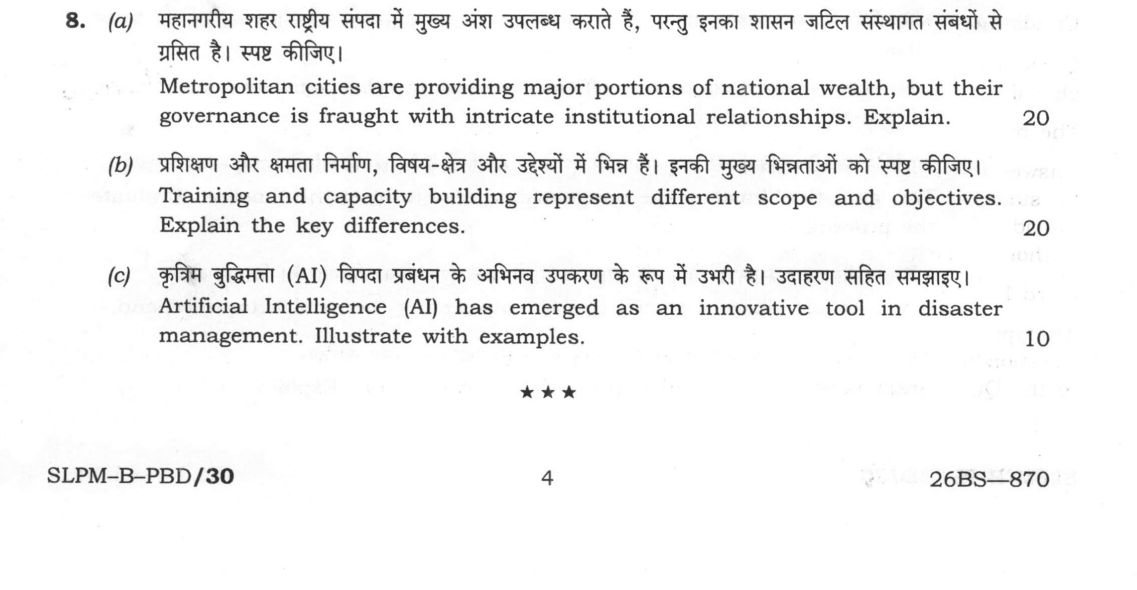
Metropolitan cities are providing major portions of national wealth, but their governance is fraught with intricate institutional relationships. Explain. 20 marks
Training and capacity building represent different scope and objectives. Explain the key differences. 20 marks
Artificial Intelligence (AI) has emerged as an innovative tool in disaster management. Illustrate with examples. 10 marks
हिंदी में प्रश्न पढ़ें
महानगरीय शहर राष्ट्रीय संपदा में मुख्य अंश उपलब्ध कराते हैं, परन्तु इनका शासन जटिल संस्थागत संबंधों से ग्रस्त है। स्पष्ट कीजिए। (20 अंक)
प्रशिक्षण और क्षमता निर्माण, विषय-क्षेत्र और उद्देश्यों में भिन्न हैं। इनकी मुख्य भिन्नताओं को स्पष्ट कीजिए। (20 अंक)
कृत्रिम बुद्धिमत्ता (AI) विपदा प्रबंधन के अभिनव उपकरण के रूप में उभरी है। उदाहरण सहित समझाइए। (10 अंक)
Model answer
Written by UPSC Answer Check against this question's marking rubric, to the expected length. UPSC does not publish answers for Mains — this is one way to score well, not an official key.
Metropolitan regions drive economic growth while confronting complex administrative matrices. Addressing these challenges necessitates disentangling governance networks, institutionalizing robust capacity development, and deploying emerging technologies like Artificial Intelligence.
Institutional Complexities in Metropolitan Governance
Metropolitan agglomerations such as Mumbai, Delhi, and Bengaluru generate roughly 60 percent of India's GDP, serving as primary engines of national wealth. However, their administrative efficiency is severely impeded by institutional fragmentation.
Vertically, the incomplete implementation of the 74th Constitutional Amendment Act leaves urban local bodies dependent on state governments, which routinely retain control over funds, functions, and functionaries. Horizontally, governance is fractured among a multiplicity of agencies: municipal corporations, state line departments, parastatals (such as water and transport boards), and single-purpose entities like Special Purpose Vehicles (SPVs) under the Smart Cities Mission and ward committees.
This multiplicity causes severe functional overlaps, particularly between urban local bodies mandated with municipal planning and state-controlled development authorities (such as DDA or BDA) exercising land-use regulation. The resulting institutional friction leads to diffused accountability, policy incoherence, and uncoordinated infrastructure execution, diminishing the economic and living potential of metropolitan regions.
Differentiating Training and Capacity Building
While frequently conflated in administrative discourse, training and capacity building differ fundamentally in scope, focus, and strategic objectives.
Training is an input-oriented, episodic, and skill-specific intervention focused on the individual functionary. Its primary objective is the acquisition of specific technical proficiencies and the improvement of immediate task performance, such as learning a new software tool or mastering a standard operating procedure.
Capacity building, as conceptualized in UNDP and OECD frameworks, is an outcome-oriented, continuous, and systemic process. Its scope extends far beyond individual competency to encompass organizational structures, institutional relationships, and the broader enabling legal and policy environment. The objective of capacity building is sustainable institutional reform, enhancing the collective capability of public systems to adapt to changing environments, manage policy transitions, and sustain long-term performance improvements. Training thus represents merely one component within the broader architecture of capacity building.
Artificial Intelligence in Disaster Management
Artificial Intelligence (AI) has emerged as a transformative tool across disaster preparedness, forecasting, response, and recovery phases.
In disaster mitigation and preparedness, machine learning models and predictive analytics process vast meteorological and geological datasets. Collaborations involving the India Meteorological Department (IMD) and the National Disaster Management Authority (NDMA) leverage predictive algorithms for precise cyclone track prediction and seismic hazard assessment. In high-risk states like Bihar and Assam, AI-powered river basin modeling and Google’s Flood Hub platform provide hyper-local, real-time flood inundation warnings.
During response and recovery, AI-enabled computer vision tools analyze high-resolution satellite and drone imagery to conduct rapid post-disaster damage assessments. In Delhi, AI algorithms process geospatial and structural data for building vulnerability mapping against seismic risks. Furthermore, AI-driven conversational chatbots facilitate automated emergency communication and public alerts, while algorithmic logistics optimization assists NDMA’s Aapda Mitra volunteers with real-time resource routing and targeted rescue operations.
To realize sustainable development, urban governance must reconcile fragmented metropolitan jurisdictions with empowered metropolitan planning committees, transition from ad-hoc training to systemic capacity building, and institutionalize predictive AI tools to build resilient, future-ready public administrative systems.
What "Explain" is asking you to do
Make the working of something clear — what sets it off, what follows from what, and what it produces. Explain is the Commission's mechanism word: it dominates the technical papers and the “explain why” stems, where the marks sit in the causal chain and not in the label.
Structure that answers it
State what it is → the initiating condition → the chain of cause, step by step → an instance where it plays out → what the chain produces
Where marks are lost
Describing what something looks like instead of why it works that way. Naming the stages without linking them reads as description too.
How this answer will be evaluated
Approach
Framework: Public Administration Paper II (Governance & HRM). (a) explain: definition/context > points in order > small example > short close | (b) compare: paired headings or table > key differences > significance > conclusion | (c) explain: definition/context > points in order > small example > short close Full marks: Comprehensive, well-structured, with specific Indian institutional references and clear distinctions.
Key points expected
- Define Metropolitan Region/Agglomeration
- Identify multi-layered institutional actors (State, District, ULBs)
- Explain jurisdictional overlaps and coordination failures
- Reference 74th Amendment or 14th Finance Commission
- Define Training (short-term, skill-specific)
- Define Capacity Building (long-term, systemic, organizational)
- Contrast objectives (performance vs. sustainability)
- Contrast scope (individual vs. institutional)
Evaluation rubric
Each sub-part is marked on its own, against the marks and word limit printed on the paper.
- (a) Explain the paradox of high economic contribution vs. complex governance in metropolitan cities. 20 marks
explain— definition/context → points in order → small example → short close
Must cover
- Define Metropolitan Region/Agglomeration
- Identify multi-layered institutional actors (State, District, ULBs)
- Explain jurisdictional overlaps and coordination failures
- Reference 74th Amendment or 14th Finance Commission
Loses marks
- Treating 'metropolitan' as just 'big city' without institutional analysis
- Ignoring the 'intricate relationships' aspect of the prompt
- GS-2 style policy advocacy without administrative analysis
Earns more
- Mention specific city examples (e.g., Delhi, Mumbai)
- Discuss the role of Special Purpose Vehicles (SPVs)
- Reference 2nd ARC recommendations on urban governance
- Mention the concept of 'Metropolitan Development Authority'
Extra mark
- Cite specific data on urban GDP contribution
- Reference the 15th Finance Commission's urban grants
- (b) Distinguish between Training and Capacity Building in scope and objectives. 20 marks
compare— paired headings or table → key differences → significance → conclusion
Must cover
- Define Training (short-term, skill-specific)
- Define Capacity Building (long-term, systemic, organizational)
- Contrast objectives (performance vs. sustainability)
- Contrast scope (individual vs. institutional)
Loses marks
- Treating the two terms as synonyms
- Focusing only on individual training without systemic capacity
- Lack of distinction between 'scope' and 'objectives'
Earns more
- Use a table or paired headings for comparison
- Mention 'Knowledge, Skills, Attitudes' (KSA) framework
- Reference Indian HRD initiatives (e.g., LBSNAA, NITI Aayog)
- Discuss the 'capacity' of the system vs. the 'competency' of the officer
Extra mark
- Reference the 2nd ARC's view on capacity building
- Mention specific schemes like 'Pradhan Mantri Yojana' training modules
- (c) Illustrate AI's role in disaster management with specific examples. 10 marks
explain— definition/context → points in order → small example → short close
Must cover
- Define AI in the context of disaster management
- Provide at least 2 distinct examples (e.g., prediction, response)
- Explain the specific function of AI in the example
- Mention the benefit (e.g., speed, accuracy)
Loses marks
- Vague statements about 'technology helping' without specific AI examples
- Ignoring the 'illustrate' command (no examples)
- Focusing only on hardware (drones) without the AI processing aspect
Earns more
- Mention specific tools (e.g., satellite imagery analysis, chatbots)
- Reference Indian context (e.g., IMD, NDMA, ISRO)
- Discuss 'Pre-disaster' vs 'Post-disaster' AI applications
- Mention 'Big Data' and 'Machine Learning' specifically
Extra mark
- Cite a specific recent disaster where AI was used (e.g., 2023 floods)
- Mention specific Indian AI initiatives for disaster management
Practice this exact question
Write your answer and it is marked point by point against the model answer above — what you covered, what you missed, what you got wrong.
Evaluate my answer →More from Public Administration 2025 Paper II
- Q5 Answer the following in about 150 words each: (a) Low cyber awareness among officials is…
- Q6 (a) Centralized Public Grievance Redress and Monitoring System (CPGRAMS) does not effecti…
- Q7 (a) Many elected women representatives in local governments in India, especially from mar…
- Q8 (a) Metropolitan cities are providing major portions of national wealth, but their govern…