Paper II — Q3
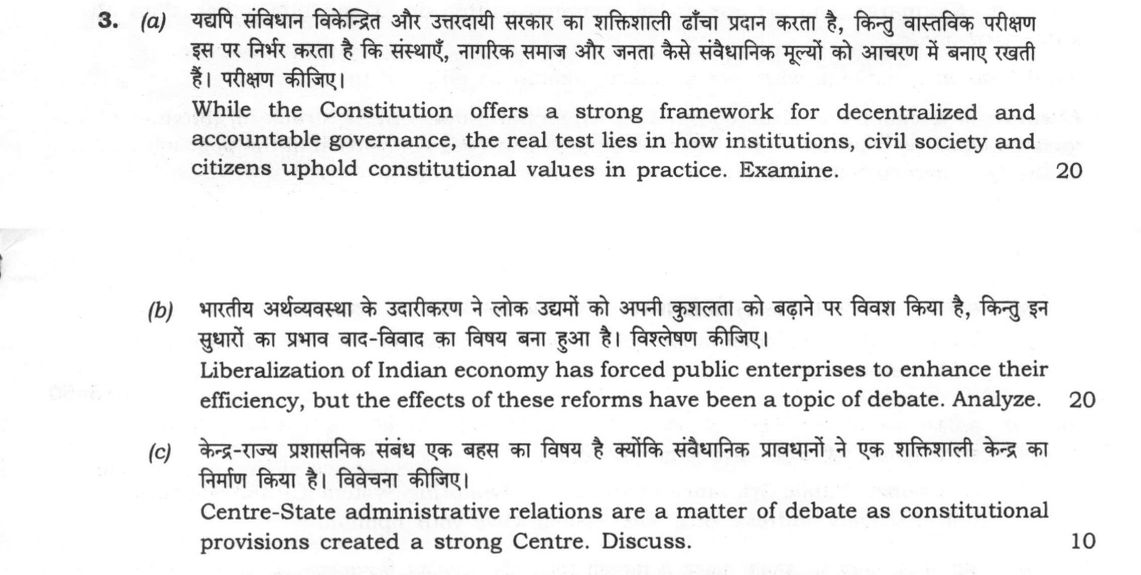
(a) While the Constitution offers a strong framework for decentralized and accountable governance, the real test lies in how…
While the Constitution offers a strong framework for decentralized and accountable governance, the real test lies in how institutions, civil society and citizens uphold constitutional values in practice. Examine. 20 marks
Liberalization of Indian economy has forced public enterprises to enhance their efficiency, but the effects of these reforms have been a topic of debate. Analyze. 20 marks
Centre-State administrative relations are a matter of debate as constitutional provisions created a strong Centre. Discuss. 10 marks
हिंदी में प्रश्न पढ़ें
यद्यपि संविधान विकेन्द्रीत और उत्तरदायी सरकार का शक्तिशाली ढाँचा प्रदान करता है, किन्तु वास्तविक परीक्षण इस पर निर्भर करता है कि संस्थाएँ, नागरिक समाज और जनता कैसे संवैधानिक मूल्यों को आचरण में बनाए रखती हैं। परीक्षण कीजिए। (20 अंक)
भारतीय अर्थव्यवस्था के उदारीकरण ने लोक उद्यमों को अपनी कुशलता को बढ़ाने पर विवश किया है, किन्तु इन सुधारों का प्रभाव बाद-विवाद का विषय बना हुआ है। विश्लेषण कीजिए। (20 अंक)
केन्द्र-राज्य प्रशासनिक संबंध एक बहस का विषय है क्योंकि संवैधानिक प्रावधानों ने एक शक्तिशाली केन्द्र का निर्माण किया है। विवेचना कीजिए। (10 अंक)
Model answer
Written by UPSC Answer Check against this question's marking rubric, to the expected length. UPSC does not publish answers for Mains — this is one way to score well, not an official key.
The Constitution’s decentralised architecture is strong on paper, but its real value is tested when institutions, civil society and citizens convert constitutional promises into daily governance.
Decentralisation and accountability Article 40 (village panchayats), the 73rd and 74th Amendments, and the Eleventh and Twelfth Schedules provide a strong framework for local self-government by reserving subjects, regular elections and finances. Yet the real test is implementation. The divergence between political and administrative decentralization means elected local bodies may have mandates but not resources or personnel. Political decentralization often outpaces administrative decentralization: states devolve revenue, functions and functionaries unevenly, and local bodies remain dependent on state departments. State Election Commissions are essential for free local elections, but their independence, staffing and enforcement vary. State Finance Commissions recommend devolution, yet actual transfers often fall short, weakening fiscal accountability. Accountability mechanisms—RTI, CAG, Lokpal and social audit—can expose waste, but their effectiveness depends on institutional courage, timely action and citizen use. Civil society, pressure groups and judicial activism matter because they translate constitutional values into demand for transparency, service delivery and corrective action. The finding is that the framework is necessary but not sufficient; without capable institutions and active citizens, decentralisation remains formal.
Liberalisation and public enterprises Liberalisation has forced PSEs to improve efficiency through disinvestment policy, Navratna/Maharatna status, autonomy packages and competitive neutrality. These measures exposed PSEs to market discipline, improved productivity, cost control and turnaround in some cases, as seen in BHEL, ONGC and the privatisation/turnaround of VSNL. However, effects are debated. The debate is not simply whether PSEs should exist, but how public ownership can be made efficient without surrendering strategic or social objectives. Efficiency gains may coexist with job losses, regional inequality and reduced public-interest obligations. Strategic versus non-strategic disinvestment has generated controversy: the State may retain control in strategic sectors while exiting others, creating perceptions of selective reform. A residual-control paradox persists: ministries may retain informal influence over policy, pricing and personnel even after autonomy packages, weakening market discipline. The Raghuram Rajan Committee’s 2008-09 concerns about governance and risk in public sector financial institutions show that efficiency can be undermined by weak oversight. The performance of privatized versus retained PSEs is mixed: privatization can improve efficiency but may raise questions of public accountability, while retained PSEs may suffer from bureaucratic control. The way forward is clear autonomy with transparent performance criteria, independent boards, and disinvestment guided by public interest rather than ideology.
Centre-State administrative relations The Constitution creates a strong Centre through Articles 256, 257 and 365, which require states to comply with Union law and executive action; Article 356, now restricted by the 44th Amendment, can suspend state government. All-India Services and integrated audit further strengthen Union administrative reach. This has generated debate. The debate is whether administrative centralisation is a necessary price of national unity or a threat to state autonomy. Sarkaria Commission recommended limiting Article 356, SR Bommai clarified procedural safeguards, and Punchhi Commission emphasised cooperative federalism and reducing administrative overreach. Contemporary tensions include GST implementation, where compensation and administration require coordination; NIA/CBI jurisdiction, which states see as encroachment; and PM-KISAN/DBT conditionalities, which may impose behavioural constraints. The Governor’s office also becomes a site of administrative coordination and, at times, conflict. The balance lies in cooperative federalism: strong Union coordination without administrative centralisation, and competitive federalism that allows states to experiment within constitutional limits.
In sum, constitutional design is strong, but practice is uneven. Decentralisation needs real devolution and citizen vigilance; PSE reform needs autonomy with accountability; and Centre-State relations need cooperative federalism. The ultimate test is not the text but institutional conduct.
What "Examine" is asking you to do
Test the proposition the question puts to you and return a finding on how far it holds. Examine stems carry a claim, or ask whether something has happened, and expect evidence weighed both ways before the extent is stated — often with remedial measures attached.
Structure that answers it
Restate the claim as the question frames it → evidence that supports it → evidence that undercuts it → the conditions under which it holds → verdict on how far it stands
Where marks are lost
Stopping at description. An examination has to reach a finding, and “examine with justification” means the extent must be stated, not implied.
How this answer will be evaluated
Approach
Framework: Concept > Thinker > Indian institutional application > Reform. (a) examine: intro > how/why with reasoning > evidence > conclusion | (b) analyse: intro > causes > effects > stakeholders/linkages > way forward | (c) discuss: intro > 3-4 dimensions > example > balanced close Full marks: Precise constitutional references, specific Indian examples, balanced analysis, 2nd ARC/recent reform integration
Key points expected
- Cite specific constitutional provisions for decentralization
- Analyze role of institutions in upholding values
- Discuss civil society's role in accountability
- Provide evidence of practical implementation gaps
- Identify causes of forced efficiency enhancement
- Analyze positive effects on enterprise efficiency
- Discuss negative effects and social costs
- Identify key stakeholders and their linkages
Evaluation rubric
Each sub-part is marked on its own, against the marks and word limit printed on the paper.
- (a) Examine the gap between constitutional framework and practical upholding of values. 20 marks
examine— intro → how/why with reasoning → evidence → conclusion
Must cover
- Cite specific constitutional provisions for decentralization
- Analyze role of institutions in upholding values
- Discuss civil society's role in accountability
- Provide evidence of practical implementation gaps
Loses marks
- Theory without Indian administrative anchor
- GS-2 style political analysis
- Vague generalities without specific evidence
Earns more
- Reference to 73rd/74th Amendment Acts
- Mention of RTI or CAG mechanisms
- Examples of citizen participation (e.g., Gram Sabha)
- Reference to 2nd ARC recommendations
Extra mark
- Specific recent governance reform example
- Reference to a specific Supreme Court judgment
- (b) Analyze causes, effects, and stakeholder impacts of liberalization on public enterprises. 20 marks
analyse— intro → causes → effects → stakeholders/linkages → way forward
Must cover
- Identify causes of forced efficiency enhancement
- Analyze positive effects on enterprise efficiency
- Discuss negative effects and social costs
- Identify key stakeholders and their linkages
Loses marks
- One-sided analysis without debate
- Theory without Indian administrative anchor
- Vague generalities without specific evidence
Earns more
- Reference to specific disinvestment cases
- Mention of specific public sector reforms
- Discussion of employment impacts
- Reference to specific efficiency metrics
Extra mark
- Specific 2nd ARC recommendation on PSUs
- Recent governance reform in public sector
- (c) Discuss constitutional provisions creating strong Centre and resulting debates. 10 marks
discuss— intro → 3-4 dimensions → example → balanced close
Must cover
- Identify constitutional provisions creating strong Centre
- Explain how these provisions create administrative tension
- Present arguments for strong Centre
- Present arguments for state autonomy
Loses marks
- One-sided discussion without balance
- Theory without Indian administrative anchor
- Vague generalities without specific evidence
Earns more
- Reference to specific Articles (e.g., 356, 246)
- Mention of specific Centre-State disputes
- Discussion of financial federalism
- Reference to Sarkaria Commission
Extra mark
- Specific 2nd ARC recommendation on federalism
- Recent Centre-State administrative reform
Practice this exact question
Write your answer and it is marked point by point against the model answer above — what you covered, what you missed, what you got wrong.
Evaluate my answer →More from Public Administration 2025 Paper II
- Q1 Answer the following in about 150 words each: (a) Arthashastra of Kautilya means the scie…
- Q2 (a) "The colonial legacy is responsible for many administrative problems in independent I…
- Q3 (a) While the Constitution offers a strong framework for decentralized and accountable go…
- Q4 (a) Experience of various States suggests that reorganization of districts was prompted m…
- Q5 Answer the following in about 150 words each: (a) Low cyber awareness among officials is…
- Q6 (a) Centralized Public Grievance Redress and Monitoring System (CPGRAMS) does not effecti…