Paper II — Q7
(a) Many elected women representatives in local governments in India, especially from marginalized backgrounds, often struggle to…
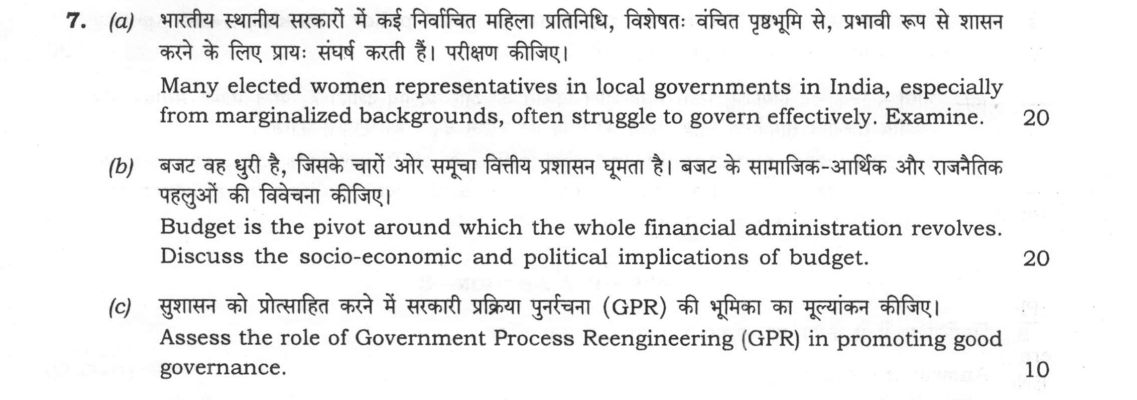
Many elected women representatives in local governments in India, especially from marginalized backgrounds, often struggle to govern effectively. Examine. 20 marks
Budget is the pivot around which the whole financial administration revolves. Discuss the socio-economic and political implications of budget. 20 marks
Assess the role of Government Process Reengineering (GPR) in promoting good governance. 10 marks
हिंदी में प्रश्न पढ़ें
भारतीय स्थानीय सरकारों में कई निर्वाचित महिला प्रतिनिधि, विशेषतः वंचित पृष्ठभूमि से, प्रभावी रूप से शासन करने के लिए प्रायः संघर्ष करती हैं। परीक्षण कीजिए। (20 अंक)
बजट वह धुरी है, जिसके चारों ओर समूचा वित्तीय प्रशासन घूमता है। बजट के सामाजिक-आर्थिक और राजनीतिक पहलुओं की विवेचना कीजिए। (20 अंक)
सुशासन को प्रोत्साहित करने में सरकारी प्रक्रिया पुनर्निर्माण (GPR) की भूमिका का मूल्यांकन कीजिए। (10 अंक)
Model answer
Written by UPSC Answer Check against this question's marking rubric, to the expected length. UPSC does not publish answers for Mains — this is one way to score well, not an official key.
Democratic decentralisation, institutionalised through the 73rd and 74th Constitutional Amendments, sought to transform local governance by mandating political inclusion. However, the operational effectiveness of local self-government institutions, the political economy of public finance, and the administrative machinery's responsiveness continue to determine the substantive quality of Indian democracy.
Governance Challenges Faced by Elected Women Representatives
While constitutional reservations enabled over 1.4 million Elected Women Representatives (EWRs) to enter Panchayati Raj Institutions (PRIs) and Urban Local Bodies (ULBs), substantive governance remains constrained.
Structural barriers deeply impede effective leadership. Deep-rooted patriarchal norms manifest in the phenomenon of Sarpanch Pati or Pradhan Pati, where male relatives wield de facto executive authority. Intersectional vulnerabilities severely exacerbate this for women from Scheduled Caste (SC) and Scheduled Tribe (ST) backgrounds, who encounter caste-based violence, untouchability, and non-cooperation from dominant-caste ward members and local elites. Furthermore, lower literacy levels, limited exposure to public spaces, and domestic burdens restrict their administrative mobility and financial independence.
Institutional deficits further entrench this exclusion. Capacity-building initiatives through State Institutes of Rural Development (SIRDs) are often episodic, ritualistic, and lack customized modules for neo-literate marginalized women. The pervasive structural weakness of PRIs itself—characterized by delayed devolution of the 3Fs (Funds, Functions, Functionaries)—undermines their executive capacity. Inadequate secretariat assistance, coupled with bureaucratic condescension from Gram Sevaks and Block Development Officers, often leaves EWRs dependent on intermediaries. Overcoming this necessitates continuous leadership training, punitive measures against proxy governance, and functional autonomy to translate descriptive representation into substantive empowerment.
Socio-Economic and Political Implications of the Budget
As Aaron Wildavsky observed, the budget is not a mere accounting statement but the central mechanism through which political conflict is mediated and national priorities are operationalized.
Politically, the budget serves as an instrument of statecraft and agenda-setting. It reflects prevailing power relations, determining how scarce public resources are distributed across competing interest groups, sectors, and regions. Through redistributive mechanisms like progressive taxation, subsidies, and affirmative fiscal transfers, the budget operationalizes constitutional goals of distributive justice under Article 39. Economically, fiscal policy steers macroeconomic stability, capital formation, and poverty alleviation, while instruments like Gender Budgeting and SC/ST Sub-Plans target targeted socio-economic disparities.
The budgetary cycle embeds these socio-political dynamics at every stage. During formulation, the executive exercises agenda-setting power, balancing electoral mandates with fiscal consolidation under the FRBM Act. Enactment in Parliament (Articles 112–116) affirms democratic control over the purse through legislative debate, cut motions, and committee scrutiny. Execution tests administrative capacity in expenditure management and preventing the 'March rush', while accountability mechanisms—led by the Comptroller and Auditor General (CAG) under Article 148 and the Public Accounts Committee (PAC)—ensure compliance, financial rectitude, and executive answerability to citizens.
Government Process Reengineering for Good Governance
Government Process Reengineering (GPR) entails the fundamental rethinking and radical redesign of administrative workflows. Unlike mere computerization—which automates inefficient legacy procedures—GPR reconfigures government processes around citizen-centricity, simplification, time-cost reduction, and end-to-end integration of Information and Communication Technology (ICT).
GPR enhances the core tenets of good governance: transparency, efficiency, and accountability. Initiatives like UMANG integrate disparate departmental interfaces into a unified digital delivery platform, eliminating bureaucratic red tape. The SVAMITVA scheme combines drone technology with land registry reengineering to secure rural property rights, reducing litigation. Similarly, MCA21 in corporate compliance and Direct Benefit Transfer (DBT) through the Jan Dhan-Aadhaar-Mobile (JAM) trinity have curtailed rent-seeking and leakages.
Achieving administrative efficacy in India requires harmonizing these three dimensions: deepening the substantive empowerment of marginalized grassroots leaders, preserving the redistributive integrity of public budgeting, and institutionalizing citizen-centric process reengineering across all tiers of governance.
What "Examine" is asking you to do
Test the proposition the question puts to you and return a finding on how far it holds. Examine stems carry a claim, or ask whether something has happened, and expect evidence weighed both ways before the extent is stated — often with remedial measures attached.
Structure that answers it
Restate the claim as the question frames it → evidence that supports it → evidence that undercuts it → the conditions under which it holds → verdict on how far it stands
Where marks are lost
Stopping at description. An examination has to reach a finding, and “examine with justification” means the extent must be stated, not implied.
How this answer will be evaluated
Approach
Framework: Concept > Thinker > Indian institutional application > Reform. (a) examine: intro > how/why with reasoning > evidence > conclusion | (b) discuss: intro > 3-4 dimensions > example > balanced close | (c) evaluate: criteria > evidence > balanced judgment Full marks: Deep analysis with specific Indian examples, clear distinction between theory and practice, and strong use of command words.
Key points expected
- Link struggles to the 'proxy' phenomenon (husband/relative rule)
- Identify lack of administrative support and capacity building
- Discuss social stigma and patriarchal resistance in local bodies
- Reference 73rd/74th Amendment reservation context
- Define budget as a policy statement (not just financial document)
- Analyze socio-economic implications (redistribution, growth, welfare)
- Analyze political implications (coalition politics, public accountability)
- Mention the role of the Finance Commission in fiscal federalism
Evaluation rubric
Each sub-part is marked on its own, against the marks and word limit printed on the paper.
- (a) Analyze the structural and social barriers hindering effective governance by marginalized women representatives. 20 marks
examine— intro → how/why with reasoning → evidence → conclusion
Must cover
- Link struggles to the 'proxy' phenomenon (husband/relative rule)
- Identify lack of administrative support and capacity building
- Discuss social stigma and patriarchal resistance in local bodies
- Reference 73rd/74th Amendment reservation context
Loses marks
- Generic discussion of women's empowerment without local govt focus
- Ignoring the 'marginalized background' aspect of the prompt
- GS-2 style policy suggestions without administrative analysis
Earns more
- Mention specific state-level initiatives (e.g., Kerala, Rajasthan)
- Discuss the role of Gram Sabha in accountability
- Reference the 2nd ARC on local governance
- Mention the 2023 Women's Reservation Bill context
Extra mark
- Cite specific data on women's participation in Gram Sabhas
- Reference the 'One Nation One Election' impact on local bodies
- (b) Elaborate on the budget's role as a tool for socio-economic redistribution and political consensus. 20 marks
discuss— intro → 3-4 dimensions → example → balanced close
Must cover
- Define budget as a policy statement (not just financial document)
- Analyze socio-economic implications (redistribution, growth, welfare)
- Analyze political implications (coalition politics, public accountability)
- Mention the role of the Finance Commission in fiscal federalism
Loses marks
- Treating budget as a mere accounting exercise
- Ignoring the political dimension of budget-making
- Lack of distinction between revenue and capital expenditure
Earns more
- Reference the 14th Finance Commission recommendations
- Discuss the shift from 'development' to 'welfare' budgets
- Mention the role of the CAG in budget audit
- Reference the 'Zero-based budgeting' concept
Extra mark
- Cite specific recent budget allocations for specific sectors
- Reference the 'Fiscal Responsibility and Budget Management Act'
- (c) Evaluate how GPR improves efficiency, transparency, and citizen-centricity in government processes. 10 marks
evaluate— criteria → evidence → balanced judgment
Must cover
- Define GPR (rethinking and redesigning processes)
- Link GPR to 'Good Governance' (transparency, accountability)
- Mention specific GPR initiatives (e.g., e-governance, single window)
- Assess the impact on citizen satisfaction and time/cost reduction
Loses marks
- Confusing GPR with general IT adoption
- Ignoring the 'human' aspect of process reengineering
- Lack of specific examples of GPR in Indian administration
Earns more
- Reference the 'National e-Governance Plan' (NeGP)
- Mention the 'Digital India' mission as a GPR tool
- Discuss the role of the 'Administrative Reforms Commission'
- Reference the '21st Century Public Administration' report
Extra mark
- Cite specific success stories of GPR (e.g., DigiLocker, UMANG)
- Reference the '2nd ARC' recommendations on process reengineering
Practice this exact question
Write your answer and it is marked point by point against the model answer above — what you covered, what you missed, what you got wrong.
Evaluate my answer →More from Public Administration 2025 Paper II
- Q4 (a) Experience of various States suggests that reorganization of districts was prompted m…
- Q5 Answer the following in about 150 words each: (a) Low cyber awareness among officials is…
- Q6 (a) Centralized Public Grievance Redress and Monitoring System (CPGRAMS) does not effecti…
- Q7 (a) Many elected women representatives in local governments in India, especially from mar…
- Q8 (a) Metropolitan cities are providing major portions of national wealth, but their govern…