Paper II — Q5
Answer the following in about 150 words each: (a) Low cyber awareness among officials is causing cyber security issues in the…
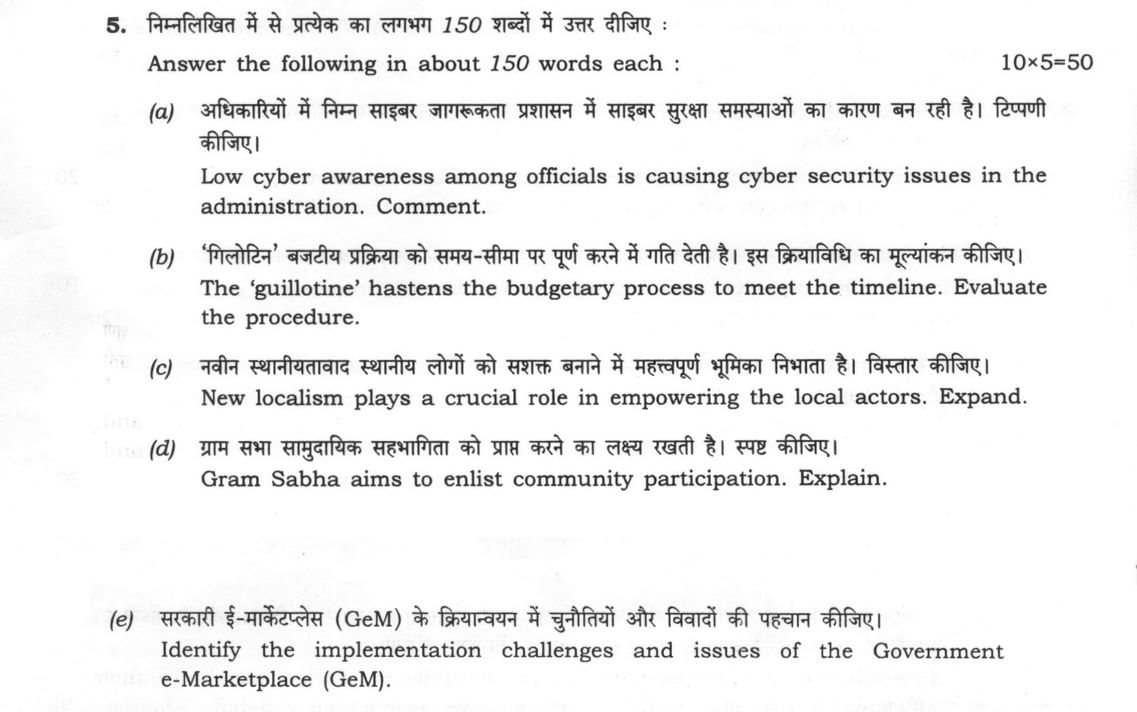
Answer the following in about 150 words each:
Low cyber awareness among officials is causing cyber security issues in the administration. Comment. 10 marks
The 'guillotine' hastens the budgetary process to meet the timeline. Evaluate the procedure. 10 marks
New localism plays a crucial role in empowering the local actors. Expand. 10 marks
Gram Sabha aims to enlist community participation. Explain. 10 marks
Identify the implementation challenges and issues of the Government e-Marketplace (GeM). 10 marks
हिंदी में प्रश्न पढ़ें
निम्नलिखित में से प्रत्येक का लगभग 150 शब्दों में उत्तर दीजिए :
अधिकारियों में निम्न साइबर जागरूकता प्रशासन में साइबर सुरक्षा समस्याओं का कारण बन रही है। टिप्पणी कीजिए। (10 अंक)
'गिलोटिन' बजटीय प्रक्रिया को समय-सीमा पर पूर्ण करने में गति देती है। इस क्रियाविधि का मूल्यांकन कीजिए। (10 अंक)
नवीन स्थानीयतावाद स्थानीय लोगों को सशक्त बनाने में महत्वपूर्ण भूमिका निभाता है। विस्तार कीजिए। (10 अंक)
ग्राम सभा सामुदायिक सहभागिता को प्राप्त करने का लक्ष्य रखती है। स्पष्ट कीजिए। (10 अंक)
सरकारी ई-मार्केटप्लेस (GeM) के क्रियान्वयन में चुनौतियों और विवादों की पहचान कीजिए। (10 अंक)
Model answer
Written by UPSC Answer Check against this question's marking rubric, to the 150-word length. UPSC does not publish answers for Mains — this is one way to score well, not an official key.
(a) Low cyber awareness among officials is causing cyber security issues in the administration
Human error remains the softest underbelly of administrative cybersecurity. As reports from the Indian Computer Emergency Response Team (CERT-In) and the National Critical Information Infrastructure Protection Centre (NCIIPC) consistently highlight, the vast majority of security breaches in government networks stem from basic human vulnerabilities rather than sophisticated technological breaches. Officials routinely fall victim to social engineering attacks such as spear-phishing, credential harvesting, the use of weak passwords, and the unauthorized handling of external storage media, which serve as entry points for ransomware attacks that can paralyze critical administrative databases. The administrative apparatus often suffers from a siloed culture where cybersecurity is relegated purely to IT departments rather than treated as a continuous operational protocol. To mitigate these risks, capacity-building frameworks such as the Cyber Surakshit Bharat initiative and Chief Information Security Officer (CISO) deep-dive training programmes are imperative to transform institutional cyber hygiene into a standard administrative discipline.
(b) The 'guillotine' hastens the budgetary process to meet the timeline: Evaluation
The 'guillotine' is a parliamentary closure device operationalized under Lok Sabha Rule 209, read with Article 113 of the Constitution, whereby the Speaker puts all outstanding Demands for Grants to vote without further discussion once the allocated time for budgetary debate expires. Evaluated against the standard of administrative efficiency, the guillotine ensures that the Appropriation Bill is passed within the constitutional timeline before the start of the financial year, preventing government business from stalling. However, evaluated against the democratic standard of executive accountability, the procedure severely diminishes legislative scrutiny. A substantial portion of the budget—often exceeding 80 percent of total expenditure—is routinely guillotined without detailed debate, turning Parliamentary approval into a procedural formality. Thus, while the guillotine succeeds as a mechanism of procedural expediency, it compromises the core principle of financial accountability, requiring mandatory and robust pre-guillotine scrutiny by Departmentally Related Standing Committees.
(c) New localism and empowering local actors
New localism, rooted in Anthony Giddens' Third Way and Blairite administrative reforms, represents a paradigm shift from traditional localism. While old localism was characterized by rigid bureaucratic decentralisation and top-down municipal delegation, new localism emphasizes network governance, subsidiarity, and the co-production of public services between local state organs, civil society, and citizen groups. In India, the 73rd and 74th Constitutional Amendment Acts institutionalized this approach by moving beyond viewing local bodies merely as implementation arms of higher tiers of government. Instead, new localism empowers local actors by leveraging contextual knowledge, social capital, and multi-stakeholder partnerships to design and manage public services. By prioritizing direct community agency and collaborative governance over bureaucratic command and control, new localism transforms local actors from passive recipients into active co-creators of local development.
(d) Gram Sabha and community participation
Under Article 243A of the Constitution, the Gram Sabha serves as the foundational institution of direct participatory democracy in India. It is structurally distinct from the Gram Panchayat: while the Gram Panchayat is an elected, representative executive body, the Gram Sabha is a deliberative assembly consisting of all registered adult voters in a village. The Gram Sabha ensures direct community participation by institutionalizing social audits, beneficiary selection, and collective oversight over local development works. Its participatory mandate is further strengthened in tribal areas through the Panchayats (Extension to Scheduled Areas) Act, 1996 (PESA) and the Forest Rights Act, 2006 (FRA), where the Gram Sabha holds mandatory powers over prior informed consent for land acquisition and the management of minor forest produce. The transformative potential of the Gram Sabha is best demonstrated by Kerala’s People’s Plan Campaign, which institutionalized bottom-up, community-driven planning across local governance.
(e) Implementation challenges and issues of the Government e-Marketplace (GeM)
The Government e-Marketplace (GeM) was established to bring transparency, efficiency, and scale to public procurement, but its execution faces several operational and structural challenges. First, small enterprises face MSME exclusion due to technical compliance burdens and high turnover criteria, compounded by a persistent digital divide among rural and semi-urban suppliers. Second, the platform experiences market distortions such as bid rigging and vendor cartelisation through algorithmic manipulation and proxy bidding syndicates. Third, post-delivery quality verification gaps remain prevalent, as procuring departments often lack decentralized testing infrastructure to inspect delivered goods against technical specifications. Finally, backend integration bottlenecks with the Public Financial Management System (PFMS) and the Goods and Services Tax Network (GSTN) cause reconciliation delays and protracted payment cycles for vendors. Addressing these bottlenecks requires algorithmic anti-fraud mechanisms, vendor onboarding support, and end-to-end integration across financial platforms.
What "Evaluate" is asking you to do
Judge how well something has performed against the standard it set for itself — its stated aim, mandate or promise — and commit to a verdict. Name the yardstick before you judge; an unanchored judgement reads as opinion.
Structure that answers it
Name the yardstick — stated aim, mandate or benchmark → performance against it → shortfall against it → why the gap exists → verdict
Where marks are lost
Presenting both sides and then declining to decide, or delivering a verdict against a standard you never stated, which makes it look arbitrary.
How this answer will be evaluated
Approach
Framework: Concept > Thinker > Indian institutional application > Reform. (a) comment: context > arguments both sides > judgment > close | (b) evaluate: criteria > evidence > balanced judgment | (c) explain: definition/context > points in order > small example > short close | (d) explain: definition/context > points in order > small example > short close | (e) challenges: 3-4 challenges > solutions mapped to them > conclusion Full marks: Precise Indian institutional anchors, clear distinction between theory and field reality, and specific 2nd ARC/reform references.
Key points expected
- Context of rising cyber threats in administration
- Arguments on why low awareness causes issues
- Arguments on institutional/systemic failures
- Judgment on administrative liability
- Criteria for evaluating the procedure
- Evidence of how it hastens the process
- Balanced judgment on its necessity
- Conclusion on its effectiveness
Evaluation rubric
Each sub-part is marked on its own, against the marks and word limit printed on the paper.
- (a) Context of cyber threats, arguments on official negligence, and a judgment on administrative liability. · 150 words
comment— context → arguments both sides → judgment → close
Must cover
- Context of rising cyber threats in administration
- Arguments on why low awareness causes issues
- Arguments on institutional/systemic failures
- Judgment on administrative liability
Loses marks
- GS-2 style policy answers without admin focus
- Theory with no Indian administrative anchor
Earns more
- Mention of CERT-In or IT Act 2000
- Reference to specific cyber incidents
- Distinction between technical and human error
Extra mark
- 2nd ARC recommendation on IT security
- Recent governance reform in digital security
- (b) Criteria for evaluation, evidence of the procedure's impact, and a balanced judgment on its necessity. · 150 words
evaluate— criteria → evidence → balanced judgment
Must cover
- Criteria for evaluating the procedure
- Evidence of how it hastens the process
- Balanced judgment on its necessity
- Conclusion on its effectiveness
Loses marks
- GS-2 style policy answers without admin focus
- Theory with no Indian administrative anchor
Earns more
- Mention of Article 112 or 113
- Reference to specific budgetary delays
- Distinction between procedural and substantive delay
Extra mark
- 2nd ARC recommendation on budgetary process
- Recent governance reform in budgeting
- (c) Definition of new localism, points on how it empowers local actors, and a small example. · 150 words
explain— definition/context → points in order → small example → short close
Must cover
- Definition/context of new localism
- Points in order on empowerment mechanisms
- Small example of local actor empowerment
- Short close on its significance
Loses marks
- GS-2 style policy answers without admin focus
- Theory with no Indian administrative anchor
Earns more
- Mention of 73rd/74th Amendment
- Reference to Panchayati Raj or Municipalities
- Distinction between traditional and new localism
Extra mark
- 2nd ARC recommendation on local governance
- Recent governance reform in decentralization
- (d) Definition of Gram Sabha, points on community participation mechanisms, and a small example. · 150 words
explain— definition/context → points in order → small example → short close
Must cover
- Definition/context of Gram Sabha
- Points in order on participation mechanisms
- Small example of community participation
- Short close on its role
Loses marks
- GS-2 style policy answers without admin focus
- Theory with no Indian administrative anchor
Earns more
- Mention of Article 243B
- Reference to specific Gram Sabha functions
- Distinction between Gram Sabha and Panchayat
Extra mark
- 2nd ARC recommendation on Gram Sabha
- Recent governance reform in rural participation
- (e) 3-4 implementation challenges of GeM, solutions mapped to them, and a conclusion. · 150 words
challenges— 3-4 challenges → solutions mapped to them → conclusion
Must cover
- 3-4 specific implementation challenges
- Solutions mapped to each challenge
- Conclusion on GeM's future
- Identification of key stakeholders
Loses marks
- GS-2 style policy answers without admin focus
- Theory with no Indian administrative anchor
Earns more
- Mention of specific GeM features
- Reference to procurement delays
- Distinction between technical and administrative issues
Extra mark
- 2nd ARC recommendation on e-procurement
- Recent governance reform in digital procurement
Practice this exact question
Write your answer and it is marked point by point against the model answer above — what you covered, what you missed, what you got wrong.
Evaluate my answer →More from Public Administration 2025 Paper II
- Q2 (a) "The colonial legacy is responsible for many administrative problems in independent I…
- Q3 (a) While the Constitution offers a strong framework for decentralized and accountable go…
- Q4 (a) Experience of various States suggests that reorganization of districts was prompted m…
- Q5 Answer the following in about 150 words each: (a) Low cyber awareness among officials is…
- Q6 (a) Centralized Public Grievance Redress and Monitoring System (CPGRAMS) does not effecti…
- Q7 (a) Many elected women representatives in local governments in India, especially from mar…
- Q8 (a) Metropolitan cities are providing major portions of national wealth, but their govern…