Paper II — Q4
(a) Experience of various States suggests that reorganization of districts was prompted more by politico-populist convenience…
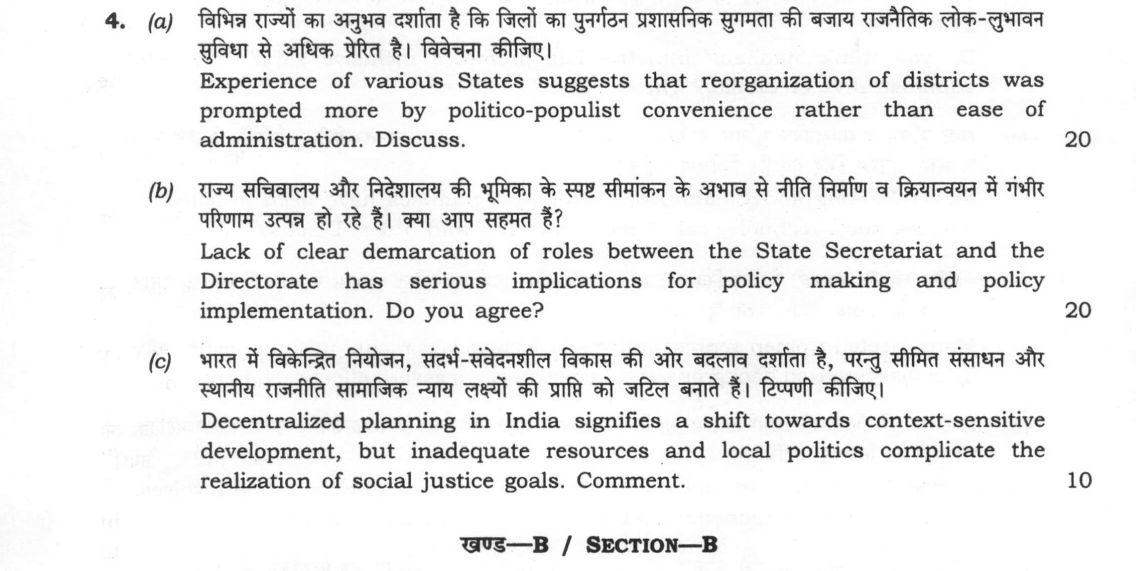
Experience of various States suggests that reorganization of districts was prompted more by politico-populist convenience rather than ease of administration. Discuss. 20 marks
Lack of clear demarcation of roles between the State Secretariat and the Directorate has serious implications for policy making and policy implementation. Do you agree? 20 marks
Decentralized planning in India signifies a shift towards context-sensitive development, but inadequate resources and local politics complicate the realization of social justice goals. Comment. 10 marks
हिंदी में प्रश्न पढ़ें
विभिन्न राज्यों का अनुभव दर्शाता है कि जिलों का पुनर्गठन प्रशासनिक सुगमता की बजाय राजनीतिक लोक-लुभावन सुविधा से अधिक प्रेरित है। विवेचना कीजिए। (20 अंक)
राज्य सचिवालय और निदेशालय की भूमिका के स्पष्ट सीमांकन के अभाव से नीति निर्माण व क्रियान्वयन में गंभीर परिणाम उत्पन्न हो रहे हैं। क्या आप सहमत हैं? (20 अंक)
भारत में विकेन्द्रित नियोजन, संदर्भ-संवेदनशील विकास की ओर बदलाव दर्शाता है, परन्तु सीमित संसाधन और स्थानीय राजनीति सामाजिक न्याय लक्ष्यों की प्राप्ति को जटिल बनाते हैं। टिप्पणी कीजिए। (10 अंक)
Model answer
Written by UPSC Answer Check against this question's marking rubric, to the expected length. UPSC does not publish answers for Mains — this is one way to score well, not an official key.
The architecture of state administration in India frequently reflects a structural tension between technical-administrative rationality and democratic-political imperatives.
District Reorganization: Administrative Need vs Political Expediency
The creation of new districts is justified administratively on grounds of enhancing citizen accessibility, optimizing the span of control, improving public service delivery, and managing disasters effectively. Telangana’s 2016 reorganization (creating 21 new districts), alongside bifurcations in Uttar Pradesh and West Bengal, sought to bridge the spatial distance between citizens and district collectorates. However, empirical patterns demonstrate that politico-populist drivers frequently predominate. New administrative units are often declared prior to elections as instruments of patronage distribution, coalition management, and vote-bank consolidation.
Both the Sarkaria Commission and the Punchhi Commission recommended institutionalized criteria for district creation—grounded in population size, geographical terrain, communication infrastructure, and administrative viability. Yet, the absence of a statutory regulatory framework permits ruling coalitions to bypass these benchmarks, resulting in fiscally unviable units plagued by acute infrastructural deficits and human resource shortages.
Secretariat-Directorate Interface and Governance Deficits
Administrative theory posits a functional dichotomy between the Secretariat (a staff agency responsible for policy formulation and assisting ministers) and the Directorate (a line agency responsible for technical execution and field operations). When this boundary blurs, Fred Riggs’ prismatic model—specifically structural formalism and functional overlapping—manifests within state headquarters.
The lack of demarcation triggers the 'secretariatization' of directorates, wherein generalist secretariat officials micromanage operational details, while technical heads are marginalized from policy design. This institutional overlap induces buck-passing, administrative paralysis, and implementation gaps. While reforms such as Gujarat’s single-window mechanisms attempt functional convergence and Kerala’s decentralized model delineates operational autonomy, many state directorates remain subordinated to clerical secretariat oversight, weakening executive capability.
Decentralized Planning and Social Justice
The 73rd and 74th Constitutional Amendments institutionalized decentralized planning via District Planning Committees (Article 243ZD), seeking to replace the top-down legacy of centralized Five-Year Plans with context-sensitive development. Nevertheless, realizing social justice goals remains constrained by fiscal and political bottlenecks.
Structurally, Local Self-Governments suffer from severe fiscal dependency—manifested in an overwhelming proportion of tied grants, chronic delays by State governments in implementing State Finance Commission awards, and negligible own-source revenue mobilization. Politically, planning processes are undermined by elite capture, entrenched caste hierarchies, and partisan interference in beneficiary selection, preventing equitable resource distribution to marginalized groups.
Way Forward
Reconciling the politics-administration dichotomy across these domains requires harmonizing democratic responsiveness with institutional rationality. As recommended by the Second Administrative Reforms Commission (2nd ARC), states should institute independent boundary commissions for district reorganization, clearly codify the delegation of powers between Secretariats and Directorates, and operationalize District Planning Committees. Aligning with the 14th Finance Commission’s emphasis on untied fiscal devolution, alongside participatory mechanisms like Kerala’s People’s Plan Campaign and Tamil Nadu’s participatory budgeting initiatives, will ensure administrative structures remain viable, functionally distinct, and capable of delivering social justice.
What "Discuss" is asking you to do
Lay the issue out from more than one side — how it arose, what is claimed for it, what is held against it, and where it now stands. UPSC attaches discuss to broad topics with several live dimensions, so coverage of the dimensions earns more than the strength of your opinion.
Structure that answers it
Set the issue up → the case as it is made → the case against → the dimension both sides leave out → where the balance now lies
Where marks are lost
Listing facts with no thread between them, or arguing one side throughout and calling it a discussion.
How this answer will be evaluated
Approach
Framework: Public Administration Paper II (Indian Administrative Context). (a) discuss: intro > 3-4 dimensions > example > balanced close | (b) examine: intro > how/why with reasoning > evidence > conclusion | (c) comment: context > arguments both sides > judgment > close Full marks: Precise Indian administrative examples, clear distinction between theory and field reality, specific committee/Article references.
Key points expected
- Define administrative criteria for district creation (area/population)
- Identify politico-populist drivers (regional identity, representation)
- Cite specific Indian state examples (e.g., UP, Bihar, Jharkhand)
- Conclude on the impact on administrative ease
- Define roles of State Secretariat (policy) vs Directorate (execution)
- Explain the 'lack of clear demarcation' (overlap/conflict)
- Link role ambiguity to policy implementation failures
- Provide a specific Indian administrative example
Evaluation rubric
Each sub-part is marked on its own, against the marks and word limit printed on the paper.
- (a) Analyze the tension between administrative efficiency and political populism in district reorganization. 20 marks
discuss— intro → 3-4 dimensions → example → balanced close
Must cover
- Define administrative criteria for district creation (area/population)
- Identify politico-populist drivers (regional identity, representation)
- Cite specific Indian state examples (e.g., UP, Bihar, Jharkhand)
- Conclude on the impact on administrative ease
Loses marks
- Generic discussion without Indian state examples
- Ignoring the 'ease of administration' aspect
- GS-2 style focus on political parties only
Earns more
- Reference to 2nd ARC recommendations on district administration
- Mention of specific state reorganization acts
- Discussion of 'ease of administration' vs 'political convenience'
Extra mark
- Reference to specific district creation dates/acts
- Mention of 'District Administration' reforms
- (b) Evaluate the impact of role ambiguity between Secretariat and Directorates on policy outcomes. 20 marks
examine— intro → how/why with reasoning → evidence → conclusion
Must cover
- Define roles of State Secretariat (policy) vs Directorate (execution)
- Explain the 'lack of clear demarcation' (overlap/conflict)
- Link role ambiguity to policy implementation failures
- Provide a specific Indian administrative example
Loses marks
- Confusing Secretariat with Cabinet/Ministry
- Ignoring the 'policy implementation' impact
- No specific Indian administrative instance
Earns more
- Reference to 2nd ARC on 'Secretariat-Directorate' interface
- Mention of 'policy formulation' vs 'policy implementation' gap
- Discussion of 'bureaucratic autonomy' vs 'political control'
Extra mark
- Reference to specific state administrative reforms
- Mention of 'Directorate' specific examples (e.g., Health, Education)
- (c) Assess the promise and limitations of decentralized planning for social justice. 10 marks
comment— context → arguments both sides → judgment → close
Must cover
- Define 'context-sensitive development' in decentralized planning
- Identify 'inadequate resources' as a constraint
- Identify 'local politics' as a constraint
- Conclude on the realization of social justice goals
Loses marks
- Ignoring the 'social justice' goal
- No mention of 'inadequate resources' or 'local politics'
- Generic discussion of decentralization without Indian context
Earns more
- Reference to 73rd/74th Constitutional Amendments
- Mention of 'Gram Sabha' or 'Panchayati Raj' institutions
- Discussion of 'social justice' vs 'local elite capture'
Extra mark
- Reference to specific decentralized planning schemes (e.g., MGNREGA)
- Mention of 'local politics' specific examples
Practice this exact question
Write your answer and it is marked point by point against the model answer above — what you covered, what you missed, what you got wrong.
Evaluate my answer →More from Public Administration 2025 Paper II
- Q1 Answer the following in about 150 words each: (a) Arthashastra of Kautilya means the scie…
- Q2 (a) "The colonial legacy is responsible for many administrative problems in independent I…
- Q3 (a) While the Constitution offers a strong framework for decentralized and accountable go…
- Q4 (a) Experience of various States suggests that reorganization of districts was prompted m…
- Q5 Answer the following in about 150 words each: (a) Low cyber awareness among officials is…
- Q6 (a) Centralized Public Grievance Redress and Monitoring System (CPGRAMS) does not effecti…
- Q7 (a) Many elected women representatives in local governments in India, especially from mar…