Paper II — Q2
(a) "The colonial legacy is responsible for many administrative problems in independent India as the role of company agents and…
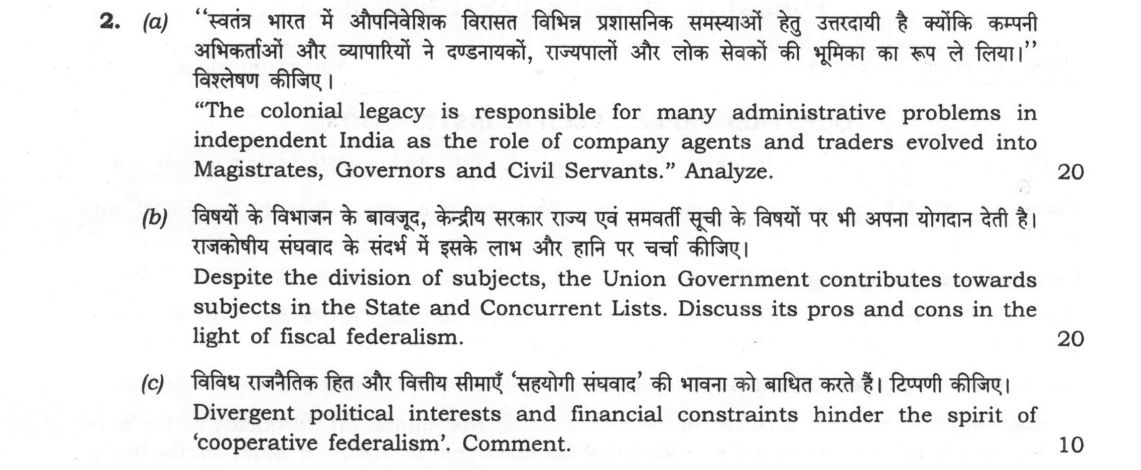
"The colonial legacy is responsible for many administrative problems in independent India as the role of company agents and traders evolved into Magistrates, Governors and Civil Servants." Analyze. 20 marks
Despite the division of subjects, the Union Government contributes towards subjects in the State and Concurrent Lists. Discuss its pros and cons in the light of fiscal federalism. 20 marks
Divergent political interests and financial constraints hinder the spirit of 'cooperative federalism'. Comment. 10 marks
हिंदी में प्रश्न पढ़ें
"स्वतंत्र भारत में औपनिवेशिक विरासत विभिन्न प्रशासनिक समस्याओं हेतु उत्तरदायी है क्योंकि कम्पनी अभिकर्ताओं और व्यापारियों ने दण्डनायकों, राज्यपालों और लोक सेवकों की भूमिका का रूप ले लिया।" विश्लेषण कीजिए। (20 अंक)
विषयों के विभाजन के बावजूद, केन्द्रीय सरकार राज्य एवं समवर्ती सूची के विषयों पर भी अपना योगदान देती है। राजकोषीय संघवाद के संदर्भ में इसके लाभ और हानि पर चर्चा कीजिए। (20 अंक)
विविध राजनीतिक हित और वित्तीय सीमाएँ 'सहयोगी संघवाद' की भावना को बाधित करते हैं। टिप्पणी कीजिए। (10 अंक)
Model answer
Written by UPSC Answer Check against this question's marking rubric, to the expected length. UPSC does not publish answers for Mains — this is one way to score well, not an official key.
Colonial legacy The colonial legacy is not a historical footnote; it shaped the administrative grammar of independent India. Company factors and traders, working through zamindars and revenue intermediaries, built a state whose first task was revenue extraction, control and law-and-order. As company agents and traders evolved into Magistrates, Governors and Civil Servants, the ICS succeeded the Company’s administrative cadres and later became the IAS, carrying forward an elitist, hierarchical and status-quoist culture. The district collector, police hierarchy and secretariat system retained the colonial logic of vertical command, alienation from the masses and distrust of local self-government. C. Rajagopalachari’s critique of a bureaucracy strong in execution but weak in policy imagination, and Paul Appleby’s observation that Indian administration was structurally weak in formulation and excessively strong in execution, capture this continuity. The result is a system that can implement directives efficiently but often struggles with participatory planning, local accountability and developmental innovation. This colonial habit of ruling through files, not forums, made administration a closed system, where policy was formulated at the top and filtered down through district and secretariat channels.
Union fiscal reach Fiscal federalism in India is not merely a division of subjects; it is also a division of resources. The Union contributes to State and Concurrent List subjects through constitutional and institutional channels. Articles 275 and 282 permit grants to states and for public purposes; Article 293 regulates state borrowing and recognises residual Union liability; Article 360 provides for financial emergency, not disaster management, by enabling the Centre to direct states to observe financial propriety. Disaster response is governed mainly by the Disaster Management Act, 2005, and Article 355’s duty to secure conditions of governance. The Finance Commission, Centrally Sponsored Schemes and disaster relief funds operationalise this reach. The Commission’s recommendations anchor the divisible pool and grants, while CSS often carry matching grants and central guidelines. The pros are real: equalisation among states, pursuit of national priorities, and crisis management when states lack capacity. PMGSY and Swachh Bharat Mission show how Union funding can accelerate infrastructure and sanitation. But the cons are equally serious. Vertical imbalance gives the Centre leverage; conditionalities can distort state priorities; and the proliferation of CSS may reduce state autonomy by making them implementers of centrally designed programmes.
Cooperative federalism The spirit of cooperative federalism is hindered by divergent political interests and financial constraints. When opposition parties rule states, coordination can become competitive, with states resisting Union schemes or negotiating for greater resources. Competitive federalism may strengthen bargaining but can undermine shared national goals. When political cycles differ, states may use policy delays or selective implementation to protect their interests, weakening the cooperative ethos. Financial constraints deepen the problem: delays in GST compensation, shrinking state share of the divisible pool, and FRBM pressures limit states’ ability to invest in health, education and rural development. Institutions meant to promote cooperation—Inter-State Council, NITI Aayog and GST Council—have mixed effectiveness. The Inter-State Council remains underused; NITI Aayog has improved policy dialogue but lacks binding authority; the GST Council works well on tax rates but faces disputes over compensation and state finances. Strengthening cooperative federalism requires implementing Sarkaria Commission recommendations on inter-state coordination, adopting Punchhi Commission’s fiscal federalism reforms, giving states a clearer voice in CSS design, and ensuring timely, transparent transfers.
In conclusion, colonial centralisation still strains India’s federal architecture. The way forward is not to reject Union support but to make it more cooperative: constitutionally anchored fiscal transfers, reduced conditionalities, stronger local self-government, and institutions that convert political competition into negotiated development. A more cooperative federalism would therefore treat state governments as partners, not merely implementing agencies.
What "Analyse" is asking you to do
Break the subject into its working parts and show how they act on each other. The marks are in the interconnections — which factor drives which, and what the resulting structure explains — not in the inventory of factors.
Structure that answers it
Define the whole → separate it into its parts → show which part drives which → what that interaction produces → what the structure implies
Where marks are lost
A flat list of causes with no account of which drives which. An answer of neatly separated headings, each self-contained, scores as description.
How this answer will be evaluated
Approach
Framework: UPSC Public Administration Paper II (Federalism & Administration). (a) analyse: intro > causes > effects > stakeholders/linkages > way forward | (b) discuss: intro > 3-4 dimensions > example > balanced close | (c) comment: context > arguments both sides > judgment > close Full marks: Precise, well-structured, with specific Indian examples and references to committees/reports.
Key points expected
- Identify specific colonial roles (e.g., Company agents, Magistrates).
- Link these roles to modern counterparts (IAS, Civil Servants).
- Analyze the 'legacy' as a cause of administrative problems.
- Provide specific examples of these problems (e.g., elitism, distance from people).
- Define 'fiscal federalism' in the Indian context.
- Explain the mechanism of Union contribution (Grants-in-aid, Centrally Sponsored Schemes).
- Discuss the 'pros' (e.g., equity, national standards).
- Discuss the 'cons' (e.g., conditionalities, erosion of state autonomy).
Evaluation rubric
Each sub-part is marked on its own, against the marks and word limit printed on the paper.
- (a) Trace the evolution of colonial administrative roles into modern Indian bureaucracy and its resulting problems. 20 marks
analyse— intro → causes → effects → stakeholders/linkages → way forward
Must cover
- Identify specific colonial roles (e.g., Company agents, Magistrates).
- Link these roles to modern counterparts (IAS, Civil Servants).
- Analyze the 'legacy' as a cause of administrative problems.
- Provide specific examples of these problems (e.g., elitism, distance from people).
Loses marks
- Generalizing without specific colonial examples.
- Failing to link the 'evolution' to current 'problems'.
- Ignoring the 'administrative' aspect and focusing only on political history.
Earns more
- Mention the 'Steel Frame' concept.
- Reference the 2nd ARC on bureaucracy.
- Discuss the 'colonial mindset' or 'custodial state' approach.
- Mention the transition from 'ruling' to 'serving' administration.
Extra mark
- Reference specific 2nd ARC recommendations on bureaucracy.
- Mention the 'One Nation, One Election' debate in context of federalism.
- (b) Evaluate the Union Government's financial contribution to State/Concurrent List subjects under fiscal federalism. 20 marks
discuss— intro → 3-4 dimensions → example → balanced close
Must cover
- Define 'fiscal federalism' in the Indian context.
- Explain the mechanism of Union contribution (Grants-in-aid, Centrally Sponsored Schemes).
- Discuss the 'pros' (e.g., equity, national standards).
- Discuss the 'cons' (e.g., conditionalities, erosion of state autonomy).
Loses marks
- Confusing 'fiscal federalism' with 'political federalism'.
- Failing to distinguish between State and Concurrent List contributions.
- Ignoring the 'pros and cons' balance.
Earns more
- Mention the Finance Commission's role.
- Reference specific schemes (e.g., PMAY, MGNREGA).
- Discuss the 'coercive federalism' argument.
- Mention the 14th/15th Finance Commission recommendations.
Extra mark
- Reference the 'Swarnajayanti' grants.
- Mention the 'National Monetisation Pipeline' as a new fiscal tool.
- (c) Assess how political and financial factors hinder 'cooperative federalism'. 10 marks
comment— context → arguments both sides → judgment → close
Must cover
- Define 'cooperative federalism'.
- Explain 'divergent political interests' (e.g., Centre-Party vs State-Party).
- Explain 'financial constraints' (e.g., fiscal deficit, debt).
- Provide a judgment on the current state of cooperation.
Loses marks
- Failing to distinguish between 'political' and 'financial' constraints.
- Ignoring the 'spirit' of cooperation and focusing only on legal structures.
- Being too general without specific Indian examples.
Earns more
- Mention the 'Inter-State Council'.
- Reference specific examples of political friction (e.g., GST Council).
- Discuss the 'fiscal federalism' vs 'cooperative federalism' tension.
- Mention the 'National Development Council' (NDC).
Extra mark
- Reference the 'One Nation, One Election' proposal.
- Mention the 'G20' presidency as a platform for federal cooperation.
Practice this exact question
Write your answer and it is marked point by point against the model answer above — what you covered, what you missed, what you got wrong.
Evaluate my answer →More from Public Administration 2025 Paper II
- Q1 Answer the following in about 150 words each: (a) Arthashastra of Kautilya means the scie…
- Q2 (a) "The colonial legacy is responsible for many administrative problems in independent I…
- Q3 (a) While the Constitution offers a strong framework for decentralized and accountable go…
- Q4 (a) Experience of various States suggests that reorganization of districts was prompted m…
- Q5 Answer the following in about 150 words each: (a) Low cyber awareness among officials is…