Paper II — Q6
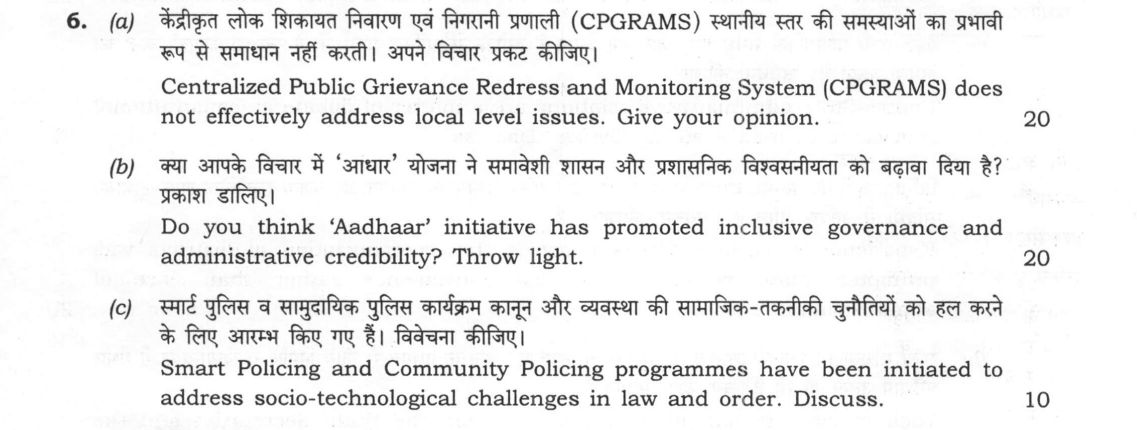
(a) Centralized Public Grievance Redress and Monitoring System (CPGRAMS) does not effectively address local level issues. Give…
Centralized Public Grievance Redress and Monitoring System (CPGRAMS) does not effectively address local level issues. Give your opinion. 20 marks
Do you think 'Aadhaar' initiative has promoted inclusive governance and administrative credibility? Throw light. 20 marks
Smart Policing and Community Policing programmes have been initiated to address socio-technological challenges in law and order. Discuss. 10 marks
हिंदी में प्रश्न पढ़ें
केन्द्रीकृत लोक शिकायत निवारण एवं निगरानी प्रणाली (CPGRAMS) स्थानीय स्तर की समस्याओं का प्रभावी रूप से समाधान नहीं करती। अपने विचार प्रकट कीजिए। (20 अंक)
क्या आपके विचार में 'आधार' योजना ने समावेशी शासन और प्रशासनिक विश्वसनीयता को बढ़ावा दिया है? प्रकाश डालिए। (20 अंक)
स्मार्ट पुलिस व सामुदायिक पुलिस कार्यक्रम कानून और व्यवस्था की सामाजिक-तकनीकी चुनौतियों को हल करने के लिए आरम्भ किए गए हैं। विवेचना कीजिए। (10 अंक)
Model answer
Written by UPSC Answer Check against this question's marking rubric, to the expected length. UPSC does not publish answers for Mains — this is one way to score well, not an official key.
CPGRAMS and Local-Level Grievance Redressal
The Centralized Public Grievance Redress and Monitoring System (CPGRAMS), administered by DARPG, serves as a pan-India platform to uphold administrative accountability. However, its efficacy at the grassroots level exhibits structural and operational limitations. Structurally, CPGRAMS was designed predominantly for Union ministries and departments. Local self-governance issues under Panchayati Raj Institutions and Urban Local Bodies often fall under State jurisdiction (Seventh Schedule), creating jurisdictional mismatches when routed through a top-down federal portal. Last-mile digital connectivity gaps, linguistic barriers, and complex portal interfaces often exclude rural citizens, rendering the system distant from immediate civic realities. Consequently, localized state-level grievance architectures—such as Uttar Pradesh’s Jansunwai, Madhya Pradesh’s CM Helpline 181, and Rajasthan’s Sampark portal—have proven more responsive to day-to-day municipal, revenue, and block-level concerns.
Conversely, CPGRAMS has evolved to bridge these grassroots divides. As part of the broader Digital India architecture, the integration of Sevottam framework principles has standardized quality benchmarks and citizen service charters. Recent iterations feature automated routing to district-level officers, integration with Common Service Centres (CSCs), and multilingual interfaces. Furthermore, centralized, data-driven dashboards facilitate real-time monitoring of redressal timelines, systemic root-cause analyses, and periodic administrative reforms, ensuring higher bureaucratic responsiveness across governance tiers.
Aadhaar, Inclusive Governance, and Administrative Credibility
The Aadhaar initiative has fundamentally altered India's welfare delivery paradigm by fostering inclusive governance. Leveraged through the Jan Dhan-Aadhaar-Mobile (JAM) trinity, it has underpinned Direct Benefit Transfer (DBT) across central and state welfare programmes. In social safety nets like the Public Distribution System (PDS) and MGNREGA, Aadhaar-enabled payments and biometric verification have significantly curbed leakages, eliminated intermediary rent-seeking, and empowered unbanked and migrant beneficiaries through seamless wage and entitlement transfers.
From an administrative credibility perspective, Aadhaar introduced verifiable identity through biometric de-duplication, systematically eliminating millions of duplicate and ghost beneficiaries from fiscal rolls. However, this credibility is tempered by critical operational and constitutional challenges. Biometric mismatch, network downtime, and seeding errors have led to exclusion errors among vulnerable sections, including manual labourers and elderly citizens. Furthermore, concerns regarding mass surveillance and digital privacy prompted the landmark Supreme Court ruling in Justice K.S. Puttaswamy (Retd.) v. Union of India (2018), which balanced administrative efficiency and national security against the fundamental right to privacy under Article 21, mandating strict proportionality and data protection safeguards.
Smart Policing and Community Policing
Modern law and order administration faces dual challenges: sophisticated cyber-enabled crime and socio-demographic friction. To tackle these, the 'SMART' policing framework (Strict and Sensitive, Modern and Mobile, Alert and Accountable, Reliable and Responsive, Trained and Techno-savvy) utilizes technological platforms like the Crime and Criminal Tracking Network & Systems (CCTNS) and the Inter-operable Criminal Justice System (ICJS), along with dedicated cybercrime units and predictive policing analytics.
Simultaneously, community policing models like Kerala’s Maithri, Tamil Nadu’s Friends of Police, and Rajasthan’s Jan Sampark address grassroots societal vulnerabilities. By building institutional partnerships between citizens and local police stations, these initiatives mitigate trust deficits, foster communal harmony, and facilitate ground-level intelligence collection. Integrating smart technology with community engagement establishes a socio-technological synergy, enabling law enforcement to manage hybrid cyber-physical threats while maintaining a humane, citizen-centric posture.
Way Forward
Building an accountable, inclusive, and secure administrative ecosystem requires deeper institutional convergence. CPGRAMS must achieve end-to-end integration with state and local grievance portals; Aadhaar-based welfare mechanisms must integrate non-exclusionary exception-handling protocols alongside robust data privacy norms; and law enforcement agencies must continuously blend digital forensics with empathetic community policing to sustain public trust.
What "Discuss" is asking you to do
Lay the issue out from more than one side — how it arose, what is claimed for it, what is held against it, and where it now stands. UPSC attaches discuss to broad topics with several live dimensions, so coverage of the dimensions earns more than the strength of your opinion.
Structure that answers it
Set the issue up → the case as it is made → the case against → the dimension both sides leave out → where the balance now lies
Where marks are lost
Listing facts with no thread between them, or arguing one side throughout and calling it a discussion.
How this answer will be evaluated
Approach
Framework: Public Administration Paper II (Governance & Administration). (a) comment: context > arguments both sides > judgment > close | (b) critically evaluate: positives > negatives/limits > conditions/safeguards > conclusion | (c) discuss: intro > 3-4 dimensions > example > balanced close Full marks: Precise administrative analysis with Indian institutional anchors and balanced judgment
Key points expected
- Define CPGRAMS and its centralized architecture
- Arguments: Centralization vs local context mismatch
- Arguments: Digital divide and access barriers
- Balanced judgment on its utility
- Definition of Inclusive Governance & Administrative Credibility
- Positives: Direct Benefit Transfer (DBT), identity proof
- Negatives: Digital exclusion, privacy concerns
- Safeguards: UIDAI Act, Supreme Court judgments
Evaluation rubric
Each sub-part is marked on its own, against the marks and word limit printed on the paper.
- (a) Context of CPGRAMS > Arguments for/against effectiveness at local level > Judgment > Close 20 marks
comment— context → arguments both sides → judgment → close
Must cover
- Define CPGRAMS and its centralized architecture
- Arguments: Centralization vs local context mismatch
- Arguments: Digital divide and access barriers
- Balanced judgment on its utility
Loses marks
- GS-2 style policy analysis without administrative focus
- Ignoring the 'local level' constraint
Earns more
- Mention of specific local issues (e.g., land, water)
- Reference to grievance redressal committees
- Comparison with local grievance mechanisms
Extra mark
- 2nd ARC recommendations on grievance redressal
- Specific data on CPGRAMS resolution rates
- (b) Positives (Inclusion/Credibility) > Negatives/Limits (Privacy/Exclusion) > Safeguards > Conclusion 20 marks
critically evaluate— positives → negatives/limits → conditions/safeguards → conclusion
Must cover
- Definition of Inclusive Governance & Administrative Credibility
- Positives: Direct Benefit Transfer (DBT), identity proof
- Negatives: Digital exclusion, privacy concerns
- Safeguards: UIDAI Act, Supreme Court judgments
Loses marks
- Theory with no Indian administrative anchor
- Ignoring the 'credibility' aspect of administration
Earns more
- Mention of 'JAM Trinity' (Jan Dhan, Aadhaar, Mobile)
- Reference to specific exclusion cases (e.g., elderly)
- Discussion on data security architecture
Extra mark
- Puttaswamy judgment on Right to Privacy
- Specific statistics on DBT savings
- (c) Intro > 3-4 dimensions (Smart/Community) > Example > Balanced close 10 marks
discuss— intro → 3-4 dimensions → example → balanced close
Must cover
- Define Smart Policing (Tech) vs Community Policing (Social)
- Link to socio-technological challenges
- Example of a specific program (e.g., e-Prakruti)
- Balanced conclusion on law and order
Loses marks
- Confusing Smart and Community policing concepts
- Ignoring the 'socio-technological' link
Earns more
- Mention of CCTV, AI, or data analytics
- Reference to citizen participation mechanisms
- Discussion on trust-building with police
Extra mark
- Specific state-level policing reforms
- Reference to National Police Commission
Practice this exact question
Write your answer and it is marked point by point against the model answer above — what you covered, what you missed, what you got wrong.
Evaluate my answer →More from Public Administration 2025 Paper II
- Q3 (a) While the Constitution offers a strong framework for decentralized and accountable go…
- Q4 (a) Experience of various States suggests that reorganization of districts was prompted m…
- Q5 Answer the following in about 150 words each: (a) Low cyber awareness among officials is…
- Q6 (a) Centralized Public Grievance Redress and Monitoring System (CPGRAMS) does not effecti…
- Q7 (a) Many elected women representatives in local governments in India, especially from mar…
- Q8 (a) Metropolitan cities are providing major portions of national wealth, but their govern…