Paper I — Q1
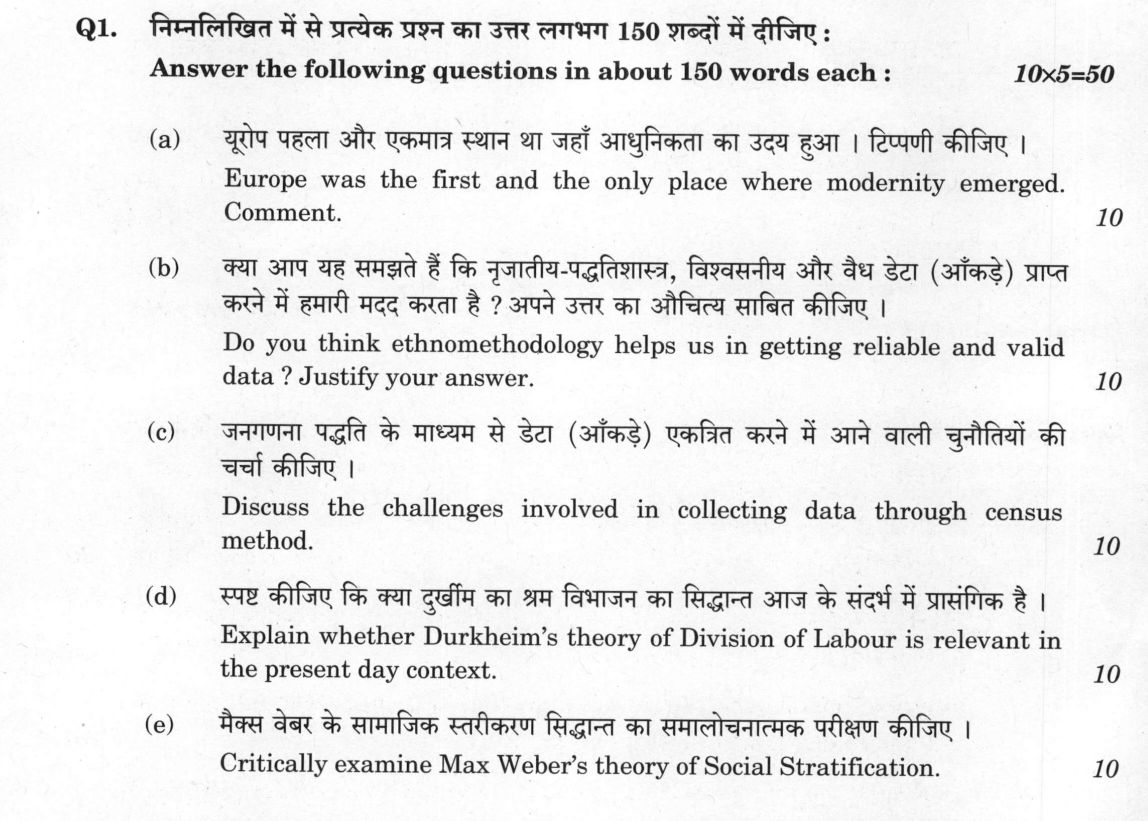
Answer the following questions in about 150 words each : 10×5=50 (a) Europe was the first and the only place where modernity…
Answer the following questions in about 150 words each : 10×5=50
Europe was the first and the only place where modernity emerged. Comment. 10 marks
Do you think ethnomethodology helps us in getting reliable and valid data ? Justify your answer. 10 marks
Discuss the challenges involved in collecting data through census method. 10 marks
Explain whether Durkheim's theory of Division of Labour is relevant in the present day context. 10 marks
Critically examine Max Weber's theory of Social Stratification. 10 marks
हिंदी में प्रश्न पढ़ें
निम्नलिखित में से प्रत्येक प्रश्न का उत्तर लगभग 150 शब्दों में दीजिए : 10×5=50
यूरोप पहला और एकमात्र स्थान था जहाँ आधुनिकता का उदय हुआ । टिप्पणी कीजिए । 10
क्या आप यह समझते हैं कि नुजातीय-पद्धतिशास्त्र, विश्वसनीय और वैध डेटा (आँकड़े) प्राप्त करने में हमारी मदद करता है ? अपने उत्तर का औचित्य साबित कीजिए । 10
जनगणना पद्धति के माध्यम से डेटा (आँकड़े) एकत्रित करने में आने वाली चुनौतियों की चर्चा कीजिए । 10
स्पष्ट कीजिए क्या दुर्खीम का श्रम विभाजन का सिद्धांत आज के संदर्भ में प्रासंगिक है । 10
मैक्स वेबर के सामाजिक स्तरीकरण सिद्धांत का समालोचनात्मक परीक्षण कीजिए । 10
Model answer
Written by UPSC Answer Check against this question's marking rubric, to the 150-word length. UPSC does not publish answers for Mains — this is one way to score well, not an official key.
(a) The assertion that Europe was the sole crucible of modernity reflects a Eurocentric bias in classical sociology. While Europe experienced the first institutionalised transition to modernity via the Enlightenment, the French Revolution, and the Industrial Revolution, S.N. Eisenstadt’s concept of "Multiple Modernities" demonstrates that modernity does not follow a singular Western blueprint. Non-Western civilisations possessed indigenous trajectories of rationality, commerce, and complex urban planning—such as the Bronze Age urbanism of Mehrgarh and the Indus Valley Civilisation—centuries prior to European industrialisation. Furthermore, historical sociologists demonstrate that European modernity was structurally interdependent with colonialism, which actively dismantled, subordinate, and suppressed alternative non-Western developmental pathways. Therefore, while Europe was historically the first site of institutionalised Western modernity, it was neither the only place where modern principles emerged nor the sole template for modern societal organization.
(b) Ethnomethodology, pioneered by Harold Garfinkel, focuses on the commonsense methods and practical reasoning through which social actors construct social order. By treating social reality as an ongoing practical accomplishment through "indexicality" (meaning contingent on context) and "reflexivity" (the mutual constitution of accounts and social settings), it achieves high ecological validity. It captures authentic, unmediated actor perspectives through member validation and breaching experiments, unveiling deeply embedded background expectancies. However, from a positivist standpoint, ethnomethodology faces significant reliability challenges. Its micro-sociological, interpretative design relies heavily on the subjective orientation of the researcher, making standardisation, quantitative measurement, and cross-contextual replicability virtually impossible. Thus, while ethnomethodology cannot provide positivist, replicable data, it justifies its utility by generating exceptionally valid qualitative insights into the micro-foundations of social reality.
(c) Collecting demographic data through the census method involves major conceptual, operational, and structural challenges. A primary methodological challenge is definitional fluidity: categories like caste, tribe, ethnicity, and informal or unpaid female household labour lack static definitions, causing significant classification errors during enumeration. Operationally, structural underenumeration routinely excludes floating migrant populations, pavement dwellers, and remote tribal communities. Furthermore, census operations face severe political contestation; demographic outcomes directly impact legislative representation through the Delimitation Commission and influence affirmative action quotas, incentivising strategic misreporting by identity groups. In the contemporary context, the proposed transition to a digital census introduces new barriers, wherein the digital divide and inadequate enumerator training risk systemic data distortions. A robust census requires transparent classification protocols and rigorous ground-level verification to safeguard data integrity.
(d) Émile Durkheim’s The Division of Labour in Society remains highly relevant for analysing contemporary socio-economic transformations. Durkheim posited that modern societies develop organic solidarity rooted in functional interdependence and structural differentiation. In today's globalised economy, hyper-specialised supply chains, platform work, and the gig economy (such as app-based logistics and service aggregators) illustrate this structural interdependence. However, contemporary neoliberal deregulation has exacerbated Durkheim’s "abnormal forms" of the division of labour. The anomic division of labour is manifested in precarious platform work where rapid technological disruption outpaces legal and moral regulation. In India, Durkheim's framework is crucial for understanding changing occupational stratification, revealing how modern economic roles coexist with traditional caste-based labour hierarchies, showing that organic solidarity remains contested by persistent mechanical solidarities.
(e) Max Weber formulated a multidimensional, pluralistic alternative to mono-causal models by conceptualising social stratification along three distinct axes: Class (economic order and market situation), Status (social order, prestige, and lifestyle), and Party (political order and power). This tridimensional formulation effectively explains complex empirical realities, such as the Indian caste-class-party nexus, where dominant agrarian castes utilize political parties to compensate for market disadvantages, and marginalized groups achieve status through political mobilization. However, Marxist scholars critically argue that Weber’s model obscures fundamental structural exploitation, viewing status groups as an ideological distraction from core class antagonisms and economic reductionism. Conversely, Functionalists argue that Weber overemphasises structural conflict at the expense of social cohesion. Ultimately, Weber's theory remains indispensable for avoiding economic determinism and deciphering the autonomous, intersecting dimensions of modern social inequality.
What "Comment" is asking you to do
Take a position on the statement and support it. Comment usually attaches to a quoted line in the short slots, so the reasoning must be compressed — an opening view, a few load-bearing reasons, and the limit of the claim.
Structure that answers it
Unpack what the statement asserts → your stance → two or three supporting reasons → the qualification that limits it
Where marks are lost
Neutral summary; a comment without a stance has not answered. Equally costly is accepting the quoted line wholesale and never testing where it fails.
How this answer will be evaluated
Approach
Framework: Sociology Paper 1 (UPSC). (a) comment: context > arguments both sides > judgment > close | (b) justify: claim > 3-4 reasons > evidence > conclusion | (c) challenges: 3-4 challenges > solutions mapped to them > conclusion | (d) explain: definition/context > points in order > small example > short close | (e) critique: the claim > its strengths > its weaknesses > your judgment Full marks: Precise definitions, clear distinction between thinkers, and specific contemporary examples.
Key points expected
- Define modernity (rationalization, secularization, individualism)
- Arguments supporting Europe as the origin (Enlightenment, Industrial Revolution)
- Arguments against 'only place' (non-Western modernities, Japan, China)
- Final judgment on the Eurocentric nature of the claim
- Define ethnomethodology (Harold Garfinkel)
- Focus on 'indexicality' and 'reflexivity' of social action
- Argument for validity: understanding 'taken-for-granted' knowledge
- Argument for reliability: exposing the 'bracketing' of researcher bias
Evaluation rubric
Each sub-part is marked on its own, against the marks and word limit printed on the paper.
- (a) Contextualize European modernity and provide a balanced judgment on its uniqueness. 10 marks · 150 words
comment— context → arguments both sides → judgment → close
Must cover
- Define modernity (rationalization, secularization, individualism)
- Arguments supporting Europe as the origin (Enlightenment, Industrial Revolution)
- Arguments against 'only place' (non-Western modernities, Japan, China)
- Final judgment on the Eurocentric nature of the claim
Loses marks
- Treating modernity as a purely economic phenomenon
- Ignoring the 'non-West' in the counter-argument
Earns more
- Reference to Max Weber's Protestant Ethic
- Mention of 'multiple modernities' (Shmuel Eisenstadt)
- Contrast with Asian or African developmental paths
Extra mark
- Specific reference to the 'Great Divergence' (Pomeranz)
- (b) Justify the role of ethnomethodology in ensuring data reliability and validity. 10 marks · 150 words
justify— claim → 3-4 reasons → evidence → conclusion
Must cover
- Define ethnomethodology (Harold Garfinkel)
- Focus on 'indexicality' and 'reflexivity' of social action
- Argument for validity: understanding 'taken-for-granted' knowledge
- Argument for reliability: exposing the 'bracketing' of researcher bias
Loses marks
- Confusing ethnomethodology with general ethnography
- Failing to link the theory to 'data quality' (validity/reliability)
Earns more
- Mention of 'breaching experiments'
- Contrast with positivist 'objective' data collection
- Reference to 'member's method' vs 'researcher's method'
Extra mark
- Specific example of a Garfinkel experiment (e.g., home visitor)
- (c) Discuss the specific challenges of data collection via the census method. 10 marks · 150 words
challenges— 3-4 challenges → solutions mapped to them → conclusion
Must cover
- Define the census method (complete enumeration)
- Challenge 1: High cost and resource intensity
- Challenge 2: Time lag (data becomes outdated)
- Challenge 3: Non-response or undercounting (nomadic populations)
Loses marks
- Confusing census with sample surveys (NSSO)
- Listing only technical errors without logistical challenges
Earns more
- Mention of 'coverage error' vs 'content error'
- Reference to the 2011 Census of India (or similar)
- Mention of the 'demographic dividend' reliance on census data
Extra mark
- Reference to the delay in the 2021 Census of India
- (d) Explain the relevance of Durkheim's Division of Labour in the present context. 10 marks · 150 words
explain— definition/context → points in order → small example → short close
Must cover
- Define 'Mechanical' vs 'Organic' solidarity
- Link division of labour to 'organic solidarity' (interdependence)
- Present day context: Globalization and complex supply chains
- Relevance: How specialization creates social cohesion today
Loses marks
- Failing to distinguish between mechanical and organic solidarity
- Treating the theory as purely historical without modern application
Earns more
- Mention of 'anomie' in modern labor markets
- Reference to the 'gig economy' as a new form of division
- Contrast with Marx's view of alienation
Extra mark
- Specific reference to the 'knowledge economy' or 'digital labor'
- (e) Critically examine Max Weber's theory of Social Stratification. 10 marks · 150 words
critique— the claim → its strengths → its weaknesses → your judgment
Must cover
- Define the 'Three-Dimensional' scheme (Class, Status, Party)
- Explain 'Class' (market situation) vs 'Status' (lifestyle)
- Explain 'Party' (power/political association)
- Critique: Interplay of dimensions vs Marx's economic determinism
Loses marks
- Confusing Weber's 'class' with Marx's 'class' (ownership of means)
- Ignoring the 'Party' (power) dimension of the triad
Earns more
- Mention of 'life chances' (Lebenschancen)
- Reference to 'status groups' (Stände)
- Comparison with Parsons' functionalist stratification
Extra mark
- Reference to 'cultural capital' (Bourdieu) as a modern extension
Practice this exact question
Write your answer and it is marked point by point against the model answer above — what you covered, what you missed, what you got wrong.
Evaluate my answer →More from Sociology 2021 Paper I
- Q1 Answer the following questions in about 150 words each : 10×5=50 (a) Europe was the first…
- Q2 (a) From the viewpoint of growing importance of multidisciplarity, how do you relate soci…
- Q3 (a) How do qualitative and quantitative methods supplement each other in sociological enq…
- Q4 (a) Explain the concept of social mobility. Describe with suitable illustrations how educ…