Paper I — Q4
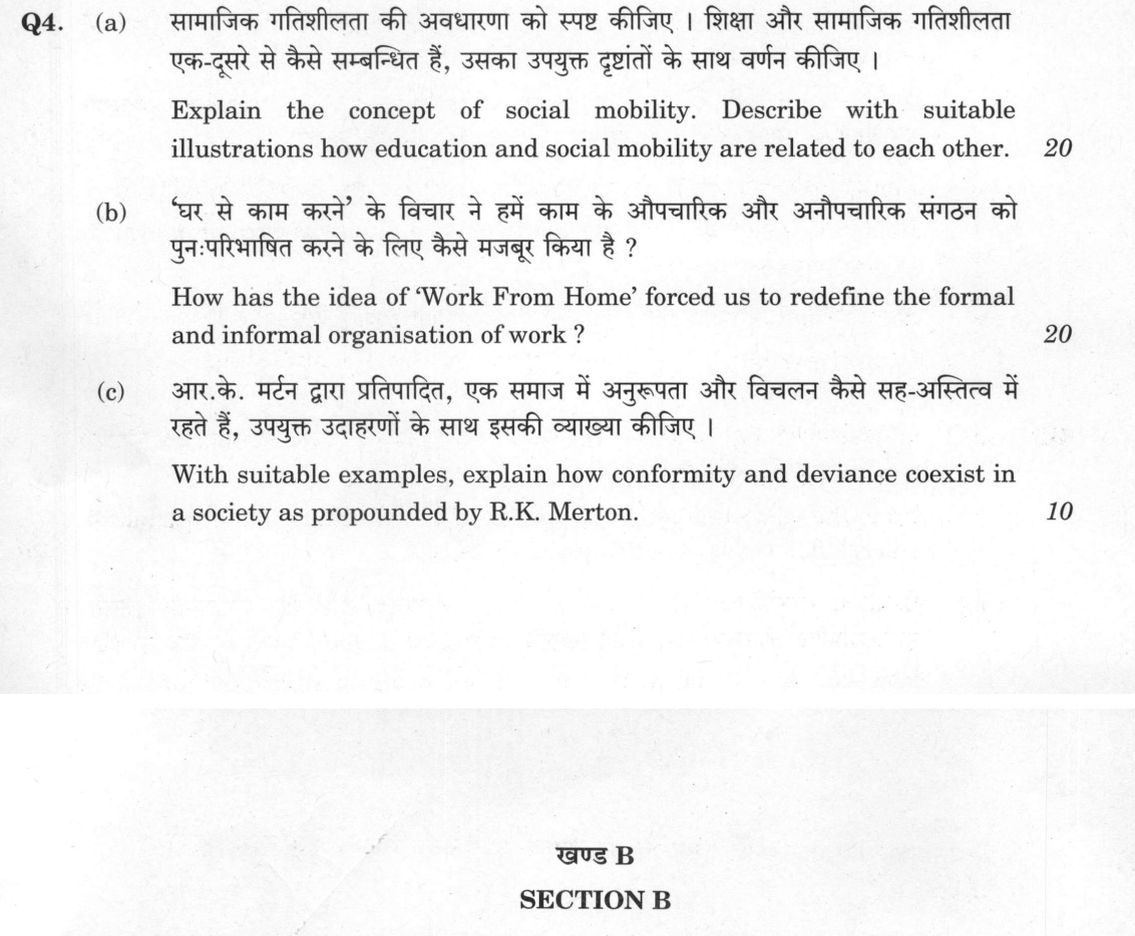
(a) Explain the concept of social mobility. Describe with suitable illustrations how education and social mobility are related to…
Explain the concept of social mobility. Describe with suitable illustrations how education and social mobility are related to each other. 20 marks
How has the idea of 'Work From Home' forced us to redefine the formal and informal organisation of work ? 20 marks
With suitable examples, explain how conformity and deviance coexist in a society as propounded by R.K. Merton. 10 marks
हिंदी में प्रश्न पढ़ें
सामाजिक गतिशीलता की अवधारणा को स्पष्ट कीजिए । शिक्षा और सामाजिक गतिशीलता एक-दूसरे से कैसे संबंधित हैं, उसका उपयुक्त दृष्टांतों के साथ वर्णन कीजिए । 20
'घर से काम करने' के विचार ने हमें काम के औपचारिक और अनौपचारिक संगठन को पुनःपरिभाषित करने के लिए कैसे मजबूर किया है ? 20 marks
आर.के. मर्टन द्वारा प्रतिपादित, एक समाज में अनुकूलता और विचलन कैसे सह-अस्तित्व में रहते हैं, उपयुक्त उदाहरणों के साथ इसकी व्याख्या कीजिए । 10
Model answer
Written by UPSC Answer Check against this question's marking rubric, to the expected length. UPSC does not publish answers for Mains — this is one way to score well, not an official key.
Social mobility denotes the movement of individuals or groups between different positions within a system of social stratification. It is categorised along vertical (upward or downward) and horizontal axes, as well as inter-generational (between generations) and intra-generational (within an individual’s lifetime) trajectories. Pitirim Sorokin conceptualised mobility as a measure of structural openness, wherein institutional channels facilitate circulation to prevent systemic ossification.
Education and Social Mobility
Education operates through a dialectical tension between meritocratic opportunity and structural reproduction. Human capital theorists (Schultz, Becker) view education as an open meritocratic channel where cognitive skills directly translate into upward mobility. In India, entrance systems like the IIT-JEE, combined with constitutional affirmative action (Article 15 reservations in higher education), have facilitated significant inter-generational upward mobility for historically disadvantaged groups.
Conversely, critical and Neo-Marxist perspectives argue that education acts as a credentialist filter (Randall Collins) and a class reproducer. Samuel Bowles and Herbert Gintis’s correspondence principle demonstrates how educational structures mirror the capitalist hierarchy. In India, the commodification of schooling—characterised by elite English-medium private institutions and capital-intensive coaching ecosystems—reproduces class advantage. As Annual Status of Education Report (ASER) data continuously reveals, persistent foundational learning deficits in state schools restrict subaltern groups to low-tier credentials, turning education into an instrument of social reproduction rather than mobility.
Work From Home and the Organisation of Work
The expansion of 'Work From Home' (WFH) has accelerated the transition from classical Taylorist-Fordist bureaucratic models to Post-Fordist flexible labour regimes, fundamentally reconfiguring formal and informal structures.
Formal organisation has experienced spatial decentralisation and temporal flexibility, severing the Weberian necessity of physical bureaucratic co-presence. However, direct supervision has been replaced by digital panopticism (Shoshana Zuboff’s surveillance capitalism), where algorithmic logging, keystroke tracking, and round-the-clock connectivity intensify managerial control. Concurrently, Harry Braverman’s deskilling thesis is reflected in remote gig-platformisation and the fragmentation of formal corporate duties.
Informally, WFH has dissolved the spatial and temporal boundaries separating the public workplace from the domestic sphere. This has led to the informalisation of formal employment, externalising infrastructural costs onto workers. Crucially, it has exacerbated the burden of invisible domestic and emotional labour, particularly for women. Periodic Labour Force Survey (PLFS) trends and post-pandemic employment patterns highlight how the erosion of work-life boundaries suppressed female workforce participation in formal sectors. Furthermore, the loss of physical shared spaces has eroded the informal social capital, organic solidarity, and collective bargaining mechanisms that traditionally shielded employees from alienation.
Conformity and Deviance: R.K. Merton
Robert K. Merton’s structural-functional strain theory demonstrates that conformity and deviance are not individual pathologies, but systemic outcomes arising from the structural strain between culturally defined goals (e.g., monetary success) and institutionalised means to attain them. Because access to legitimate means is unequally distributed across the social structure, individuals adopt different modes of adaptation, causing conformity and deviance to continuously coexist:
Conformity (+ Goals, + Means) forms the foundation of social order, where individuals accept both cultural aspirations and institutional channels (e.g., standard career paths).
Innovation (+ Goals, - Means) accepts cultural success but bypasses legitimate means; this explains corporate white-collar crime in the banking sector as well as aspects of the modern startup 'hustle' culture that skirt regulatory frameworks to secure hyper-growth.
Ritualism (- Goals, + Means) abandons high aspirations while compulsively clinging to institutional rules. This is visible in bureaucratic inertia and the acute psychological strain seen among students in hyper-competitive academic coaching hubs who mechanistically follow routines despite diminishing prospects of success.
Retreatism (- Goals, - Means) involves the simultaneous rejection of goals and means, manifesting in social dropouts, severe substance dependency, and chronic vagrancy.
Rebellion (+/- Goals, +/- Means) rejects the prevailing institutional order entirely to establish alternative socio-economic structures, exemplified by radical ideological insurgencies such as Naxalism.
In conclusion, individual trajectories across mobility, remote work adaptation, and deviance are systematically governed by prevailing opportunity structures. Whether accessing human capital through education, navigating post-Fordist labour flexibilisation, or reconciling cultural goals with legitimate means, it is the structural distribution of institutional resources that ultimately determines whether social action results in upward mobility, functional conformity, or structured deviance.
What "Explain" is asking you to do
Make the working of something clear — what sets it off, what follows from what, and what it produces. Explain is the Commission's mechanism word: it dominates the technical papers and the “explain why” stems, where the marks sit in the causal chain and not in the label.
Structure that answers it
State what it is → the initiating condition → the chain of cause, step by step → an instance where it plays out → what the chain produces
Where marks are lost
Describing what something looks like instead of why it works that way. Naming the stages without linking them reads as description too.
How this answer will be evaluated
Approach
Framework: Sociology Paper 1 (General Sociology). (a) explain: definition/context > points in order > small example > short close | (b) examine: intro > how/why with reasoning > evidence > conclusion | (c) explain: definition/context > points in order > small example > short close Full marks: Precise definitions, named thinkers, clear illustrations, and balanced analysis.
Key points expected
- Define social mobility (inter/intra-generational, vertical/horizontal)
- Name a key thinker (e.g., Weber, Durkheim, or Parsons)
- Explain education as a mechanism for upward mobility
- Provide a suitable illustration (e.g., caste vs class in India)
- Define formal organization (structure, hierarchy, rules)
- Define informal organization (networks, culture, relationships)
- Explain how WFH blurs the boundary between work and home
- Discuss the impact on hierarchy and communication
Evaluation rubric
Each sub-part is marked on its own, against the marks and word limit printed on the paper.
- (a) Define social mobility and explain the relationship between education and mobility. 20 marks
explain— definition/context → points in order → small example → short close
Must cover
- Define social mobility (inter/intra-generational, vertical/horizontal)
- Name a key thinker (e.g., Weber, Durkheim, or Parsons)
- Explain education as a mechanism for upward mobility
- Provide a suitable illustration (e.g., caste vs class in India)
Loses marks
- Confusing social mobility with social stratification
- Ignoring the 'illustration' requirement
- Vague generalities without naming specific mechanisms
Earns more
- Mention 'meritocracy' vs 'social reproduction'
- Reference to Indian context (e.g., SC/ST reservation or private coaching)
- Contrast structural vs individual mobility
Extra mark
- Cite a specific statistic (e.g., ASER or NSSO data on education)
- Reference to a specific Indian study (e.g., M. N. Srinivas)
- (b) Examine how WFH redefines formal and informal work organization. 20 marks
examine— intro → how/why with reasoning → evidence → conclusion
Must cover
- Define formal organization (structure, hierarchy, rules)
- Define informal organization (networks, culture, relationships)
- Explain how WFH blurs the boundary between work and home
- Discuss the impact on hierarchy and communication
Loses marks
- Focusing only on the benefits of WFH
- Ignoring the 'informal organization' aspect
- Treating WFH as a temporary measure rather than a structural change
Earns more
- Mention 'digital surveillance' or 'always-on culture'
- Reference to 'gig economy' or 'remote work' trends
- Discuss the impact on work-life balance
Extra mark
- Cite a specific study on WFH productivity
- Reference to a specific company's WFH policy
- (c) Explain Merton's theory of how conformity and deviance coexist. 10 marks
explain— definition/context → points in order → small example → short close
Must cover
- Name R.K. Merton
- Explain the 'Anomie' or 'Strain Theory'
- List the 5 modes of adaptation (Conformity, Innovation, Ritualism, Retreatism, Rebellion)
- Provide a suitable example for at least 2 modes
Loses marks
- Confusing Merton with Durkheim's 'Anomie'
- Listing the 5 modes without explaining them
- Ignoring the 'coexistence' aspect
Earns more
- Explain the 'cultural goals' vs 'institutionalized means' gap
- Reference to 'white-collar crime' or 'street crime' as examples
Extra mark
- Cite a specific example of 'Rebellion' (e.g., social movements)
- Reference to a specific Indian context (e.g., corruption or protest)
Practice this exact question
Write your answer and it is marked point by point against the model answer above — what you covered, what you missed, what you got wrong.
Evaluate my answer →More from Sociology 2021 Paper I
- Q1 Answer the following questions in about 150 words each : 10×5=50 (a) Europe was the first…
- Q2 (a) From the viewpoint of growing importance of multidisciplarity, how do you relate soci…
- Q3 (a) How do qualitative and quantitative methods supplement each other in sociological enq…
- Q4 (a) Explain the concept of social mobility. Describe with suitable illustrations how educ…
- Q5 Answer the following questions in about 150 words each : 10×5=50 (a) Explain the emerging…
- Q6 (a) Elucidate the main problems and challenges faced by the migrant labourers in the rece…
- Q7 (a) Explain how the pattern of patriarchy is being altered in a family and at the workpla…