Paper I — Q8
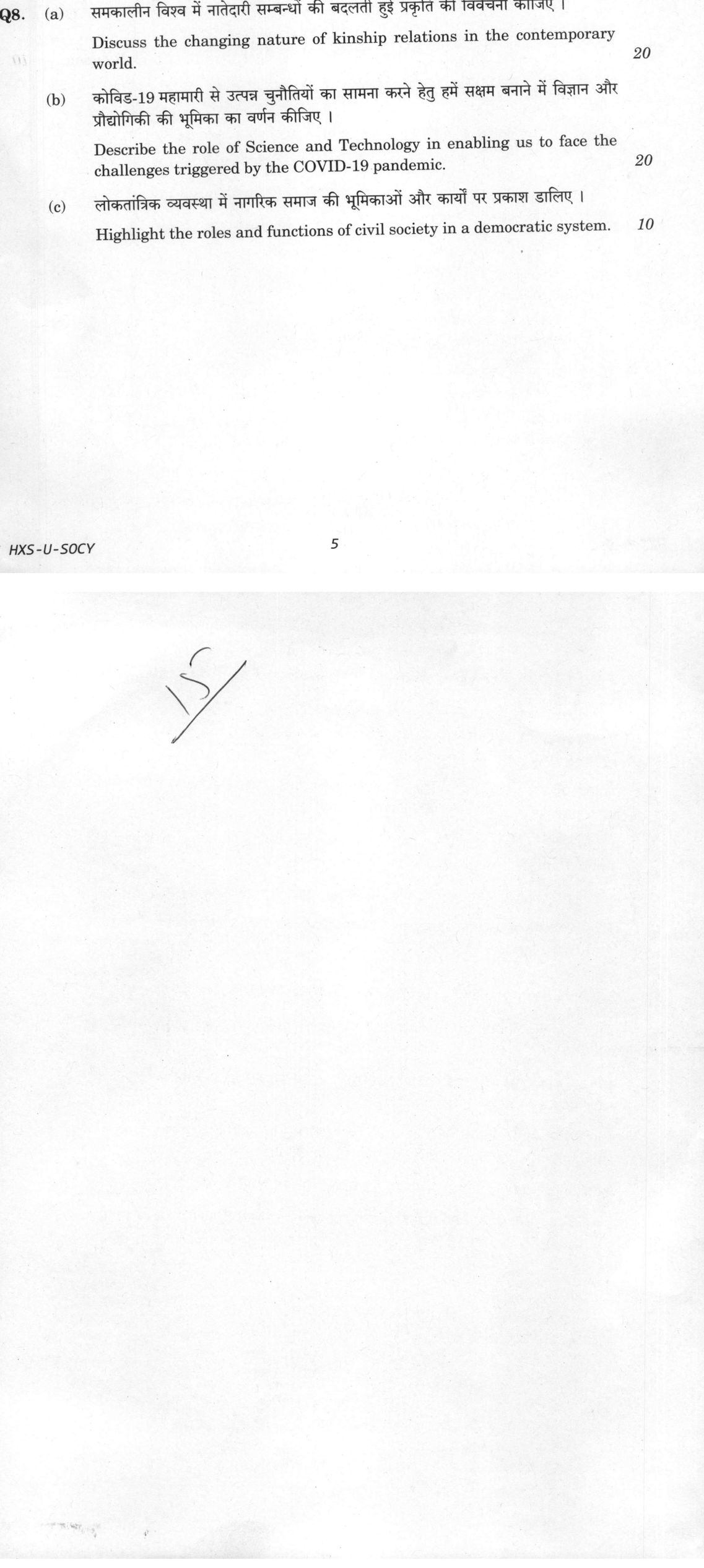
(a) Discuss the changing nature of kinship relations in the contemporary world. 20 (b) Describe the role of Science and…
Discuss the changing nature of kinship relations in the contemporary world. 20 marks
Describe the role of Science and Technology in enabling us to face the challenges triggered by the COVID-19 pandemic. 20 marks
Highlight the roles and functions of civil society in a democratic system. 10 marks
हिंदी में प्रश्न पढ़ें
समकालीन विश्व में नातेदारी संबंधों की बदलती हुई प्रकृति की विवेचना कीजिए । 20
कोविड-19 महामारी से उत्पन्न चुनौतियों का सामना करने हेतु हमें सक्षम बनाने में विज्ञान और प्रौद्योगिकी की भूमिका का वर्णन कीजिए । 20
लोकतांत्रिक व्यवस्था में नागरिक समाज की भूमिकाओं और कार्यों पर प्रकाश डालिए । 10
Model answer
Written by UPSC Answer Check against this question's marking rubric, to the expected length. UPSC does not publish answers for Mains — this is one way to score well, not an official key.
Contemporary social transformations are characterized by a dynamic reconfiguration of primary institutions, scientific capabilities, and civic agency. Kinship systems, technological infrastructure, and civil society together mediate the relationship between the individual, the community, and the modern state.
Changing Nature of Kinship Relations
Kinship across the globe is experiencing structural diversification alongside cultural resilience. Modernization, urbanization, and spatial migration have fragmented traditional corporate joint families into nuclear units, single-parent households, reconstituted families, and live-in arrangements. The expansion of women’s workforce participation has contested patriarchal domestic divisions of labor, while Assisted Reproductive Technologies (ART) such as in vitro fertilization and surrogacy have denaturalized biological lineage by decoupling reproduction from traditional heterosexual marriage.
However, kinship change does not follow a simple trajectory of Westernization. As Patricia Uberoi observes in the Indian context, the thesis of complete family breakdown or "McDonaldization" is countered by the enduring strength of traditional norms. Arranged marriages remain the normative ideal, adapting seamlessly through digital matrimonial platforms. Patrilocal obligations, caste endogamy, and dowry practices demonstrate profound institutional inertia.
Furthermore, kinship has adapted through technology. Transnational and dispersed families sustain affective bonds through "WhatsApp family groups" and tele-rituals, demonstrating that spatial atomization does not necessarily erode relational solidarity, but rather produces "modified extended" kinship networks.
Science, Technology, and the Pandemic Challenge
Science and technology functioned as the frontline defense against the disruptions caused by the COVID-19 pandemic. Biomedical breakthroughs enabled the unprecedented acceleration of vaccine platforms, including mRNA and indigenous inactivated vaccines (such as Covaxin). In India, genomic surveillance anchored by the INSACOG consortium tracked viral mutations in real time, while telemedicine platforms democratized clinical consultations during nationwide lockdowns.
Digital public infrastructure bridged critical governance gaps. Platforms like Aarogya Setu for contact tracing, CoWIN for nationwide vaccine deployment, and digital Direct Benefit Transfers (DBT) linked to the Jan Dhan-Aadhaar-Mobile (JAM) trinity ensured targeted relief delivery.
Nonetheless, technology reflected existing socio-economic fissures. The stark digital divide excluded rural, working-class, and marginalized-caste populations from online schooling, tele-health, and digital vaccine slot allocations. State deployment of algorithmic tracking also prompted legitimate concerns regarding biometric surveillance, data privacy, and the reproduction of structural inequalities in emergency response mechanisms.
Roles and Functions of Civil Society
Civil society acts as a vital institutional buffer between the state, market, and citizenry. As Robert Putnam argued, voluntary associational life generates social capital and civic trust, vital for deepening democratic deliberation. In practice, civil society performs crucial watchdog functions—exemplified in India by grassroots movements leveraging the Right to Information (RTI) Act, civil liberties advocacy, and environmental public interest litigation against ecologically destructive projects.
During systemic crises, civil society bridges state delivery deficits; during the pandemic, non-governmental organizations (NGOs) mobilized community kitchens, managed oxygen supply lines, and organized distress relief for stranded migrant workers. Digital networks have democratized this space through rapid crowd-funding and civic mobilization.
However, civil society faces internal and external constraints. It remains vulnerable to elite capture, donor-driven priorities, and co-optation. Simultaneously, heightened regulatory scrutiny—notably through amendments to the Foreign Contribution (Regulation) Act (FCRA)—and debates over whether certain advocacy groups deepen democracy or destabilize developmental agendas illustrate the contested terrain of civic action.
Conclusion
Kinship adaptation, scientific capability, and civic mobilization collectively constitute the pillars of contemporary social resilience. Navigating future socio-economic shocks requires harmonizing indigenous kinship support systems with universal social protection, democratizing technological access to bridge structural divides, and safeguarding autonomous civic spaces to sustain an equitable, deliberative democracy.
What "Discuss" is asking you to do
Lay the issue out from more than one side — how it arose, what is claimed for it, what is held against it, and where it now stands. UPSC attaches discuss to broad topics with several live dimensions, so coverage of the dimensions earns more than the strength of your opinion.
Structure that answers it
Set the issue up → the case as it is made → the case against → the dimension both sides leave out → where the balance now lies
Where marks are lost
Listing facts with no thread between them, or arguing one side throughout and calling it a discussion.
How this answer will be evaluated
Approach
Framework: Sociology Paper I (UPSC). (a) discuss: intro > 3-4 dimensions > example > balanced close | (b) describe: define > structure or process in order > labelled diagram > significance | (c) highlight: name the salient points > one line of substance each > close Full marks: Sophisticated analysis with named thinkers, specific Indian data, and clear argumentation.
Key points expected
- Contrast traditional joint family with nuclear/extended variants
- Link kinship changes to industrialization and urbanization
- Discuss the rise of 'chosen family' or non-biological kinship
- Reference a key sociologist (e.g., Goode, Parry, or Srinivas)
- Explain the role of virology and epidemiology in tracking the virus
- Describe the development and deployment of vaccines (mRNA, etc.)
- Discuss the use of digital technology (contact tracing, telemedicine)
- Mention the role of biotechnology in rapid testing (RT-PCR)
Evaluation rubric
Each sub-part is marked on its own, against the marks and word limit printed on the paper.
- (a) Analyze the structural and functional shifts in kinship systems in the modern era. 20 marks
discuss— intro → 3-4 dimensions → example → balanced close
Must cover
- Contrast traditional joint family with nuclear/extended variants
- Link kinship changes to industrialization and urbanization
- Discuss the rise of 'chosen family' or non-biological kinship
- Reference a key sociologist (e.g., Goode, Parry, or Srinivas)
Loses marks
- Descriptive account of 'family values' without sociological analysis
- Ignoring the Indian context in favor of purely Western theory
- Name-dropping thinkers without explaining their specific arguments
Earns more
- Mention the impact of migration on inter-generational ties
- Discuss the changing role of women in kinship networks
- Reference the concept of 'individualization' in family life
- Mention the legal changes affecting inheritance and marriage
Extra mark
- Cite specific data from NFHS or Census on family size
- Reference a specific contemporary Indian debate (e.g., same-sex marriage)
- (b) Detail the specific scientific and technological interventions used to manage the pandemic. 20 marks
describe— define → structure or process in order → labelled diagram → significance
Must cover
- Explain the role of virology and epidemiology in tracking the virus
- Describe the development and deployment of vaccines (mRNA, etc.)
- Discuss the use of digital technology (contact tracing, telemedicine)
- Mention the role of biotechnology in rapid testing (RT-PCR)
Loses marks
- General statements about 'science is good' without specific examples
- Focusing only on the virus itself rather than the response
- Ignoring the social/behavioral aspect of the pandemic response
Earns more
- Discuss the role of AI in drug discovery or vaccine design
- Mention the role of social media in public health communication
- Reference the role of the Indian Council of Medical Research (ICMR)
- Discuss the ethical challenges of technology use (privacy, data)
Extra mark
- Cite a specific statistic on vaccine efficacy or testing capacity
- Reference a specific Indian initiative (e.g., CoWIN portal)
- (c) Identify the key functions of civil society in maintaining a democracy. 10 marks
highlight— name the salient points → one line of substance each → close
Must cover
- Define civil society (NGOs, media, associations)
- Explain the role in social mobilization and awareness
- Discuss the role in holding the state accountable (watchdog)
- Mention the role in providing public goods/services
Loses marks
- Confusing civil society with the state or political parties
- Listing functions without explaining their democratic significance
- Ignoring the potential for civil society to be co-opted by the state
Earns more
- Discuss the role in bridging the gap between state and citizen
- Mention the role in promoting social justice and inclusion
- Reference the concept of 'social capital'
- Mention the role in conflict resolution
Extra mark
- Cite a specific Indian NGO or movement (e.g., RTI movement)
- Reference a specific legal provision protecting civil society
Practice this exact question
Write your answer and it is marked point by point against the model answer above — what you covered, what you missed, what you got wrong.
Evaluate my answer →More from Sociology 2021 Paper I
- Q5 Answer the following questions in about 150 words each : 10×5=50 (a) Explain the emerging…
- Q6 (a) Elucidate the main problems and challenges faced by the migrant labourers in the rece…
- Q7 (a) Explain how the pattern of patriarchy is being altered in a family and at the workpla…
- Q8 (a) Discuss the changing nature of kinship relations in the contemporary world. 20 (b) De…