Paper I — Q6
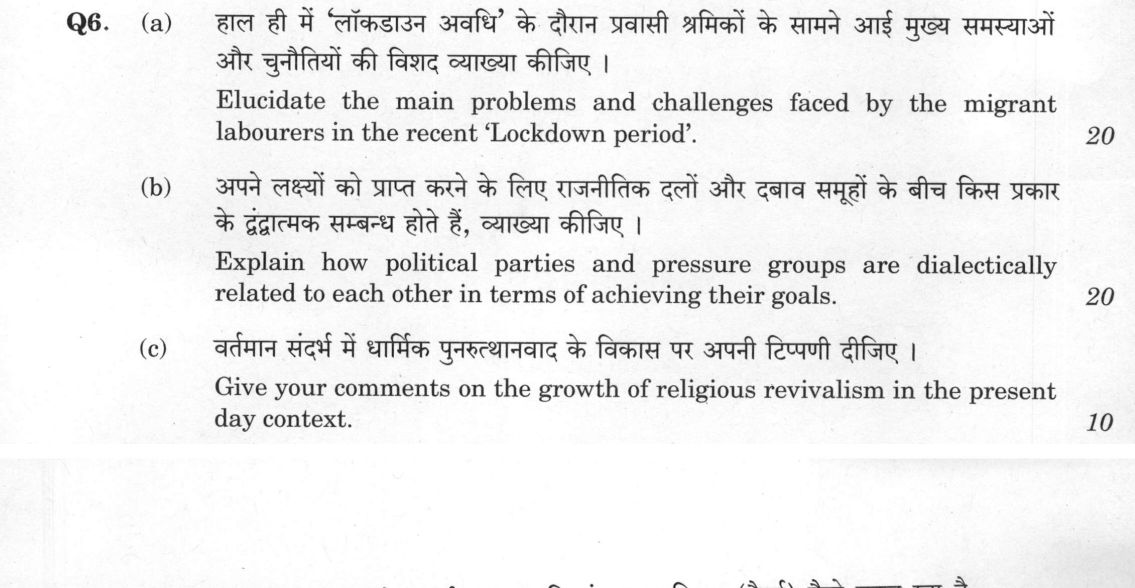
(a) Elucidate the main problems and challenges faced by the migrant labourers in the recent 'Lockdown period'. 20 (b) Explain…
Elucidate the main problems and challenges faced by the migrant labourers in the recent 'Lockdown period'. 20 marks
Explain how political parties and pressure groups are dialectically related to each other in terms of achieving their goals. 20 marks
Give your comments on the growth of religious revivalism in the present day context. 10 marks
हिंदी में प्रश्न पढ़ें
हाल ही में 'लॉकडाउन अवधि' के दौरान प्रवासी श्रमिकों के सामने आई मुख्य समस्याओं और चुनौतियों की विशद व्याख्या कीजिए । 20
अपने लक्ष्यों को प्राप्त करने के लिए राजनीतिक दलों और दबाव समूहों के बीच किस प्रकार के द्वंद्वात्मक संबंध होते हैं, व्याख्या कीजिए । 20
वर्तमान संदर्भ में धार्मिक पुनरुत्थानवाद के विकास पर अपनी टिप्पणी दीजिए । 10
Model answer
Written by UPSC Answer Check against this question's marking rubric, to the expected length. UPSC does not publish answers for Mains — this is one way to score well, not an official key.
Contemporary social transformations in India reveal profound structural realignments across the economic, political, and cultural spheres, highlighting the evolving and contested relationship between the state, market, and civil society.
Precarity and Challenges of Migrant Labourers during Lockdown
The nationwide lockdown during COVID-19 exposed the multi-dimensional precarity of India’s circular and informal migrant workforce. The immediate cessation of economic activity caused instant wage loss, rapid depletion of savings, and acute food and shelter insecurity. With the sudden collapse of public transport, millions were forced to walk hundreds of kilometres home, enduring severe physical exhaustion, psychological trauma, dehydration, and instances of police brutality at interstate borders.
Sociologically, this mass reverse migration exposed the structural failure of India’s exclusionary urbanisation model, which relies on Jan Breman’s concept of "footloose labour" while denying workers urban citizenship and social safety nets. State response gaps were evident in the initial disconnect between centralized relief packages and ground realities, as millions of unregistered workers lacking local ration cards were excluded from the Public Distribution System (PDS), highlighting the non-implementation of the Inter-State Migrant Workmen Act, 1979. This institutional failure eventually required the Supreme Court’s suo motu intervention in In Re Problems and Miseries of Migrant Labourers (2020), which mandated free transport, universal food distribution irrespective of ration cards, and the expedited registration of unorganised workers on the e-Shram portal.
Dialectical Relationship: Political Parties and Pressure Groups
Political parties and pressure groups operate in a dialectical relation characterized by mutual dependence, systemic tension, and reciprocal transformation. While political parties aggregate broad coalitions of interests to capture state power, pressure groups articulate specialized, sectoral demands without seeking direct office.
Parties require pressure groups to secure grassroots mobilization, ideological legitimacy, and dedicated vote bases. Conversely, pressure groups depend on parties and legislative elites to translate their demands into state policy and institutional concessions. This relationship oscillates between co-optation—where parties assimilate interest group leaders and dilute radical demands—and resistance, where groups maintain autonomy to hold parties accountable.
In India, this dialectic manifests in three major forms: trade unions functioning as industrial wings of political parties (e.g., CITU with CPI-M, INTUC with Congress) while pushing those parties toward pro-labour stances; caste associations transforming into political parties through sustained mobilization, such as the Vanniyar Sangam giving rise to the Pattali Makkal Katchi (PMK) or BAMCEF birthing the Bahujan Samaj Party (BSP); and agrarian pressure groups, notably the Samyukt Kisan Morcha during the 2020–21 farm law protests, which maintained strategic distance from political parties while fundamentally reshaping regional electoral realignments.
Religious Revivalism in the Present-Day Context
Religious revivalism represents a modern socio-political project aimed at restoring and asserting religious identity in public life. It is analytically distinct from individual religiosity (private devotion) and fundamentalism (inflexible doctrinal literalism), operating instead as an active renegotiation of collective identity against perceived social decay. Contemporary manifestations include Hindutva mobilization in India, Islamist political resurgence globally, and the rapid expansion of Pentecostal-Charismatic movements across Latin America and parts of Asia.
Revivalism is propelled by the structural anxieties of neoliberal globalization, where rapid marketization and cultural dislocation lead individuals to seek security in what Manuel Castells terms "resistance identities." These anxieties are further amplified by competitive electoral politics, majority-minority identity polarizations, and digital echo chambers that foster affective polarization. Nevertheless, the growth of religious revivalism is not absolute; it remains consistently checked by counter-tendencies of secular constitutionalism, subaltern rights assertions, and deeply rooted syncretic traditions.
In conclusion, the struggles of informal labour, the bargaining between parties and civic groups, and the rise of religious revivalism reflect the continuous friction between state institutions and social groups, underscoring the imperative of deepening constitutional protections and inclusive developmental democracy.
What "Elucidate" is asking you to do
Make a stated proposition plain and then prove it with instances. Elucidate stems almost always carry a claim or a named concept, and very often the words “with examples” or “with suitable diagrams” — the illustration is part of the directive, not decoration.
Structure that answers it
Plain-language statement of what the proposition means → the part that is obscure, resolved → first illustration → second illustration → why the proposition holds
Where marks are lost
Adding terminology; elucidate rewards removing it. The commoner loss is a clean explanation with no example, when the stem asked for examples.
How this answer will be evaluated
Approach
(a) explain: definition/context > points in order > small example > short close | (b) explain: definition/context > points in order > small example > short close | (c) discuss: intro > 3-4 dimensions > example > balanced close Full marks: Sophisticated sociological analysis with specific Indian examples and theoretical grounding.
Key points expected
- Migrant labour precarity
- Dialectical party-group relationship
- Religious revivalism and identity
Evaluation rubric
Each sub-part is marked on its own, against the marks and word limit printed on the paper.
- (a) Analytical breakdown of structural and immediate crises for migrant workers during lockdown. 20 marks
explain— definition/context → points in order → small example → short close
Must cover
- Loss of daily wage income
- Breakdown of social security nets
- Physical hardship of return migration
- Gender-specific vulnerabilities (women)
Loses marks
- General sympathy without structural analysis
- Ignoring the 'lockdown' specific context
Earns more
- Reference to PLI or MGNREGA failure
- Concept of 'precarity' or 'informality'
- State vs. market failure analysis
Extra mark
- Specific statistic on migrant deaths
- Reference to specific state policy response
- (b) Dialectical relationship between parties and pressure groups in goal achievement. 20 marks
explain— definition/context → points in order → small example → short close
Must cover
- Pressure groups as 'agents' of parties
- Parties as 'vehicles' for group goals
- Mutual dependence for legitimacy
- Conflict/competition for resources
Loses marks
- Treating them as separate entities
- Ignoring the 'dialectical' (interdependent) nature
Earns more
- Reference to 'Iron Law of Oligarchy'
- Example of a specific Indian pressure group
- Distinction between 'insider' and 'outsider' groups
Extra mark
- Reference to a specific political scientist (e.g., Schattschneider)
- Diagram of the interaction cycle
- (c) Critical commentary on the resurgence of religious revivalism in modern India. 10 marks
discuss— intro → 3-4 dimensions → example → balanced close
Must cover
- Definition of 'religious revivalism'
- Link to identity politics
- Role of media/technology
- Impact on secularism
Loses marks
- Taking a purely political stance
- Ignoring the sociological drivers
Earns more
- Reference to 'Hindu nationalism' or 'Saffronization'
- Comparison with other religious movements
- Sociological explanation (e.g., secularization theory)
Extra mark
- Reference to a specific recent event
- Statistical data on religious demographics
Practice this exact question
Write your answer and it is marked point by point against the model answer above — what you covered, what you missed, what you got wrong.
Evaluate my answer →More from Sociology 2021 Paper I
- Q3 (a) How do qualitative and quantitative methods supplement each other in sociological enq…
- Q4 (a) Explain the concept of social mobility. Describe with suitable illustrations how educ…
- Q5 Answer the following questions in about 150 words each : 10×5=50 (a) Explain the emerging…
- Q6 (a) Elucidate the main problems and challenges faced by the migrant labourers in the rece…
- Q7 (a) Explain how the pattern of patriarchy is being altered in a family and at the workpla…
- Q8 (a) Discuss the changing nature of kinship relations in the contemporary world. 20 (b) De…