Paper I — Q3
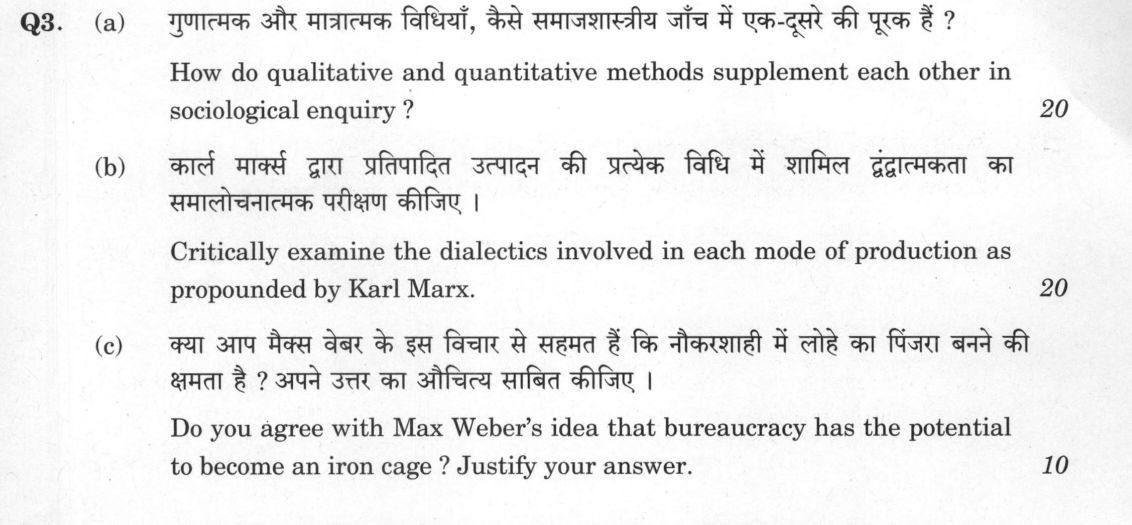
(a) How do qualitative and quantitative methods supplement each other in sociological enquiry ? 20 (b) Critically examine the…
How do qualitative and quantitative methods supplement each other in sociological enquiry ? 20 marks
Critically examine the dialectics involved in each mode of production as propounded by Karl Marx. 20 marks
Do you agree with Max Weber's idea that bureaucracy has the potential to become an iron cage ? Justify your answer. 10 marks
हिंदी में प्रश्न पढ़ें
गुणात्मक और मात्रात्मक विधियाँ, कैसे समाजशास्त्रीय जाँच में एक-दूसरे की पूरक हैं ? 20 marks
कार्ल मार्क्स द्वारा प्रतिपादित उत्पादन की प्रत्येक विधि में शामिल द्वंद्वात्मकता का समालोचनात्मक परीक्षण कीजिए । 20
क्या आप मैक्स वेबर के इस विचार से सहमत हैं कि नौकरशाही में लोहे का पिंजरा बनने की क्षमता है ? अपने उत्तर का औचित्य साबित कीजिए । 10
Model answer
Written by UPSC Answer Check against this question's marking rubric, to the expected length. UPSC does not publish answers for Mains — this is one way to score well, not an official key.
Methodological complementarity Sociological enquiry requires both qualitative and quantitative methods because they answer different questions and correct each other’s blind spots. Quantitative methods—surveys, NFHS, census, statistical analysis—measure prevalence, trends and associations, allowing generalisation and policy comparison. Qualitative methods—ethnography, interviews, case studies—reveal meanings, power, everyday practices and causal mechanisms. Quantitative methods are especially useful for establishing baselines, monitoring policy outcomes and comparing states, while qualitative methods capture informal institutions, caste and gender hierarchies, and state-society relations that are difficult to code. They also help identify variables missing from surveys, such as emotional labour, informal care or honour-related constraints, which can later be quantified. Creswell’s mixed-methods logic shows they are not rivals but complementary: quantitative data identify patterns; qualitative data explain why and how those patterns occur. Quantitative results can also test qualitative hypotheses across larger populations, while qualitative work can challenge survey categories such as “household”, “work” or “poverty”. This is especially important in plural societies where aggregate numbers hide caste, gender and regional differences. In India, NFHS data show fertility decline and regional variation, but ethnographic studies by Leela Gulati and Karin Kapadia show that son preference, dowry and household bargaining sustain sex-selective behaviour even when fertility falls. The survey reveals the statistical fact; ethnography supplies the social mechanism. Triangulation thus strengthens validity: quantitative results can be tested against lived experience, while qualitative claims can be checked for representativeness. This makes mixed-methods design essential for policy-relevant sociology.
Marx’s dialectics of modes of production Marx’s dialectic treats history as movement through contradictions internal to each mode of production. In primitive communism, communal ownership and low surplus meant no class antagonism; the contradiction arose when surplus, private property and division of labour emerged, negating communal equality and producing class society. In the Asiatic mode, as noted in the Preface to A Contribution to the Critique of Political Economy, communal village land and state control of irrigation produced a contradiction between village autonomy and despotic extraction of surplus; limited commodity development tended to stagnate until external trade or conquest opened capitalist relations. In slavery, the slave was simultaneously property and producer; this contradiction—ownership that denies incentive and freedom—generated resistance, revolts and the eventual negation of slavery. In feudalism, the lord claimed surplus while peasants possessed tools and some land; serf resistance, urban growth and money relations weakened manorial control, creating conditions for wage labour. In capitalism, production is socialised but appropriation is private; this contradiction generates crises, unemployment and class conflict, making the proletariat the revolutionary subject. Critically, this schema is powerful for exposing structural contradictions, but it is teleological, economistic and sometimes Eurocentric; it underplays culture, gender, colonialism and agency. Read as tendencies rather than mechanical law, the dialectic explains structural pressures without denying political and cultural agency. The Asiatic mode is especially contested, yet including it shows Marx was aware that not all pre-capitalist societies followed the same path.
Weber’s iron cage Weber’s iron cage describes how rationalisation—rules, calculability, hierarchy and depersonalisation—can trap individuals in formal rationality, displacing substantive rationality. I agree that bureaucracy has this potential, but not as an inevitable fate. In India, NREGA shows both sides: transparent eligibility, work entitlements and digital records improve accountability, yet biometric authentication, file-based compliance and procedural delays can reduce welfare to rule-following, excluding the poorest. Post-liberalisation corporate structures similarly use HR metrics, audits and performance dashboards that increase efficiency but can depersonalise labour. The cage is strongest when rules become ends in themselves; democratic rights, judicial review and social movements can keep bureaucracy accountable to substantive ends. Thus Weber’s warning remains valid: rational institutions must remain answerable to human purposes.
What "Critically examine" is asking you to do
Test the proposition the question puts to you and return a finding on how far it holds. Examine stems carry a claim, or ask whether something has happened, and expect evidence weighed both ways before the extent is stated — often with remedial measures attached. “Critically” is not a section added at the end: name the yardstick you are judging by — the evidence, the stated objective, a constitutional principle, a rival explanation — and let a verdict close each part of the body. Where the question quotes a claim, that verdict must land on the claim itself, accepted, qualified or rejected, and not on the theme in general.
Structure that answers it
Restate the claim as the question frames it → evidence that supports it → evidence that undercuts it → the conditions under which it holds → verdict on how far it stands
Where marks are lost
Merits in one paragraph, demerits in the next, and a conclusion calling for a balanced and holistic approach. That is a survey with the judgement left out and it holds the answer in the middle band. The opposite error is reading “critically” as permission to attack — and with the odd pairings, critically describe or critically explain, the exposition still carries most of the marks, the judgement being a layer on it rather than a substitute for it.
How this answer will be evaluated
Approach
Framework: Sociological Theory & Methodology. (a) discuss: intro > 3-4 dimensions > example > balanced close | (b) critique: the claim > its strengths > its weaknesses > your judgment | (c) justify: claim > 3-4 reasons > evidence > conclusion Full marks: Comprehensive, well-structured, with specific examples and critical analysis.
Key points expected
- Define qualitative and quantitative methods
- Explain how qualitative provides depth/context
- Explain how quantitative provides breadth/generalization
- Discuss mixed-methods approach for triangulation
- Define dialectical materialism (thesis-antithesis-synthesis)
- Explain transition from feudalism to capitalism
- Explain transition from capitalism to socialism
- Critique the teleological nature of the theory
Evaluation rubric
Each sub-part is marked on its own, against the marks and word limit printed on the paper.
- (a) Explain the complementary relationship between qualitative and quantitative methods in sociological research. 20 marks
discuss— intro → 3-4 dimensions → example → balanced close
Must cover
- Define qualitative and quantitative methods
- Explain how qualitative provides depth/context
- Explain how quantitative provides breadth/generalization
- Discuss mixed-methods approach for triangulation
Loses marks
- Treating methods as mutually exclusive
- Lack of specific examples
- Confusing qualitative with subjective
Earns more
- Mention specific techniques (e.g., interviews vs. surveys)
- Reference to specific sociological studies
- Discussion of validity and reliability
- Mention of specific sociologists (e.g., Durkheim, Weber)
Extra mark
- Reference to specific Indian sociological surveys (e.g., NFHS, NSSO)
- Mention of specific methodological debates
- (b) Critically examine the dialectical process in Marx's modes of production. 20 marks
critique— the claim → its strengths → its weaknesses → your judgment
Must cover
- Define dialectical materialism (thesis-antithesis-synthesis)
- Explain transition from feudalism to capitalism
- Explain transition from capitalism to socialism
- Critique the teleological nature of the theory
Loses marks
- Ignoring the 'critical' aspect of the command word
- Over-simplifying the dialectical process
- Lack of specific historical examples
Earns more
- Mention of base and superstructure
- Reference to specific historical examples
- Discussion of class struggle as engine of change
- Mention of specific Marxist critics (e.g., Althusser, Gramsci)
Extra mark
- Reference to specific Indian historical context
- Mention of specific Marxist texts
- (c) Justify agreement or disagreement with Weber's 'iron cage' concept of bureaucracy. 10 marks
justify— claim → 3-4 reasons → evidence → conclusion
Must cover
- Define Weber's 'iron cage' concept
- Explain the rationalization process
- Provide arguments for the 'iron cage' (dehumanization, rigidity)
- Provide arguments against (efficiency, predictability)
Loses marks
- Failing to take a clear position
- Lack of specific examples
- Confusing bureaucracy with government
Earns more
- Mention of specific bureaucratic features (hierarchy, rules)
- Reference to modern organizational examples
- Discussion of 'disenchantment of the world'
- Mention of specific Weberian concepts (e.g., value rationality)
Extra mark
- Reference to specific Indian bureaucratic examples
- Mention of specific Weberian texts
Practice this exact question
Write your answer and it is marked point by point against the model answer above — what you covered, what you missed, what you got wrong.
Evaluate my answer →More from Sociology 2021 Paper I
- Q1 Answer the following questions in about 150 words each : 10×5=50 (a) Europe was the first…
- Q2 (a) From the viewpoint of growing importance of multidisciplarity, how do you relate soci…
- Q3 (a) How do qualitative and quantitative methods supplement each other in sociological enq…
- Q4 (a) Explain the concept of social mobility. Describe with suitable illustrations how educ…
- Q5 Answer the following questions in about 150 words each : 10×5=50 (a) Explain the emerging…
- Q6 (a) Elucidate the main problems and challenges faced by the migrant labourers in the rece…