Paper I — Q5
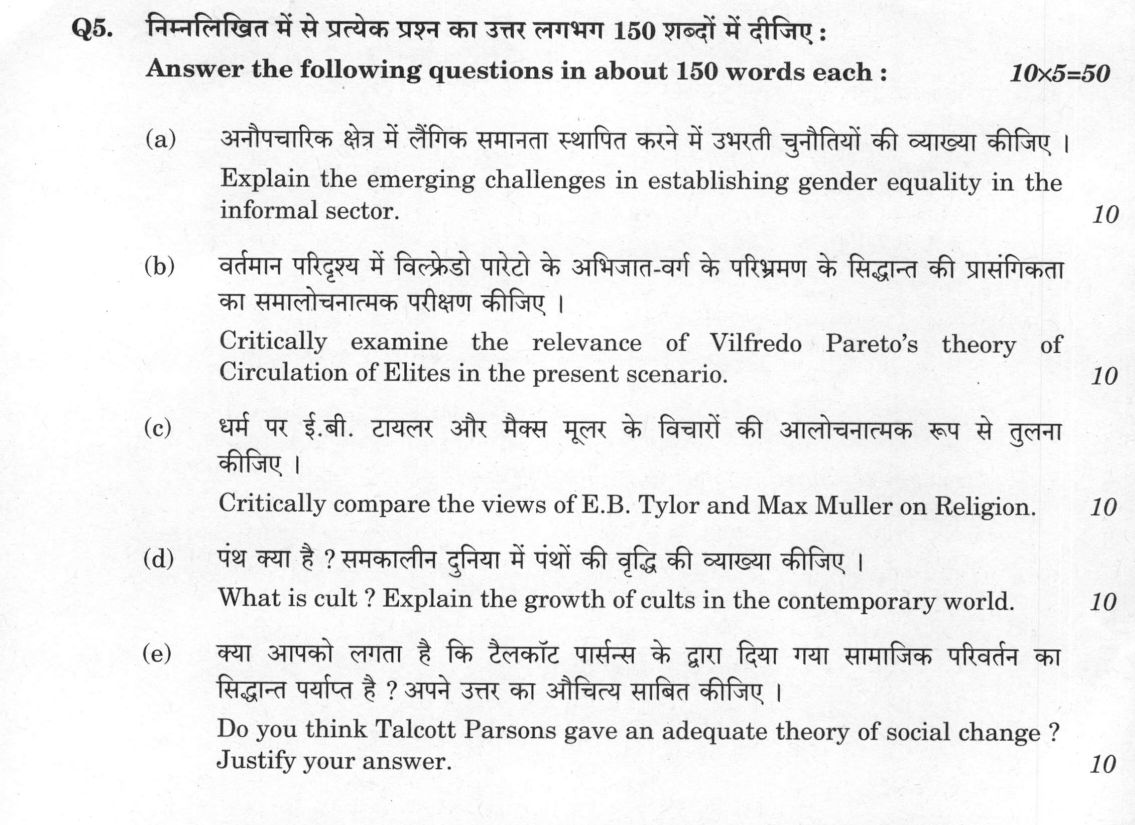
Answer the following questions in about 150 words each : 10×5=50 (a) Explain the emerging challenges in establishing gender…
Answer the following questions in about 150 words each : 10×5=50
Explain the emerging challenges in establishing gender equality in the informal sector. 10 marks
Critically examine the relevance of Vilfredo Pareto's theory of Circulation of Elites in the present scenario. 10 marks
Critically compare the views of E.B. Tylor and Max Muller on Religion. 10 marks
What is cult ? Explain the growth of cults in the contemporary world. 10 marks
Do you think Talcott Parsons gave an adequate theory of social change ? Justify your answer. 10 marks
हिंदी में प्रश्न पढ़ें
निम्नलिखित में से प्रत्येक प्रश्न का उत्तर लगभग 150 शब्दों में दीजिए : 10×5=50
अनौपचारिक क्षेत्र में लैंगिक समानता स्थापित करने में उभरती चुनौतियों की व्याख्या कीजिए । 10
वर्तमान परिदृश्य में विल्फ्रेडो पारेटो के अभिजात-वर्ग के परिभ्रमण के सिद्धांत की प्रासंगिकता का समालोचनात्मक परीक्षण कीजिए । 10
धर्म पर ई.बी. टायलर और मैक्स मूलर के विचारों की आलोचनात्मक रूप से तुलना कीजिए । 10
पंथ क्या है ? समकालीन दुनिया में पंथों की वृद्धि की व्याख्या कीजिए । 10
क्या आपको लगता है कि टैलकॉट पार्सन्स के द्वारा दिया गया सामाजिक परिवर्तन का सिद्धांत पर्याप्त है ? अपने उत्तर का औचित्य साबित कीजिए । 10
Model answer
Written by UPSC Answer Check against this question's marking rubric, to the 150-word length. UPSC does not publish answers for Mains — this is one way to score well, not an official key.
(a) Challenges to Gender Equality in the Informal Sector
The informal sector absorbs over 90% of working women in developing economies like India, yet deep structural asymmetries perpetuate gender inequality. A primary impediment is the disproportionate burden of unpaid care and domestic work, which restricts women to low-yielding, home-based, or piece-rate activities. Furthermore, informal women workers lack institutional social protection, maternity entitlements, and occupational safety nets, leaving them vulnerable to economic shocks and health crises.
In the emerging platform and gig economy, algorithmic biases often penalize women for discontinuous work profiles caused by domestic responsibilities, reinforcing occupational segregation under a guise of digital neutrality. Although grassroots initiatives like the Self-Employed Women’s Association (SEWA) and legislative interventions like the Street Vendors (Protection of Livelihood and Regulation of Street Vending) Act provide collective bargaining power and legal protection, they remain partial remedies against deep-seated patriarchal norms. Achieving substantive equality requires transforming informal social protection frameworks and instituting universal care infrastructure.
(b) Relevance of Vilfredo Pareto’s Circulation of Elites
Vilfredo Pareto posited history as a "graveyard of aristocracies," driven by the cyclical alternation between speculative, innovative "foxes" (Class I residues) and coercive, conservative "lions" (Class II residues). In contemporary scenarios, this circulation is visible in democratic transitions where traditional political dynasties yield ground to populist, technocratic, or meritocratic leadership, as observed in Indian electoral dynamics. Similarly, modern corporate governance exhibits high CEO turnover, shifting between innovative disruptors (foxes) and cost-stabilizing administrators (lions).
However, Pareto’s model possesses significant limitations. Gaetano Mosca’s emphasis on the cohesiveness of the organized minority, alongside modern democratic institutionalization, shows that power is not purely cyclical among closed oligarchies. Universal franchise, mass political mobilizations, and constitutional safeguards enable genuine bottom-up democratization rather than mere horizontal elite circulation. Thus, while Pareto effectively illuminates elite psychology and intra-elite displacement, his theory underplays structural democratization and mass agency in contemporary societies.
(c) Comparative Analysis of E. B. Tylor and Max Müller on Religion
Both Edward Burnett Tylor and Friedrich Max Müller pioneered intellectualist approaches to the evolutionary origins of religion, viewing belief as an early attempt to explain existential phenomena. Tylor propounded animism, identifying the belief in the soul and spiritual beings—prompted by dream experiences, shadows, and death—as the earliest form of religion, evolving unilinearly into polytheism and monotheism. Conversely, Müller advocated naturism, arguing that religion arose from human encounters with awe-inspiring natural forces, where metaphorical descriptions suffered a "disease of language" or linguistic corruption, transforming descriptive nature words into personified deities.
However, both theories suffer from intellectualist reductionism by treating primitive human beings merely as individual philosophers rather than social actors. As Émile Durkheim argued, both scholars ignored religion's core function in reinforcing social solidarity and sacred-profane binaries. Later, Clifford Geertz demonstrated that religion is a dynamic cultural system of symbols and meanings, rather than an archaic cognitive error or a linguistic misapprehension.
(d) Cults and their Growth in the Contemporary World
Sociologically, Rodney Stark and William Sims Bainbridge define a cult as a loosely structured, non-traditional religious or spiritual group that offers novel, esoteric compensators to individuals seeking meaning outside institutionalized orthodoxies.
The proliferation of cults and New Religious Movements (NRMs) in the contemporary world is driven by existential anomie and the alienation wrought by rapid secularization and hyper-individualism. Modern society functions as a spiritual marketplace where rational actors consume alternative spiritual goods. In India and globally, movements such as ISKCON and the Brahma Kumaris expanded by offering psychological solace, community, and accessible interpretations of sacred traditions to urban middle classes confronting structural dislocations. Furthermore, internet-mediated recruitment and decentralized digital networks have globalized these networks, lowering entry barriers. Relative deprivation—material, social, or psychic—compels individuals toward cultic associations, which provide personalized identity, therapeutic healing, and moral community in an otherwise fragmented world.
(e) Talcott Parsons’ Theory of Social Change
Talcott Parsons formulated an evolutionary model of social change grounded in functional equilibrium, structural differentiation, adaptive upgrading, inclusion, and value generalization. He conceptualized change as an orderly transition across pattern variables, moving from traditional particularism, ascription, and affectivity toward modern universalism, achievement, and affective neutrality.
However, Parsons’ theory is inadequate for capturing the full reality of social transformation. By prioritizing equilibrium and normative integration, it fails to explain change arising from violent rupture, class struggle, and ideological revolutions, as highlighted by conflict theorists like Karl Marx and Ralf Dahrendorf. Additionally, Immanuel Wallerstein’s world-systems theory demonstrates that global inequalities stem from coercive core-periphery exploitation rather than internal adaptive differentiation. In India, the persistence of caste endogamy and gender-based violence reflects deep structural lag and entrenched hierarchies, proving that social change is contested and uneven rather than smoothly evolutionary. Parsons’ framework remains a useful taxonomy of systemic adjustment, but falls short of a comprehensive theory of change.
What "Critically examine" is asking you to do
Test the proposition the question puts to you and return a finding on how far it holds. Examine stems carry a claim, or ask whether something has happened, and expect evidence weighed both ways before the extent is stated — often with remedial measures attached. “Critically” is not a section added at the end: name the yardstick you are judging by — the evidence, the stated objective, a constitutional principle, a rival explanation — and let a verdict close each part of the body. Where the question quotes a claim, that verdict must land on the claim itself, accepted, qualified or rejected, and not on the theme in general.
Structure that answers it
Restate the claim as the question frames it → evidence that supports it → evidence that undercuts it → the conditions under which it holds → verdict on how far it stands
Where marks are lost
Merits in one paragraph, demerits in the next, and a conclusion calling for a balanced and holistic approach. That is a survey with the judgement left out and it holds the answer in the middle band. The opposite error is reading “critically” as permission to attack — and with the odd pairings, critically describe or critically explain, the exposition still carries most of the marks, the judgement being a layer on it rather than a substitute for it.
How this answer will be evaluated
Approach
Framework: Sociology Paper I (UPSC). (a) explain: definition/context > points in order > small example > short close | (b) examine: intro > how/why with reasoning > evidence > conclusion | (c) compare: paired headings or table > key differences > significance > conclusion | (d) explain: definition/context > points in order > small example > short close | (e) justify: claim > 3-4 reasons > evidence > conclusion Full marks: Precise definitions, named thinkers, specific examples, critical analysis, and clear structure.
Key points expected
- Define informal sector (unregulated, unorganized)
- Challenge: Lack of legal protection (maternity benefits)
- Challenge: Wage discrimination and low pay
- Challenge: Occupational segregation (domestic work)
- Define 'Circulation of Elites' (Pareto)
- Concept of 'Lions and Foxes'
- Mechanism of elite replacement
- Relevance: Political dynasties or corporate power
Evaluation rubric
Each sub-part is marked on its own, against the marks and word limit printed on the paper.
- (a) Definition of informal sector and 3-4 specific challenges to gender equality. 10 marks · 150 words
explain— definition/context → points in order → small example → short close
Must cover
- Define informal sector (unregulated, unorganized)
- Challenge: Lack of legal protection (maternity benefits)
- Challenge: Wage discrimination and low pay
- Challenge: Occupational segregation (domestic work)
Loses marks
- Discussing formal sector issues only
- Vague generalities without specific challenges
Earns more
- Mention of 'feminization of poverty'
- Reference to PLFS or NFHS data
- Mention of lack of social security
Extra mark
- Specific statistic on female informal workforce
- Reference to a specific policy gap
- (b) Pareto's theory of elite circulation and its relevance to modern society. 10 marks · 150 words
examine— intro → how/why with reasoning → evidence → conclusion
Must cover
- Define 'Circulation of Elites' (Pareto)
- Concept of 'Lions and Foxes'
- Mechanism of elite replacement
- Relevance: Political dynasties or corporate power
Loses marks
- Confusing Pareto with Weber
- Failing to link theory to present scenario
Earns more
- Mention of 'residues' and 'derivations'
- Contrast with Mosca's elite theory
- Example of modern political dynasties
Extra mark
- Reference to specific modern elite group
- Critique of the theory's determinism
- (c) Critical comparison of Tylor's and Max Muller's views on religion. 10 marks · 150 words
compare— paired headings or table → key differences → significance → conclusion
Must cover
- Tylor: Animism (definition and origin)
- Max Muller: Mythology (language/linguistic origin)
- Key difference: Animism vs. Linguistic theory
- Critical evaluation of both
Loses marks
- Confusing the two theories
- Failing to provide a critical comparison
Earns more
- Mention of 'dying and rising god' (Muller)
- Mention of 'ghosts' (Tylor)
- Reference to 'solar mythology'
Extra mark
- Reference to specific works (Primitive Culture)
- Mention of later critiques (Frazer)
- (d) Definition of cult and reasons for its growth in the contemporary world. 10 marks · 150 words
explain— definition/context → points in order → small example → short close
Must cover
- Define 'cult' (sociological definition)
- Distinction from religion/sect
- Reason 1: Social alienation/modernity
- Reason 2: Search for meaning/community
Loses marks
- Using 'cult' as a pejorative term only
- Failing to explain the 'growth' aspect
Earns more
- Mention of 'new religious movements'
- Example of a contemporary cult
- Role of media/internet in growth
Extra mark
- Specific example of a modern cult
- Reference to a specific sociological concept
- (e) Evaluation of Talcott Parsons' theory of social change (AGIL scheme). 10 marks · 150 words
justify— claim → 3-4 reasons → evidence → conclusion
Must cover
- Parsons' AGIL scheme (Adaptation, Goal, Integration, Latency)
- Parsons' view on social change (evolutionary)
- Critique: Functionalism's bias towards stability
- Justification: Adequate or not (with reasons)
Loses marks
- Failing to name the AGIL scheme
- Vague judgment without specific reasons
Earns more
- Mention of 'evolutionary potentialities'
- Contrast with conflict theory (Marx)
- Reference to 'social systems'
Extra mark
- Reference to a specific Parsons work
- Mention of a specific limitation of AGIL
Practice this exact question
Write your answer and it is marked point by point against the model answer above — what you covered, what you missed, what you got wrong.
Evaluate my answer →More from Sociology 2021 Paper I
- Q2 (a) From the viewpoint of growing importance of multidisciplarity, how do you relate soci…
- Q3 (a) How do qualitative and quantitative methods supplement each other in sociological enq…
- Q4 (a) Explain the concept of social mobility. Describe with suitable illustrations how educ…
- Q5 Answer the following questions in about 150 words each : 10×5=50 (a) Explain the emerging…
- Q6 (a) Elucidate the main problems and challenges faced by the migrant labourers in the rece…
- Q7 (a) Explain how the pattern of patriarchy is being altered in a family and at the workpla…
- Q8 (a) Discuss the changing nature of kinship relations in the contemporary world. 20 (b) De…