Paper I — Q7
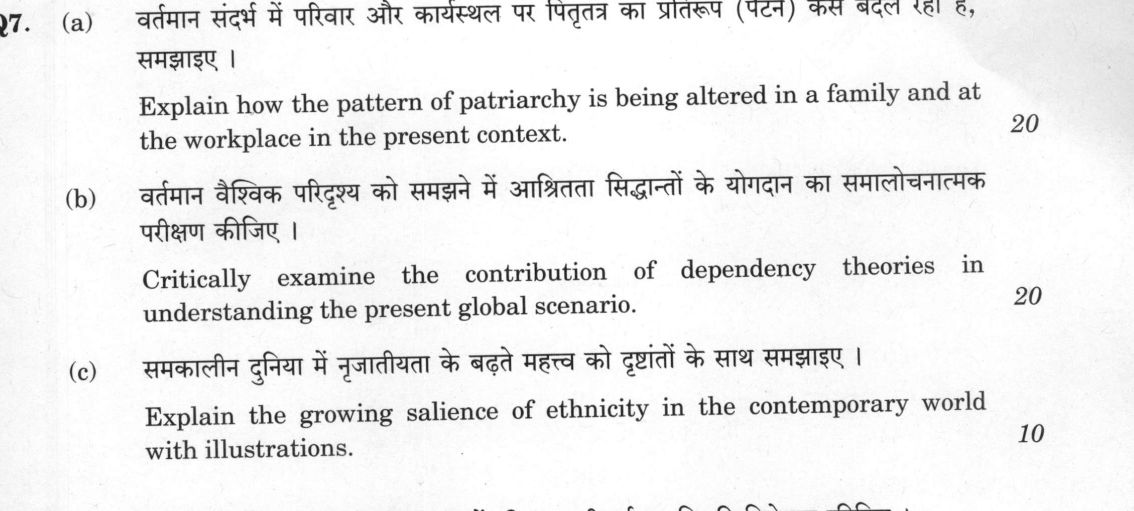
(a) Explain how the pattern of patriarchy is being altered in a family and at the workplace in the present context. 20 (b)…
Explain how the pattern of patriarchy is being altered in a family and at the workplace in the present context. 20 marks
Critically examine the contribution of dependency theories in understanding the present global scenario. 20 marks
Explain the growing salience of ethnicity in the contemporary world with illustrations. 10 marks
हिंदी में प्रश्न पढ़ें
वर्तमान संदर्भ में परिवार और कार्यस्थल पर पितृतंत्र का प्रतिरूप (पैटर्न) कैसे बदल रहा है, समझाइए । 20
वर्तमान वैश्विक परिदृश्य को समझने में आश्रितता सिद्धांतों के योगदान का समालोचनात्मक परीक्षण कीजिए । 20
समकालीन दुनिया में नृजातीयता के बढ़ते महत्व को दृष्टांतों के साथ समझाइए । 10
Model answer
Written by UPSC Answer Check against this question's marking rubric, to the expected length. UPSC does not publish answers for Mains — this is one way to score well, not an official key.
Contemporary socio-economic transformations reveal a dual dynamic where structural forces alter traditional institutions while entrenched hierarchies adaptively reproduce themselves across gender relations, global political economy, and ethnic configurations.
Patterns of Patriarchy in Family and Workplace
In the family, economic modernization causes a structural transition from joint to nuclear families and dual-earner households, granting women greater financial agency. Marriage patterns are altering as evidenced by delayed age at marriage and rising inter-caste unions. Demographically, while sex ratios at birth continue to decline in specific regions due to sex-selection technologies, daughter preference is emerging in urban middle-class pockets due to state incentives and welfare schemes like Beti Bachao Beti Padhao. However, Sylvia Walby's shift from private to public patriarchy remains visible: national Time Use Surveys consistently reveal an asymmetric domestic division of labour, where women continue to shoulder an unequal unpaid care economy burden despite their employment status.
At the workplace, institutional interventions such as the Maternity Benefit (Amendment) Act and collective mobilisations like the #MeToo movement challenge corporate glass ceilings and workplace harassment. Yet patriarchy adapts through the feminisation of the workforce in low-wage informal sectors. In the emerging platform economy and gig work, algorithmic management often reproduces gender disparities, isolating female workers in flexible, precarious, and low-paid home-based service niches.
Dependency Theories in the Contemporary Global Scenario
Classical dependency theories, including the Prebisch-Singer hypothesis and Andre Gunder Frank’s concept of the "development of underdevelopment," alongside Immanuel Wallerstein’s World-Systems analysis, explain how unequal terms of trade lock the periphery into structural subordination to the core. In the contemporary context, this explains modern phenomena such as digital colonialism by multinational tech monopolies, global value chains that concentrate high-value design in the core while shifting low-value extraction to the periphery, and climate debt, where environmental externalisations and ecological damage are shifted disproportionately onto developing nations.
However, dependency theory overstates core-periphery rigidity and neglects internal class dynamics and domestic institutional failures. It fails to explain the rapid industrialisation of East Asian Newly Industrialised Countries (NICs), China's manufacturing rise, or the counter-hegemonic economic coordination of the BRICS grouping. Alternative frameworks—such as W.W. Rostow’s modernisation stages and Amartya Sen’s capability approach—demonstrate that development can be driven internally through targeted human capital investments, governance reforms, and individual capability expansion rather than being perpetually constrained by external dependency.
Growing Salience of Ethnicity in the Contemporary World
Ethnicity increasingly acts as an effective political resource rather than a fading pre-modern remnant. In sociological theory, this reflects the instrumentalist perspective, where ethnic identities are mobilised by elites for material and political gains, countering primordialist assumptions of fixed cultural attachments. This is visible in ethnic nationalism and secessionist assertions in Kashmir and Northeast India, violent ethnic conflicts involving Sri Lankan Tamils and the Rohingya in Myanmar, and institutional accommodations like ethnic federalism in Nepal.
Under globalisation, instead of generating cultural homogenisation, hyper-connectivity stimulates ethnic resurgence. It fuels transnational ethnic networks, diaspora politics influencing homeland policies, and ethnic entrepreneurship in global markets. Concurrently, heightened migration has triggered a sharp backlash against multiculturalism in Western democracies, giving rise to nativist identity politics and defensive ethnic mobilisations.
These contemporary transformations across family structures, global trade, and ethnic identities demonstrate significant operational changes; however, they largely represent the adaptive reproduction of underlying patriarchal, core-periphery, and ethno-political hierarchies rather than their fundamental structural dissolution.
What "Explain" is asking you to do
Make the working of something clear — what sets it off, what follows from what, and what it produces. Explain is the Commission's mechanism word: it dominates the technical papers and the “explain why” stems, where the marks sit in the causal chain and not in the label.
Structure that answers it
State what it is → the initiating condition → the chain of cause, step by step → an instance where it plays out → what the chain produces
Where marks are lost
Describing what something looks like instead of why it works that way. Naming the stages without linking them reads as description too.
How this answer will be evaluated
Approach
Framework: Sociology Paper I (UPSC). (a) explain: definition/context > points in order > small example > short close | (b) critically evaluate: positives > negatives/limits > conditions/safeguards > conclusion | (c) explain: definition/context > points in order > small example > short close Full marks: Precise definitions, named thinkers, specific Indian/global data, and balanced critical analysis.
Key points expected
- Define patriarchy (e.g., Engels, Connell)
- Family: shift from joint to nuclear/egalitarian
- Workplace: women's entry and glass ceiling
- Indian context: NFHS data or legal changes
- Define Dependency Theory (Frank, Cardoso)
- Core-Periphery-Periphery structure
- Critique: ignores internal factors/agency
- Application to current global scenario (e.g., BRICS)
Evaluation rubric
Each sub-part is marked on its own, against the marks and word limit printed on the paper.
- (a) Define patriarchy and detail its structural shifts in family and workplace. 20 marks
explain— definition/context → points in order → small example → short close
Must cover
- Define patriarchy (e.g., Engels, Connell)
- Family: shift from joint to nuclear/egalitarian
- Workplace: women's entry and glass ceiling
- Indian context: NFHS data or legal changes
Loses marks
- Treating family and workplace as separate topics
- Ignoring the 'present context' (modernization)
- Vague generalizations without sociological concepts
Earns more
- Mention 'hegemonic masculinity' (Connell)
- Reference 'Second Shift' (Hochschild)
- Cite 2019/2020 NFHS female workforce data
- Mention 2019 Maternity Benefit Act
Extra mark
- Reference 'Pink Economy' or 'Pink Tax'
- Mention 'Glass Cliff' phenomenon
- (b) Assess Dependency Theory's utility and limits in explaining global inequality. 20 marks
critically evaluate— positives → negatives/limits → conditions/safeguards → conclusion
Must cover
- Define Dependency Theory (Frank, Cardoso)
- Core-Periphery-Periphery structure
- Critique: ignores internal factors/agency
- Application to current global scenario (e.g., BRICS)
Loses marks
- Confusing Dependency with Modernization Theory
- Failing to provide a 'critical' assessment (only pros)
- Ignoring the 'present global scenario' (21st century)
Earns more
- Mention 'Unequal Exchange' (Prebisch-Singer)
- Reference 'World-Systems Theory' (Wallerstein)
- Contrast with Modernization Theory
- Mention 'New International Economic Order' (NIEO)
Extra mark
- Reference 'Dependency' vs 'Underdevelopment' debate
- Mention 'Global Value Chains' as modern dependency
- (c) Explain the resurgence of ethnic identity in the contemporary world. 10 marks
explain— definition/context → points in order → small example → short close
Must cover
- Define ethnicity (Gellner, Anderson)
- Causes: globalization, state failure, identity politics
- Illustration: Balkans, India, or Middle East
- Link to 'imagined communities' or 'primordialism'
Loses marks
- Confusing ethnicity with race or caste
- Lack of specific contemporary illustrations
- Ignoring the 'growing salience' (why now?)
Earns more
- Mention 'Ethno-nationalism' (Gellner)
- Reference 'Constructivism' (Brubaker)
- Cite 'Caste' as ethnicity in India
- Mention 'Identity Politics' (Crenshaw)
Extra mark
- Reference 'Ethnic Cleansing' (Bosnia)
- Mention 'Cultural Globalization' (Appadurai)
Practice this exact question
Write your answer and it is marked point by point against the model answer above — what you covered, what you missed, what you got wrong.
Evaluate my answer →More from Sociology 2021 Paper I
- Q4 (a) Explain the concept of social mobility. Describe with suitable illustrations how educ…
- Q5 Answer the following questions in about 150 words each : 10×5=50 (a) Explain the emerging…
- Q6 (a) Elucidate the main problems and challenges faced by the migrant labourers in the rece…
- Q7 (a) Explain how the pattern of patriarchy is being altered in a family and at the workpla…
- Q8 (a) Discuss the changing nature of kinship relations in the contemporary world. 20 (b) De…