Paper I — Q2
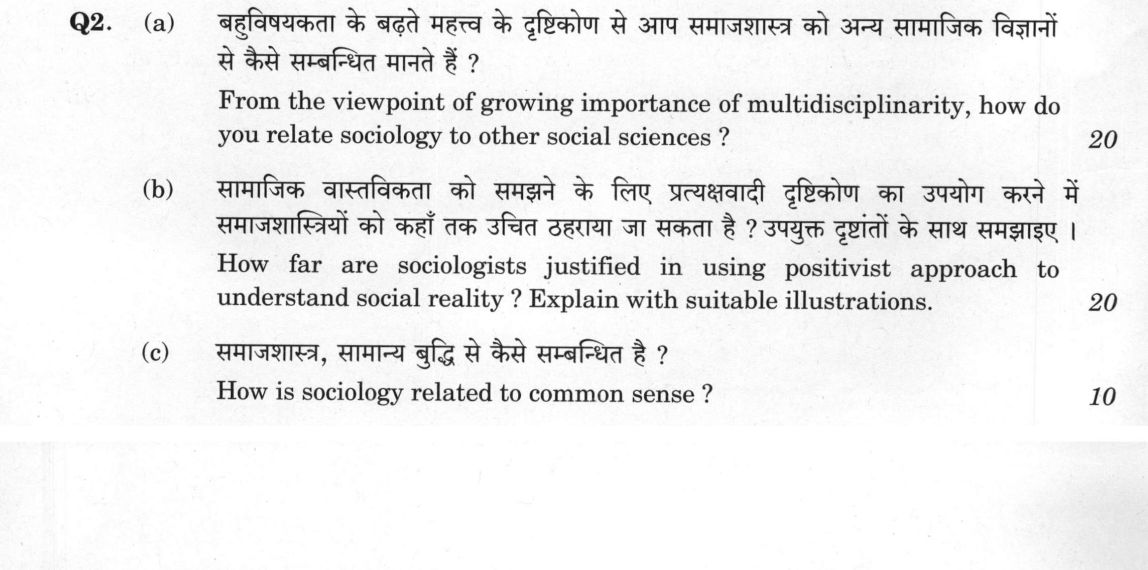
(a) From the viewpoint of growing importance of multidisciplarity, how do you relate sociology to other social sciences ? 20 (b)…
From the viewpoint of growing importance of multidisciplarity, how do you relate sociology to other social sciences ? 20 marks
How far are sociologists justified in using positivist approach to understand social reality ? Explain with suitable illustrations. 20 marks
How is sociology related to common sense ? 10 marks
हिंदी में प्रश्न पढ़ें
बहुविषयकता के बढ़ते महत्व के दृष्टिकोण से आप समाजशास्त्र को अन्य सामाजिक विज्ञानों से कैसे सम्बन्धित मानते हैं ? 20 marks
सामाजिक वास्तविकता को समझने के लिए प्रत्यक्षवादी दृष्टिकोण का उपयोग करने में समाजशास्त्रियों को कहाँ तक उचित ठहराया जा सकता है ? उपयुक्त दृष्टांतों के साथ समझाइए । 20
समाजशास्त्र, सामान्य बुद्धि से कैसे सम्बन्धित है ? 10 marks
Model answer
Written by UPSC Answer Check against this question's marking rubric, to the expected length. UPSC does not publish answers for Mains — this is one way to score well, not an official key.
Sociology occupies an integrative epistemic position within the social sciences. While multidisciplinarity juxtaposes separate disciplines and interdisciplinarity integrates their insights, transdisciplinarity transcends traditional disciplinary boundaries altogether. In this matrix, sociology functions as a bridge discipline. C. Wright Mills conceptualized the sociological imagination precisely to link personal biography with public issues, connecting individual experiences to broader structural and historical currents.
Sociology and Other Social Sciences
Sociology relates to other social sciences by interrogating their unexamined social preconditions. In relation to economics, sociology rejects the reductionist model of homo economicus; Karl Polanyi demonstrated that economic transactions are fundamentally embedded in social networks and institutions, forming the basis of modern economic sociology. In political science, sociology moved analysis beyond formal constitutional machinery toward political sociology, examining power structures, elite dominance, and social movements.
With social anthropology, the traditional division between modern industrial societies and simple non-Western communities has dissolved through shared ethnographic methods and the cultural turn. Sociology intersects with psychology through social psychology; G.H. Mead illustrated that the self is fundamentally social, emerging through symbolic interaction. Finally, historical sociology bridges sociology and history, moving past mere event-chronology to examine structural transformations over time, as seen in E.P. Thompson's history from below.
Positivism: Justification and Limits
Sociologists are justified in using positivism to uncover macro-level structural regularities. Auguste Comte placed sociology atop his hierarchy of sciences, arguing social dynamics follow discoverable laws. Émile Durkheim systematized this in The Rules of Sociological Method, treating social facts as external, coercive things amenable to inductive analysis. Durkheim’s study of Suicide demonstrated that individual acts are causally driven by social integration and moral regulation. In modern research, positivist methodologies remain essential: Robert Putnam quantitatively measured social capital to explain institutional performance, and large-scale data like National Council of Applied Economic Research (NCAER) surveys map structural poverty and mobility.
However, positivism is fundamentally limited because human subjects possess reflexivity, agency, and internal meaning. Max Weber argued that social action requires Verstehen (interpretive understanding), which cannot be captured through external causal laws alone. Alfred Schutz’s phenomenology and postmodern theorists further showed that positivist data often reifies transient social constructs. In India, colonial positivist enumeration through the Census mischaracterized caste as a fixed, rigid category. In contrast, subaltern studies and field sociologists revealed caste to be a fluid, negotiated, and historically contingent relational construct. Positivism is thus justified only as a partial tool for macro-structural mapping, requiring interpretive methods for contextual depth.
Sociology and Common Sense
Sociology differs fundamentally from common sense. While common sense is sporadic, localized, naturalizing, and susceptible to the fallacy of misplaced concreteness, sociology employs systematic methodological doubt, empirical testing, and conceptual rigor. Furthermore, Anthony Giddens identified the double hermeneutic, wherein sociological knowledge continually filters into, disrupts, and reconstructs lay common sense.
In the Indian context, common sense assumes that urbanization inevitably causes the breakdown of the joint family. Sociological research by A.M. Shah and Patricia Uberoi disproves this by demonstrating household complexity, cyclical transformation, and enduring functional jointness. Similarly, common sense often treats communal riots as spontaneous primordial flare-ups; sociological analyses by Paul Brass and Ashutosh Varshney explain them causally through institutionalized riot systems and the absence of cross-cutting civic networks.
Sociology establishes its distinctive disciplinary identity by synthesizing insights across disciplines, balancing empirical-positivist rigor with interpretive sensitivity, and systematically unmasking naturalized common-sense assumptions to explain the underlying mechanisms of social reality.
What "Explain" is asking you to do
Make the working of something clear — what sets it off, what follows from what, and what it produces. Explain is the Commission's mechanism word: it dominates the technical papers and the “explain why” stems, where the marks sit in the causal chain and not in the label.
Structure that answers it
State what it is → the initiating condition → the chain of cause, step by step → an instance where it plays out → what the chain produces
Where marks are lost
Describing what something looks like instead of why it works that way. Naming the stages without linking them reads as description too.
How this answer will be evaluated
Approach
Framework: Sociology Paper 1 (UPSC). (a) discuss: intro > 3-4 dimensions > example > balanced close | (b) critically evaluate: positives > negatives/limits > conditions/safeguards > conclusion | (c) explain: definition/context > points in order > small example > short close Full marks: Clear definitions, named thinkers, strong arguments, Indian illustrations, balanced judgment
Key points expected
- Define multidisciplinarity and its relevance to social science
- Contrast sociology with at least two other social sciences
- Name specific thinkers (e.g., Durkheim, Weber) for each discipline
- Provide an Indian illustration of interdisciplinary application
- Define positivist approach and its core tenets
- Present arguments for using positivism in sociology
- Present arguments against/limitations of positivism
- Provide suitable illustrations for both sides
Evaluation rubric
Each sub-part is marked on its own, against the marks and word limit printed on the paper.
- (a) Relate sociology to other social sciences via the lens of multidisciplinarity. 20 marks
discuss— intro → 3-4 dimensions → example → balanced close
Must cover
- Define multidisciplinarity and its relevance to social science
- Contrast sociology with at least two other social sciences
- Name specific thinkers (e.g., Durkheim, Weber) for each discipline
- Provide an Indian illustration of interdisciplinary application
Loses marks
- Name-dropping thinkers without explaining their arguments
- Treating disciplines as isolated rather than interconnected
- Common-sense opinions without theoretical grounding
Earns more
- Mention specific contemporary debates (e.g., caste and economy)
- Use concepts as analytical tools rather than decoration
- Reference specific Indian data or reports (e.g., NFHS, FLFPR)
- Take a clear position on the relationship
Extra mark
- Cite a specific statistic from FLFPR or NFHS
- Reference a current interdisciplinary debate or policy
- (b) Evaluate the justification of using positivist approach to understand social reality. 20 marks
critically evaluate— positives → negatives/limits → conditions/safeguards → conclusion
Must cover
- Define positivist approach and its core tenets
- Present arguments for using positivism in sociology
- Present arguments against/limitations of positivism
- Provide suitable illustrations for both sides
Loses marks
- One-sided argument without addressing limitations
- Vague illustrations without specific examples
- Confusing positivism with other approaches
Earns more
- Name key positivist thinkers (e.g., Comte, Durkheim)
- Name key anti-positivist thinkers (e.g., Weber, Berger)
- Use specific Indian examples to illustrate points
- Offer a balanced judgment on the approach
Extra mark
- Reference a specific study or data set
- Mention a contemporary debate on methodology
- (c) Explain the relationship between sociology and common sense. 10 marks
explain— definition/context → points in order → small example → short close
Must cover
- Define common sense and its characteristics
- Explain how sociology differs from common sense
- Provide examples where common sense is misleading
- Show how sociology provides a more rigorous understanding
Loses marks
- Treating common sense as always wrong
- Vague examples without specific illustrations
- Failing to show the analytical difference
Earns more
- Name thinkers who discussed this (e.g., Durkheim, Weber)
- Use specific Indian examples
- Show the analytical process sociology uses
- Highlight the value of sociological perspective
Extra mark
- Reference a specific study or finding
- Mention a contemporary example of common sense vs. sociology
Practice this exact question
Write your answer and it is marked point by point against the model answer above — what you covered, what you missed, what you got wrong.
Evaluate my answer →More from Sociology 2021 Paper I
- Q1 Answer the following questions in about 150 words each : 10×5=50 (a) Europe was the first…
- Q2 (a) From the viewpoint of growing importance of multidisciplarity, how do you relate soci…
- Q3 (a) How do qualitative and quantitative methods supplement each other in sociological enq…
- Q4 (a) Explain the concept of social mobility. Describe with suitable illustrations how educ…
- Q5 Answer the following questions in about 150 words each : 10×5=50 (a) Explain the emerging…