Paper II — Q1
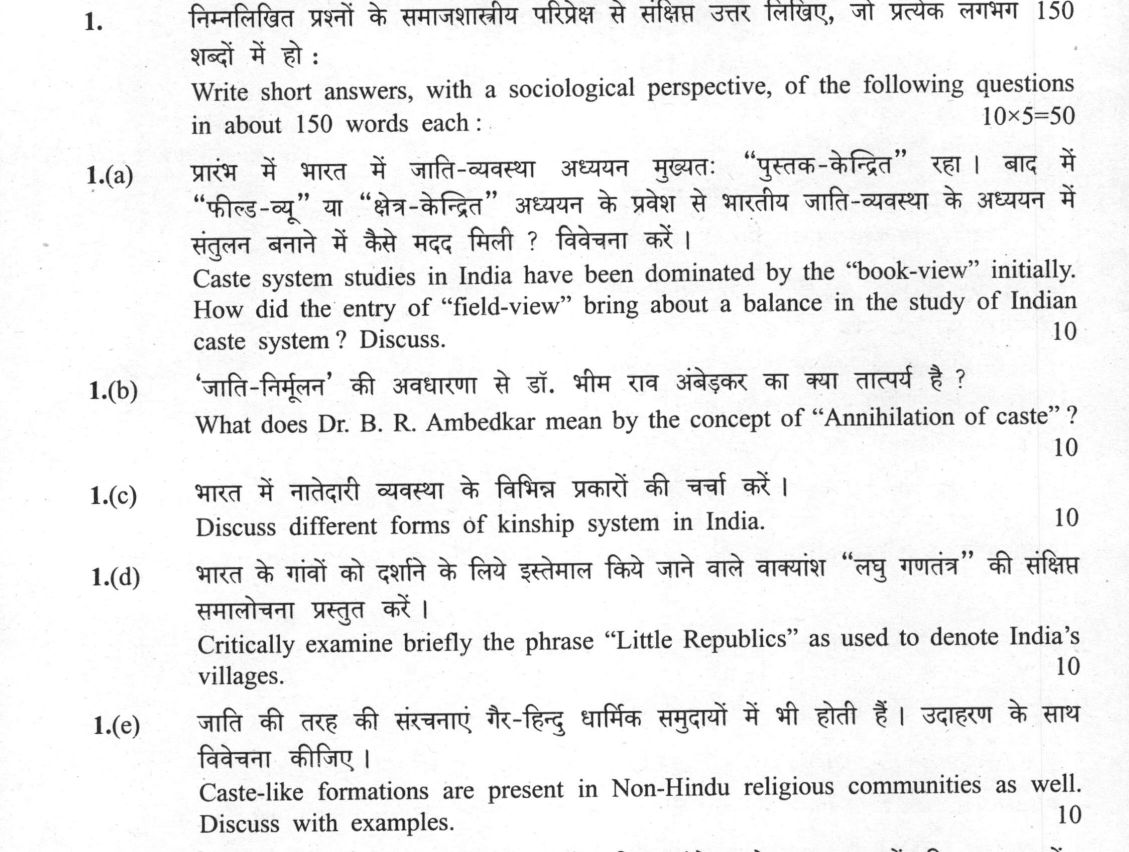
Write short answers, with a sociological perspective, of the following questions in about 150 words each: (a) Caste system…
Write short answers, with a sociological perspective, of the following questions in about 150 words each:
Caste system studies in India have been dominated by the "book-view" initially. How did the entry of "field-view" bring about a balance in the study of Indian caste system ? Discuss. 10 marks
What does Dr. B. R. Ambedkar mean by the concept of "Annihilation of caste" ? 10 marks
Discuss different forms of kinship system in India. 10 marks
Critically examine briefly the phrase "Little Republics" as used to denote India's villages. 10 marks
Caste-like formations are present in Non-Hindu religious communities as well. Discuss with examples. 10 marks
हिंदी में प्रश्न पढ़ें
निम्नलिखित प्रश्नों के समाजशास्त्रीय परिप्रेक्ष्य से संक्षिप्त उत्तर लिखिए, जो प्रत्येक लगभग 150 शब्दों में हो :
प्रारंभ में भारत में जाति-व्यवस्था अध्ययन मुख्यतः "पुस्तक-केंद्रित" रहा । बाद में "फील्ड-व्यू" या "क्षेत्र-केंद्रित" अध्ययन के प्रवेश से भारतीय जाति-व्यवस्था के अध्ययन में संतुलन बनाने में कैसे मदद मिली ? विवेचना करें । (10 अंक)
'जाति-निमूलन' की अवधारणा से डॉ. भीम राव अंबेडकर का क्या तात्पर्य है ? (10 अंक)
भारत में नातेदारी व्यवस्था के विभिन्न प्रकारों की चर्चा करें । (10 अंक)
भारत के गाँवों को दर्शाने के लिए इस्तेमाल किये जाने वाले वाक्यांश "लघु गणतंत्र" की संक्षिप्त समालोचना प्रस्तुत करें । (10 अंक)
जाति की तरह की संरचनाएँ गैर-हिंदू धार्मिक समुदायों में भी होती हैं । उदाहरण के साथ विवेचना कीजिए । (10 अंक)
Model answer
Written by UPSC Answer Check against this question's marking rubric, to the 150-word length. UPSC does not publish answers for Mains — this is one way to score well, not an official key.
(a) Book-View versus Field-View in Caste Studies
Early sociological and anthropological studies of the Indian caste system relied heavily on the "book-view", an Indological and textual approach spearheaded by scholars like G. S. Ghurye and J. H. Hutton. This perspective drew upon sacred Hindu texts like the Dharmashastras, portraying caste as a static, pan-Indian, four-fold varna hierarchy anchored purely in ritual purity and pollution.
The post-Independence shift to the "field-view" introduced intensive empirical village studies by sociologists like M. N. Srinivas (Rampur) and André Béteille (Sripuram). Field-based ethnography shifted the analytical focus from scriptural varna to operational, localized jati clusters. It exposed the dynamic reality of caste mobility through Sanskritization, revealed the secular power of "dominant castes", and balanced ritual considerations with land ownership and political control. Thus, the field-view transformed caste analysis from a rigid cultural abstraction into a dynamic, empirical study of socio-economic power relations.
(b) Dr. B. R. Ambedkar’s "Annihilation of Caste"
In The Annihilation of Caste (1936), Dr. B. R. Ambedkar formulated a radical critique of the caste system, defining it not merely as a division of labour, but as a rigid "division of labourers". Unlike Mahatma Gandhi, who advocated for the reformist preservation of Varnashrama Dharma purged of untouchability, Ambedkar asserted that caste could not be reformed from within because its roots were sanctified by Hindu religious scriptures.
For Ambedkar, structural annihilation required the destruction of the divine authority of the Shastras and Smritis. He identified inter-caste dining as inadequate and argued that inter-caste marriage was the only genuine structural remedy, as it broke blood-purity and lineage-based endogamy. Recognizing the entrenched resistance of the orthodox order, Ambedkar ultimately embraced religious conversion to Buddhism (Navayana) in 1956 as the definitive emancipatory and egalitarian alternative for the depressed classes.
(c) Kinship Systems in India
Kinship in India exhibits profound regional and structural diversity, systematically classified by sociologists such as Irawati Karve along patrilineal, matrilineal, and bilateral patterns.
In North India, the patrilineal-patrilocal system dominates, characterized by agnatic solidarity, strict gotra and village exogamy, and hypergamous or isogamous marriage rules. Cross-cousin marriages are strictly tabooed. Conversely, the South Indian (Dravidian) kinship system features bilateral tendencies and positive marriage rules, encouraging isogamous alliances such as symmetrical cross-cousin and maternal uncle-niece marriages, which consolidate property within extended kin groups.
Matrilineal systems, historically exemplified by the Nayars of Kerala (tarawad) and tribal groups like the Khasi and Garo of Meghalaya, trace descent, inheritance, and residence through the female line, though formal political authority often remains with maternal uncles. Contemporary socioeconomic transformations, urbanization, and legal reforms are increasingly nudging these varied kinship systems toward nuclearization.
(d) Critical Examination of Indian Villages as "Little Republics"
Sir Charles Metcalfe in 1810 coined the phrase "Little Republics" to describe Indian villages as self-sufficient, unchanging, and politically autonomous units governed by traditional caste panchayats.
Sociologists have rigorously critiqued this colonial construct. Louis Dumont in Homo Hierarchicus argued that the village was neither a republic nor an egalitarian commune, but a deeply stratified arena dominated by hierarchical caste relations and the Jajmani system. Dr. Ambedkar denounced the village as a "den of iniquity" and a sink of localism that institutionalized the oppression of Dalits. Furthermore, post-Independence empirical research demonstrated that villages were never entirely isolated. They were historically integrated with wider state taxation systems, and have since been radically transformed through state penetration, Green Revolution agrarian changes, market linkages, and democratic decentralization under the 73rd Constitutional Amendment Act.
(e) Caste-like Formations in Non-Hindu Communities
Although egalitarian in theological doctrine, non-Hindu religious communities in India exhibit distinct caste-like social formations, primarily due to regional conversions and the enduring influence of the local social milieu.
Among Indian Muslims, as documented by David Mandelbaum and Imtiaz Ahmad, social stratification exists between the Ashraf (noble descent, such as Sayyid and Sheikh), the Ajlaf (occupational converts like Ansari and Julaha), and the Arzal (degraded/untouchable groups). Similarly, Indian Christianity displays deep-seated caste divisions; in Kerala, Syrian Christians maintain status superiority over Latin and Dalit Christians, while Tamil Nadu features segregated caste-based parishes and burial grounds. Among Sikhs, despite Sikhism's explicit anti-caste tenets, jati endogamy persists through hierarchized identities such as Jat Sikhs, Ramgarhias (artisans), and Mazhabi or Ravidassia Sikhs (Dalit Sikhs). These formations replicate hierarchy, endogamy, and hereditary occupation without drawing legitimacy from Hindu religious texts.
What "Discuss" is asking you to do
Lay the issue out from more than one side — how it arose, what is claimed for it, what is held against it, and where it now stands. UPSC attaches discuss to broad topics with several live dimensions, so coverage of the dimensions earns more than the strength of your opinion.
Structure that answers it
Set the issue up → the case as it is made → the case against → the dimension both sides leave out → where the balance now lies
Where marks are lost
Listing facts with no thread between them, or arguing one side throughout and calling it a discussion.
How this answer will be evaluated
Approach
Framework: Sociological Perspective (UPSC Sociology Paper II). (a) discuss: intro > 3-4 dimensions > example > balanced close | (b) explain: definition/context > points in order > small example > short close | (c) discuss: intro > 3-4 dimensions > example > balanced close | (d) critique: the claim > its strengths > its weaknesses > your judgment | (e) discuss: intro > 3-4 dimensions > example > balanced close Full marks: Precise definitions, named thinkers, specific examples, balanced critique.
Key points expected
- Define 'book-view' (e.g., M.N. Srinivas, Dumont)
- Define 'field-view' (e.g., M.S. Aney, G.S. Ghurye)
- Explain how fieldwork revealed 'dominance' and 'sanction'
- Mention the shift from ideal to actual practice
- Define 'Annihilation' as total destruction, not reform
- Identify 'Religion' (Hinduism) as the root cause
- Mention 'Inter-dining' and 'Inter-marriage' as methods
- Distinguish from 'Abolition' (which implies keeping the system)
Evaluation rubric
Each sub-part is marked on its own, against the marks and word limit printed on the paper.
- (a) Contrast 'book-view' (textual) vs 'field-view' (empirical) in caste studies. 10 marks · 150 words
discuss— intro → 3-4 dimensions → example → balanced close
Must cover
- Define 'book-view' (e.g., M.N. Srinivas, Dumont)
- Define 'field-view' (e.g., M.S. Aney, G.S. Ghurye)
- Explain how fieldwork revealed 'dominance' and 'sanction'
- Mention the shift from ideal to actual practice
Loses marks
- Treating 'book-view' as merely 'wrong'
- Ignoring the contribution of textual analysis
Earns more
- Reference to 'Dominance and Sanction' (Srinivas)
- Mention of 'Caste in Modern India' (Ghurye)
- Reference to 'Caste in a Small Town' (Aney)
Extra mark
- Mention of specific fieldwork location (e.g., Rampur, Wadgaon)
- (b) Define Ambedkar's 'Annihilation of Caste' and its core arguments. 10 marks · 150 words
explain— definition/context → points in order → small example → short close
Must cover
- Define 'Annihilation' as total destruction, not reform
- Identify 'Religion' (Hinduism) as the root cause
- Mention 'Inter-dining' and 'Inter-marriage' as methods
- Distinguish from 'Abolition' (which implies keeping the system)
Loses marks
- Confusing 'Annihilation' with 'Abolition'
- Focusing only on legal rights, not social change
Earns more
- Reference to 'Annihilation of Caste' (1936) pamphlet
- Mention of 'Hinduism is not a religion' argument
- Reference to 'Untouchability' as a social evil
Extra mark
- Mention of 'Poona Pact' context
- (c) Outline the main forms of kinship systems found in India. 10 marks · 150 words
discuss— intro → 3-4 dimensions → example → balanced close
Must cover
- Define 'Kinship' (blood, marriage, adoption)
- Explain 'Unilineal' (Patrilineal/Matrilineal) systems
- Explain 'Bilateral' (Cognatic) systems
- Mention 'Gotra' and 'Exogamy' rules
Loses marks
- Confusing 'Kinship' with 'Caste'
- Ignoring the role of marriage rules
Earns more
- Example of Matrilineal (e.g., Khasis, Nairs)
- Example of Patrilineal (e.g., Brahmins, Rajputs)
- Mention of 'Joint Family' structure
Extra mark
- Mention of 'Double Descent' (e.g., Khasis)
- (d) Critically evaluate the 'Little Republics' concept of Indian villages. 10 marks · 150 words
critique— the claim → its strengths → its weaknesses → your judgment
Must cover
- Define 'Little Republics' (autonomy, self-sufficiency)
- Mention 'Gandhi' or 'Ghurye' as proponents
- Critique: Lack of autonomy (state interference)
- Critique: Economic dependence (market integration)
Loses marks
- Accepting the concept without critique
- Ignoring the role of the state
Earns more
- Reference to 'Hindu Rural Society' (Ghurye)
- Mention of 'Panchayat' system
- Reference to 'Village as a social unit'
Extra mark
- Mention of 'Rural-Urban continuum'
- (e) Discuss caste-like hierarchies in non-Hindu communities with examples. 10 marks · 150 words
discuss— intro → 3-4 dimensions → example → balanced close
Must cover
- Define 'Caste-like formations' (endogamy, hierarchy)
- Example: Muslims (Ashraf vs Ajlaf)
- Example: Christians (upper vs lower caste converts)
- Example: Sikhs (Rajput vs Jat vs other)
Loses marks
- Claiming non-Hindus have no caste
- Ignoring the role of endogamy
Earns more
- Mention of 'Ashraf' (Sheikh, Sayyid, Mughal, Qureshi)
- Mention of 'Ajlaf' (butchers, tanners)
- Mention of 'Arzal' (untouchables)
Extra mark
- Mention of 'Caste Census' data
Practice this exact question
Write your answer and it is marked point by point against the model answer above — what you covered, what you missed, what you got wrong.
Evaluate my answer →More from Sociology 2021 Paper II
- Q1 Write short answers, with a sociological perspective, of the following questions in about…
- Q2 (a) What is identity politics ? Discuss the main trends in Dalit movements in India. (20…
- Q3 (a) Discuss in detail the major contribution of Prof. Yogendra Singh in theorizing India'…
- Q4 (a) What are the sociological reasons and implication of "reverse migration" during the r…