Paper II — Q6
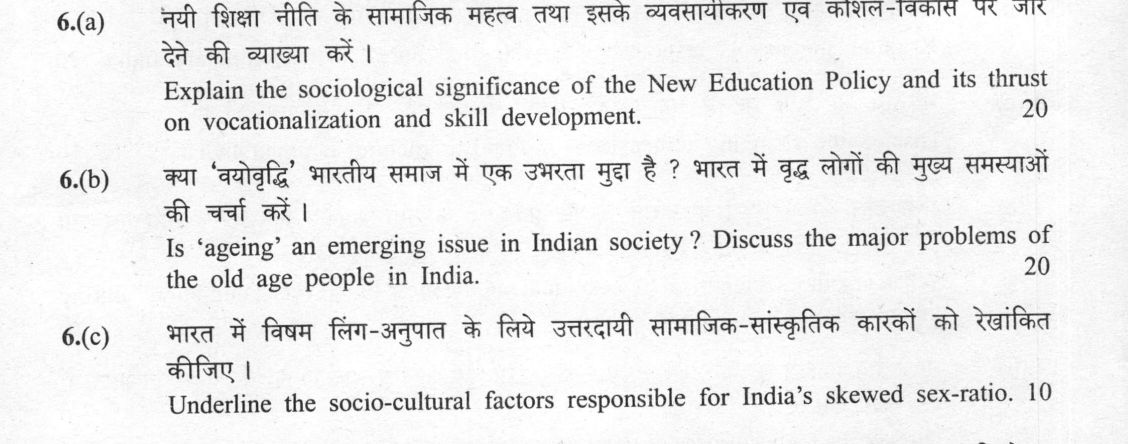
(a) Explain the sociological significance of the New Education Policy and its thrust on vocationalization and skill development…
Explain the sociological significance of the New Education Policy and its thrust on vocationalization and skill development. 20 marks
Is 'ageing' an emerging issue in Indian society ? Discuss the major problems of the old age people in India. 20 marks
Underline the socio-cultural factors responsible for India's skewed sex-ratio. 10 marks
हिंदी में प्रश्न पढ़ें
नयी शिक्षा नीति के सामाजिक महत्व तथा इसके व्यवसायीकरण एवं कौशल-विकास पर जोर देने की व्याख्या करें । (20 अंक)
क्या 'वयोवृद्धि' भारतीय समाज में एक उभरता मुद्दा है ? भारत में वृद्ध लोगों की मुख्य समस्याओं की चर्चा करें । (20 अंक)
भारत में विषम लिंग-अनुपात के लिये उत्तरदायी सामाजिक-सांस्कृतिक कारकों को रेखांकित कीजिए । (10 अंक)
Model answer
Written by UPSC Answer Check against this question's marking rubric, to the expected length. UPSC does not publish answers for Mains — this is one way to score well, not an official key.
Education, ageing and gender are interlocking dimensions of India’s social transformation. The New Education Policy 2020, the rise of an older population, and the skewed sex-ratio all show how structural change is reshaping families, labour markets and social security. Together, they test India’s ability to convert demographic change into development rather than dependency and social exclusion.
Vocationalization under NEP 2020 NEP 2020 replaces the 10+2 pattern with 5+3+3+4, introduces vocational education from Class 6, creates credit banks and multiple entry-exit points. Sociologically, this is significant because Indian education has long suffered from credentialism and what Dore called “diploma disease”: degrees are sought for status rather than productive capacity, while Collins’ credentialism shows how qualifications become gates to employment. From a human-capital perspective, the problem is not only unemployment but underutilized capability: schooling does not convert into skills demanded by the labour market. The result is a “white-collar bias”, mass unemployment among graduates and a mismatch between schooling and work. Vocationalization intervenes by making technical and practical learning normal from middle school, allowing skills to be accumulated through credit banks, and permitting exit and re-entry so that education can follow changing labour-market needs. Multiple entry-exit points also reduce dropout by giving certificates at intermediate stages, making education less all-or-nothing. This can reduce credential inflation, expand employability, and weaken the social hierarchy that treats manual and technical work as inferior.
Ageing as an emerging issue Ageing is emerging because India’s median age is rising and the old-age dependency ratio is increasing, from about 15.7 in 2022 to around 34.7 by 2050, while the elderly share of the population is projected to approach 20 per cent by 2050. As the working-age population shrinks, fewer workers support more elders, raising fiscal and care pressures. NSS 60th and 75th rounds and LASI provide evidence of economic insecurity, health morbidity and caregiving burdens among older people. The issue is not merely numerical; it is structural. Nuclear families, migration and the absence of universal social security mean that many elders depend on children or irregular pensions. The Maintenance and Welfare of Parents and Senior Citizens Act, 2007, recognizes maintenance rights, but it cannot replace universal old-age income. Health transition increases non-communicable disease burden, while digital exclusion limits access to services. Elder abuse, loneliness and empty-nest syndrome become more common as intergenerational support weakens. Feminization of ageing is especially important because women outlive men, often with lower pensions, weaker property rights and greater care responsibilities.
Socio-cultural causes of skewed sex-ratio India’s skewed sex-ratio is produced by son preference embedded in patrilineal and patriarchal property systems. A son is seen as carrying the lineage, performing religious rituals, and providing old-age support, while daughters are associated with dowry as a “burden”. Where daughters are expected to leave the natal home, son preference is reinforced by inheritance and residence norms. These cultural values become demographic when technology mediates sex selection: ultrasound and amniocentesis are misused for female foeticide despite the Pre-Conception and Pre-Natal Diagnostic Techniques Act, 1994, whose enforcement remains weak. Regional variation confirms the cultural-economic mechanism: Punjab, Haryana and Delhi show sharper skew, while Kerala and Tamil Nadu, with higher female literacy and economic participation, show better ratios.
Conclusion These three issues are connected. Education policy can address gender skew by making girls’ education and vocational pathways economically meaningful, and can prepare an ageing workforce through lifelong learning and skill renewal. As the demographic dividend window closes, India must link vocational education, old-age security and gender equity; otherwise rising age dependency and labour-market mismatch will deepen social insecurity. A coherent response requires skill formation, social protection and gender-just education.
What "Explain" is asking you to do
Make the working of something clear — what sets it off, what follows from what, and what it produces. Explain is the Commission's mechanism word: it dominates the technical papers and the “explain why” stems, where the marks sit in the causal chain and not in the label.
Structure that answers it
State what it is → the initiating condition → the chain of cause, step by step → an instance where it plays out → what the chain produces
Where marks are lost
Describing what something looks like instead of why it works that way. Naming the stages without linking them reads as description too.
How this answer will be evaluated
Approach
Framework: Sociology Paper II (Sociology of India). (a) explain: definition/context > points in order > small example > short close | (b) discuss: intro > 3-4 dimensions > example > balanced close | (c) highlight: name the salient points > one line of substance each > close Full marks: Precise sociological analysis with specific Indian data and clear structure.
Key points expected
- Define sociological significance of NEP (2020)
- Explain thrust on vocationalization
- Explain thrust on skill development
- Link to social mobility or structural change
- Establish ageing as an emerging issue (demographic transition)
- Discuss economic problems (poverty, dependency)
- Discuss social problems (isolation, neglect)
- Discuss health/medical problems
Evaluation rubric
Each sub-part is marked on its own, against the marks and word limit printed on the paper.
- (a) Sociological significance of NEP and its focus on vocationalization/skill development. 20 marks
explain— definition/context → points in order → small example → short close
Must cover
- Define sociological significance of NEP (2020)
- Explain thrust on vocationalization
- Explain thrust on skill development
- Link to social mobility or structural change
Loses marks
- General description of NEP without sociological lens
- Confusing vocationalization with mere job training
- Ignoring the 'significance' aspect
Earns more
- Reference to specific NEP 2020 provisions
- Contrast with previous education policies
- Mention of multidisciplinary approach
- Discussion of social equity in education
Extra mark
- Cite specific NEP 2020 target or statistic
- Reference to specific committee report (e.g., NCF)
- (b) Is ageing an emerging issue? Discuss major problems of old age people in India. 20 marks
discuss— intro → 3-4 dimensions → example → balanced close
Must cover
- Establish ageing as an emerging issue (demographic transition)
- Discuss economic problems (poverty, dependency)
- Discuss social problems (isolation, neglect)
- Discuss health/medical problems
Loses marks
- Failing to address the 'emerging issue' aspect
- Listing problems without sociological analysis
- Ignoring the Indian context
Earns more
- Reference to demographic dividend shift
- Mention of urbanization impact on elderly
- Discussion of legal protections (Maintenance Act)
- Reference to specific schemes (Indira Gandhi National Old Age Pension)
Extra mark
- Cite NFHS or Census data on elderly population
- Reference to specific sociological study on elderly
- (c) Socio-cultural factors responsible for India's skewed sex-ratio. 10 marks
highlight— name the salient points → one line of substance each → close
Must cover
- Identify son preference as a key factor
- Discuss dowry system's role
- Mention female feticide/infanticide
- Link to patriarchal social structure
Loses marks
- Focusing only on legal factors
- Ignoring the 'socio-cultural' aspect
- Vague generalizations without specific factors
Earns more
- Reference to caste/class variations in sex ratio
- Mention of economic factors (old age security)
- Discussion of cultural values regarding daughters
- Reference to specific states with skewed ratios
Extra mark
- Cite specific Census data on sex ratio
- Reference to specific sociological theory on gender
Practice this exact question
Write your answer and it is marked point by point against the model answer above — what you covered, what you missed, what you got wrong.
Evaluate my answer →More from Sociology 2021 Paper II
- Q3 (a) Discuss in detail the major contribution of Prof. Yogendra Singh in theorizing India'…
- Q4 (a) What are the sociological reasons and implication of "reverse migration" during the r…
- Q5 Write short answers, with sociological perspective, of the following questions in about 1…
- Q6 (a) Explain the sociological significance of the New Education Policy and its thrust on v…
- Q7 (a) The problem of displacement is inherent in the idea of development. Analyze the state…
- Q8 (a) Discuss the role of social media in communal polarisation. Suggest ways to combat it.…