Paper II — Q3
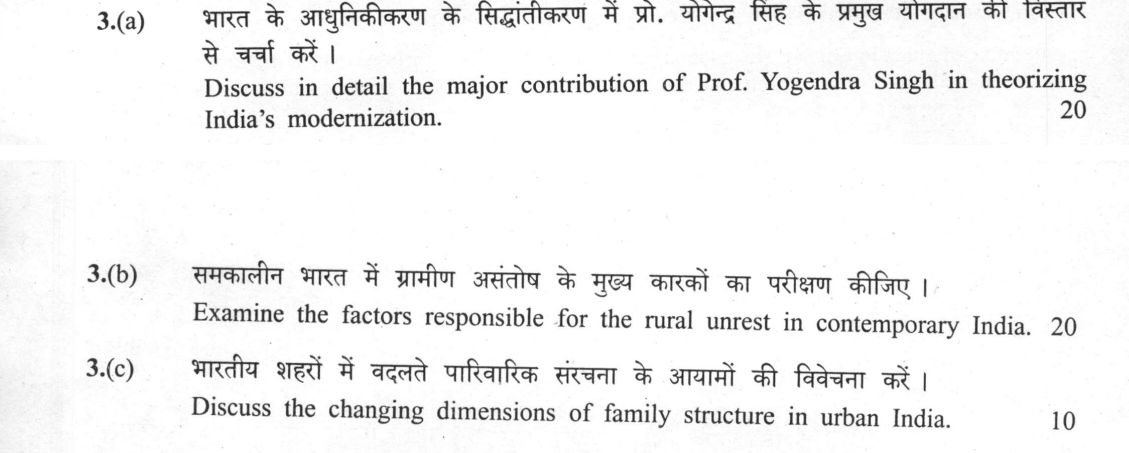
(a) Discuss in detail the major contribution of Prof. Yogendra Singh in theorizing India's modernization. (20 marks) (b) Examine…
Discuss in detail the major contribution of Prof. Yogendra Singh in theorizing India's modernization. 20 marks
Examine the factors responsible for the rural unrest in contemporary India. 20 marks
Discuss the changing dimensions of family structure in urban India. 10 marks
हिंदी में प्रश्न पढ़ें
भारत के आधुनिकीकरण के सिद्धांतीकरण में प्रो. योगेन्द्र सिंह के प्रमुख योगदान की विस्तार से चर्चा करें । (20 अंक)
समकालीन भारत में ग्रामीण असंतोष के मुख्य कारकों का परीक्षण कीजिए । (20 अंक)
भारतीय शहरों में बदलते पारिवारिक संरचना के आयामों की विवेचना करें । (10 अंक)
Model answer
Written by UPSC Answer Check against this question's marking rubric, to the expected length. UPSC does not publish answers for Mains — this is one way to score well, not an official key.
Indian modernization is characterized by a dialectical interplay between tradition and modernity, manifesting in structural transformations across both rural and urban domains.
Yogendra Singh’s Theorization of Modernization
In Modernization of Indian Tradition (1973), Yogendra Singh formulated a comprehensive dialectical framework, arguing that modernization in India is an evolutionary synthesis rather than mere Westernization. Singh distinguished between orthogenetic (internal sources like Sanskritization) and heterogenetic (external impacts like Westernization) changes operating across social structures and cultural traditions. Rejecting the static equilibrium assumptions of structural-functionalism, he introduced concepts of 'cultural choice' and 'adaptive modernization', demonstrating that traditional institutions selectively adopt modern practices without complete structural breakdown. He underscored the tension and coexistence between substantive rationality (embedded in traditional values and sacred norms) and formal rationality (demanded by modern legal, bureaucratic, and democratic structures).
In his later work, Indian Sociology: Cultural and Structural Dimensions, Singh critiqued both Indological approaches for their textual bias and Marxist models for economic reductionism. He advocated for indigenous conceptual frameworks grounded in an institutional-structural analysis of change, capable of capturing India’s multi-layered social reality without falling into parochialism.
Factors Responsible for Rural Unrest
Contemporary rural unrest stems from structural agrarian distress alongside wider political-economic and social dislocations. Economically, smallholders face an acute input cost squeeze (rising costs of seeds, power, and fertilizers), unremunerative crop prices, and inadequate implementation of Minimum Support Prices (MSP). This vulnerability is exacerbated by climate shocks, hyper-fragmentation of landholdings, and tenancy insecurity, leading to chronic indebtedness and tragic agrarian suicides, prominently in regions like Vidarbha, Maharashtra. The 2020–21 farmers' protests highlighted deep-seated agrarian anxieties over market liberalization and corporate entry.
From a political economy perspective, neoliberal state retrenchment and corporate land acquisition have displaced rural populations, while the weakening of Panchayati Raj institutions has curtailed decentralized dispute resolution. Simultaneously, rural unrest is fueled by identity mobilizations. Persistent caste atrocities against Dalits conflict with the aspirations of agrarian dominant castes (such as Marathas, Patidars, and Jats), who, facing agricultural stagnation and shrinking rural employment, have organized massive mobilizations demanding OBC reservation.
Changing Dimensions of Urban Family Structure
Urbanization, market forces, and changing value systems have reconfigured the structure and functions of the Indian family. Structurally, alongside the prevalence of nuclear households, urban areas increasingly witness single-parent units, female-headed households, delayed age at marriage, and rising rates of divorce and marital separation. Functionally, the family has transitioned from a self-contained unit of production to primarily a unit of consumption and mutual emotional support.
These transitions display marked class-differentiated patterns. Elite groups form transnational families, managing wealth and kin ties across global borders. The urban middle class adapts through dual-career arrangements, negotiating gender roles and outsourcing eldercare or childcare. Conversely, working-class families experience disruption driven by informalization of labor, economic precarity, and distress-driven female labor force participation. Across all strata, digital technology and smart devices have introduced technology-mediated intimacy, transforming spousal communication, child-rearing, and intergenerational ties.
Modernization in India remains an uneven and contested process. Addressing the resulting agrarian crises and urban domestic adaptations necessitates responsive public policies, comprehensive agrarian risk mitigation, and expanded social welfare frameworks tailored to evolving family structures.
What "Discuss" is asking you to do
Lay the issue out from more than one side — how it arose, what is claimed for it, what is held against it, and where it now stands. UPSC attaches discuss to broad topics with several live dimensions, so coverage of the dimensions earns more than the strength of your opinion.
Structure that answers it
Set the issue up → the case as it is made → the case against → the dimension both sides leave out → where the balance now lies
Where marks are lost
Listing facts with no thread between them, or arguing one side throughout and calling it a discussion.
How this answer will be evaluated
Approach
Framework: Sociology Paper II (Indian Society). (a) discuss: intro > 3-4 dimensions > example > balanced close | (b) examine: intro > how/why with reasoning > evidence > conclusion | (c) discuss: intro > 3-4 dimensions > example > balanced close Full marks: Rigorous theoretical application (Yogendra Singh) with specific Indian data (NFHS/Census) and critical analysis of structural causes.
Key points expected
- Define 'modernization' in the Indian context
- Explain the 'Sanskritization' concept and its limits
- Discuss 'Secularization' and 'Westernization' as distinct processes
- Analyze the 'Cultural Lag' or 'Structural Lag' argument
- Link unrest to agrarian distress (debt, crop failure)
- Analyze the impact of 'Green Revolution' inequalities
- Discuss the role of 'Land Reforms' (or lack thereof)
- Examine the 'Rural-Urban' divide and migration
Evaluation rubric
Each sub-part is marked on its own, against the marks and word limit printed on the paper.
- (a) Detailed theoretical analysis of Prof. Yogendra Singh's contribution to Indian modernization. 20 marks
discuss— intro → 3-4 dimensions → example → balanced close
Must cover
- Define 'modernization' in the Indian context
- Explain the 'Sanskritization' concept and its limits
- Discuss 'Secularization' and 'Westernization' as distinct processes
- Analyze the 'Cultural Lag' or 'Structural Lag' argument
Loses marks
- Confusing 'Sanskritization' with 'Westernization'
- Treating modernization as purely economic (GDP)
- Name-dropping without explaining the theoretical mechanism
Earns more
- Reference to 'The Sociology of Modernization' (1972)
- Contrast with M.N. Srinivas or A. Appadurai
- Mention 'Cultural Change' vs 'Social Change'
- Critique of the 'Western' model of modernization
Extra mark
- Specific example of 'Sanskritization' (e.g., Jats or Marathas)
- Reference to 'Caste and Modernity' debate
- (b) Critical analysis of the structural and economic causes of rural unrest in contemporary India. 20 marks
examine— intro → how/why with reasoning → evidence → conclusion
Must cover
- Link unrest to agrarian distress (debt, crop failure)
- Analyze the impact of 'Green Revolution' inequalities
- Discuss the role of 'Land Reforms' (or lack thereof)
- Examine the 'Rural-Urban' divide and migration
Loses marks
- Attributing unrest solely to 'political' factors
- Ignoring the 'economic' root causes
- Generalizing 'rural' as a monolithic entity
Earns more
- Reference to 'Farmers' Agitation' (2018-19 or 2020-21)
- Mention 'NFHS' data on rural poverty
- Discuss 'MGNREGA' as a safety net
- Analyze the role of 'Middlemen' and 'MFI' (Microfinance)
Extra mark
- Specific statistic on 'Farmer Suicide' rates
- Reference to 'NCRB' data on rural crime
- (c) Analysis of the structural and functional changes in family systems in urban India. 10 marks
discuss— intro → 3-4 dimensions → example → balanced close
Must cover
- Shift from 'Joint' to 'Nuclear' family
- Rise of 'Single-person' households
- Changing 'Gender Roles' (women's workforce participation)
- Impact of 'Urbanization' on family cohesion
Loses marks
- Ignoring the 'economic' drivers of change
- Treating 'urban' families as a monolith
- Focusing only on 'legal' changes (e.g., divorce laws)
Earns more
- Reference to 'NFHS' data on family size
- Mention 'Live-in' relationships
- Discuss 'Elderly' care in urban settings
- Analyze 'Consumerism' and family dynamics
Extra mark
- Specific statistic on 'Divorce' rates in urban India
- Reference to 'Census' data on 'Single' households
Practice this exact question
Write your answer and it is marked point by point against the model answer above — what you covered, what you missed, what you got wrong.
Evaluate my answer →More from Sociology 2021 Paper II
- Q1 Write short answers, with a sociological perspective, of the following questions in about…
- Q2 (a) What is identity politics ? Discuss the main trends in Dalit movements in India. (20…
- Q3 (a) Discuss in detail the major contribution of Prof. Yogendra Singh in theorizing India'…
- Q4 (a) What are the sociological reasons and implication of "reverse migration" during the r…
- Q5 Write short answers, with sociological perspective, of the following questions in about 1…
- Q6 (a) Explain the sociological significance of the New Education Policy and its thrust on v…