Paper II — Q5
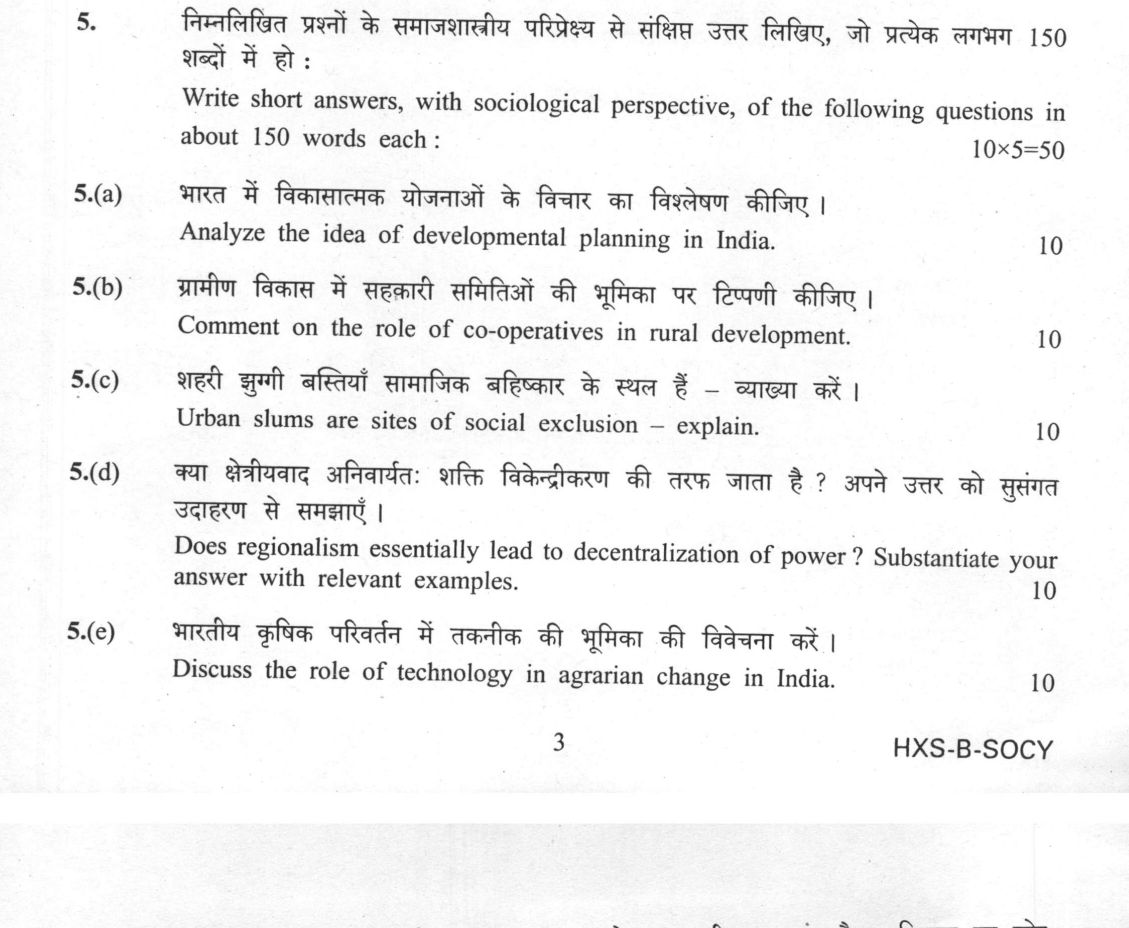
Write short answers, with sociological perspective, of the following questions in about 150 words each: (a) Analyze the idea of…
Write short answers, with sociological perspective, of the following questions in about 150 words each:
Analyze the idea of developmental planning in India. 10 marks
Comment on the role of co-operatives in rural development. 10 marks
Urban slums are sites of social exclusion – explain. 10 marks
Does regionalism essentially lead to decentralization of power ? Substantiate your answer with relevant examples. 10 marks
Discuss the role of technology in agrarian change in India. 10 marks
हिंदी में प्रश्न पढ़ें
निम्नलिखित प्रश्नों के समाजशास्त्रीय परिप्रेक्ष्य से संक्षिप्त उत्तर लिखिए, जो प्रत्येक लगभग 150 शब्दों में हो :
भारत में विकासात्मक योजनाओं के विचार का विश्लेषण कीजिए । (10 अंक)
ग्रामीण विकास में सहकारी समितियों की भूमिका पर टिप्पणी कीजिए । (10 अंक)
शहरी झुग्गी बस्तियाँ सामाजिक बहिष्कार के स्थल हैं – व्याख्या करें । (10 अंक)
क्या क्षेत्रीयवाद अनिवार्यतः शक्ति विकेन्द्रीकरण की तरफ जाता है ? अपने उत्तर को सुसंगत उदाहरण से समझाएँ । (10 अंक)
भारतीय कृषिक परिवर्तन में तकनीक की भूमिका की विवेचना करें । (10 अंक)
Model answer
Written by UPSC Answer Check against this question's marking rubric, to the 150-word length. UPSC does not publish answers for Mains — this is one way to score well, not an official key.
(a) Developmental Planning in India
Developmental planning in post-independence India was conceptualized as a state-led modernization project to overcome colonial stagnation, eliminate poverty, and build a self-reliant economy. Guided by the Nehru-Mahalanobis model, it prioritized heavy industrialization and state-controlled import substitution within a mixed-economy framework orchestrated by the Planning Commission. Sociologically, Gunnar Myrdal characterized this framework as operating within a "soft state" incapable of enforcing social discipline or executing radical land reforms. Rudolph and Rudolph highlighted the tension between "command politics" (state-directed planning) and "demand politics" (electoral mobilization). Furthermore, Pranab Bardhan’s political economy perspective revealed that developmental planning became a site of resource-sharing among three "dominant proprietary classes"—industrial capitalists, rich farmers, and white-collar professionals—undermining redistributive goals. The institutional shift from the centralized Planning Commission to NITI Aayog reflects a structural transition from social-democratic planning toward neo-liberal, market-driven indicative planning.
(b) Role of Co-operatives in Rural Development
Co-operatives were envisioned as institutional instruments of democratic decentralization and egalitarian transformation in rural India. The Anand model (AMUL) exemplified how collective marketing could eliminate agrarian intermediaries, empower smallholder milk producers, and foster women's socio-economic inclusion. Similarly, Primary Agricultural Credit Societies (PACS), linked with schemes like the Integrated Rural Development Programme (IRDP), expanded institutional credit and weakened the grip of usurious moneylenders. However, cooperatives have frequently reproduced rural stratification. As M.N. Srinivas observed, cooperatives succumbed to caste factionalism, where "dominant castes" captured executive boards to consolidate local power and patron-client "vote banks." Bardhan’s political economy lens underscores how landed elites in western India hijacked sugar and credit cooperatives to corner state subsidies. Thus, while structurally transformative, the developmental role of cooperatives remains constrained by entrenched caste and class hierarchies.
(c) Urban Slums as Sites of Social Exclusion
Urban slums epitomize the spatialization of social inequality, where the urban poor are physically concentrated yet structurally excluded from citizenship entitlements. Applying Henri Lefebvre’s spatial sociology, slums demonstrate how the capitalist "production of space" denies subaltern classes the "right to the city." Slum dwellers, predominantly drawn from marginalized castes and circular migrants, endure what Jan Breman terms the precarious existence of "footloose labour"—informalized, underpaid, and deprived of legal protections. In settlements like Mumbai’s Dharavi, spatial exclusion manifests as a lack of secure tenure rights, inadequate civic provisioning, and chronic environmental injustice. This precarious ecological and legal status subjects residents to eviction threats while subsidizing the wider urban economy with cheap labor. Consequently, slums function not as transitional spaces of assimilation, but as institutionalized sites of socio-spatial and political exclusion.
(d) Regionalism and Decentralization of Power
Regionalism in India exhibits an ambivalent relationship with the decentralization of power, acting alternately as a federalizing catalyst and a centralizing provocation. Within K.C. Wheare’s framework of India's "quasi-federal" polity, democratic regionalism has effectively checked unitary tendencies. Sub-national mobilizations led by the DMK in Tamil Nadu and the Shiromani Akali Dal in Punjab challenged over-centralization, compelled fiscal devolution via the Sarkaria Commission, and strengthened multi-party federal governance. As Subrata Mitra argues, regional parties successfully integrated vernacular elites into national democratic institutions. However, regionalism does not essentially lead to decentralization. Secessionist trajectories—such as the Khalistan movement or the United Liberation Front of Asom (ULFA)—demanded territorial separation rather than democratic devolution, prompting centralized state repression. Furthermore, regional political elites frequently centralize power within their states, resisting decentralization to local Panchayati Raj institutions.
(e) Technology in Agrarian Change in India
Technological interventions have served as the prime driver of agrarian change in India, reshaping class relations, production modes, and ecological systems. The Green Revolution introduced High-Yielding Varieties (HYV) of seeds, chemical inputs, and tubewell mechanization, securing national food self-sufficiency but sharpening socio-spatial inequalities. As Pranab Bardhan noted, capital-intensive technology favored resource-rich farmers, accelerating agrarian capitalism and the proletarianization of smallholders. Vandana Shiva’s deskilling thesis argues that corporate-driven biotechnology displaced indigenous knowledge systems and ecological balance, aggravating agrarian debt. Modern digital interventions like the Electronic National Agriculture Market (e-NAM) aim to integrate supply chains, yet risk excluding digitally illiterate smallholders. The 2020-21 farmer protests underscored persistent anxieties regarding corporate-technological hegemony over agrarian livelihoods, demonstrating that technology in agriculture remains deeply contested.
What "Analyse" is asking you to do
Break the subject into its working parts and show how they act on each other. The marks are in the interconnections — which factor drives which, and what the resulting structure explains — not in the inventory of factors.
Structure that answers it
Define the whole → separate it into its parts → show which part drives which → what that interaction produces → what the structure implies
Where marks are lost
A flat list of causes with no account of which drives which. An answer of neatly separated headings, each self-contained, scores as description.
How this answer will be evaluated
Approach
Framework: Sociological Perspective (Paper II). (a) analyse: intro > causes > effects > stakeholders/linkages > way forward | (b) comment: context > arguments both sides > judgment > close | (c) explain: definition/context > points in order > small example > short close | (d) justify: claim > 3-4 reasons > evidence > conclusion | (e) discuss: intro > 3-4 dimensions > example > balanced close Full marks: Sociological depth, specific Indian examples, and clear argumentation.
Key points expected
- Define developmental planning (e.g., Goswami or N. Rajaram).
- Analyze the 'trickle-down' vs 'bottom-up' debate.
- Examine the role of the Planning Commission.
- Link planning to structural transformation.
- Define co-operatives (e.g., Gandhian or Marxist view).
- Discuss the role in credit and marketing.
- Analyze the 'elite capture' of co-operative structures.
- Assess the impact on rural social hierarchy.
Evaluation rubric
Each sub-part is marked on its own, against the marks and word limit printed on the paper.
- (a) Critique the structural and social logic of India's Five Year Plans. 10 marks · 150 words
analyse— intro → causes → effects → stakeholders/linkages → way forward
Must cover
- Define developmental planning (e.g., Goswami or N. Rajaram).
- Analyze the 'trickle-down' vs 'bottom-up' debate.
- Examine the role of the Planning Commission.
- Link planning to structural transformation.
Loses marks
- Treating planning as mere economic policy.
- Ignoring the social dimension of development.
Earns more
- Mention the NITI Aayog transition.
- Reference the 'Hindu Rate of Growth' critique.
- Discuss the 'Green Revolution' as a planning outcome.
Extra mark
- Cite specific Five Year Plan targets (e.g., 12th Plan).
- (b) Evaluate the sociological utility of co-operatives in rural India. 10 marks · 150 words
comment— context → arguments both sides → judgment → close
Must cover
- Define co-operatives (e.g., Gandhian or Marxist view).
- Discuss the role in credit and marketing.
- Analyze the 'elite capture' of co-operative structures.
- Assess the impact on rural social hierarchy.
Loses marks
- Ignoring the political manipulation of co-ops.
- Failing to link to rural development.
Earns more
- Mention specific sectors (e.g., dairy, sugar).
- Reference the 'Amul' model.
- Discuss the 'co-operative federalism' aspect.
Extra mark
- Cite data on co-operative membership or credit flow.
- (c) Explain how urban slums function as sites of social exclusion. 10 marks · 150 words
explain— definition/context → points in order → small example → short close
Must cover
- Define 'social exclusion' (e.g., Sen or Sen's capabilities).
- Explain the spatial segregation of slums.
- Analyze the denial of civic rights (water, sanitation).
- Discuss the 'informal' nature of slum labor.
Loses marks
- Focusing only on physical infrastructure.
- Ignoring the social and political dimensions.
Earns more
- Reference the 'Right to the City' (Lefebvre).
- Mention the 'Slum Rehabilitation' policies.
- Discuss the 'urban poor' vs 'urban elite' divide.
Extra mark
- Cite specific slum data (e.g., Mumbai or Delhi).
- (d) Justify the link between regionalism and decentralization of power. 10 marks · 150 words
justify— claim → 3-4 reasons → evidence → conclusion
Must cover
- Define 'regionalism' (e.g., Laski or K. C. Wheare).
- Explain the 'demand for autonomy' aspect.
- Analyze the 'federalism' vs 'unitary' tension.
- Provide examples (e.g., Punjab, Assam, or Northeast).
Loses marks
- Confusing regionalism with separatism.
- Failing to provide concrete examples.
Earns more
- Mention the 'Sixth Schedule' or 'Fifth Schedule'.
- Discuss the 'Gautam Buddha University' case (if relevant).
- Reference the 'Panchayati Raj' as a decentralization tool.
Extra mark
- Cite specific constitutional amendments (e.g., 71st or 72nd).
- (e) Discuss the role of technology in agrarian change in India. 10 marks · 150 words
discuss— intro → 3-4 dimensions → example → balanced close
Must cover
- Define 'agrarian change' (e.g., R. H. Tawney).
- Analyze the 'Green Revolution' as a technological shift.
- Explain the 'mechanization' of agriculture.
- Discuss the 'digital agriculture' (e.g., e-NAM) aspect.
Loses marks
- Ignoring the social impact of technology.
- Failing to link to 'agrarian change'.
Earns more
- Mention the 'Kisan Credit Card' (KCC).
- Reference the 'PM-KISAN' scheme.
- Discuss the 'drone' technology in farming.
Extra mark
- Cite specific data on agricultural productivity.
Practice this exact question
Write your answer and it is marked point by point against the model answer above — what you covered, what you missed, what you got wrong.
Evaluate my answer →More from Sociology 2021 Paper II
- Q2 (a) What is identity politics ? Discuss the main trends in Dalit movements in India. (20…
- Q3 (a) Discuss in detail the major contribution of Prof. Yogendra Singh in theorizing India'…
- Q4 (a) What are the sociological reasons and implication of "reverse migration" during the r…
- Q5 Write short answers, with sociological perspective, of the following questions in about 1…
- Q6 (a) Explain the sociological significance of the New Education Policy and its thrust on v…
- Q7 (a) The problem of displacement is inherent in the idea of development. Analyze the state…
- Q8 (a) Discuss the role of social media in communal polarisation. Suggest ways to combat it.…