Paper II — Q8
(a) Discuss the role of social media in communal polarisation. Suggest ways to combat it. (20 marks) (b) Urban settlements in…
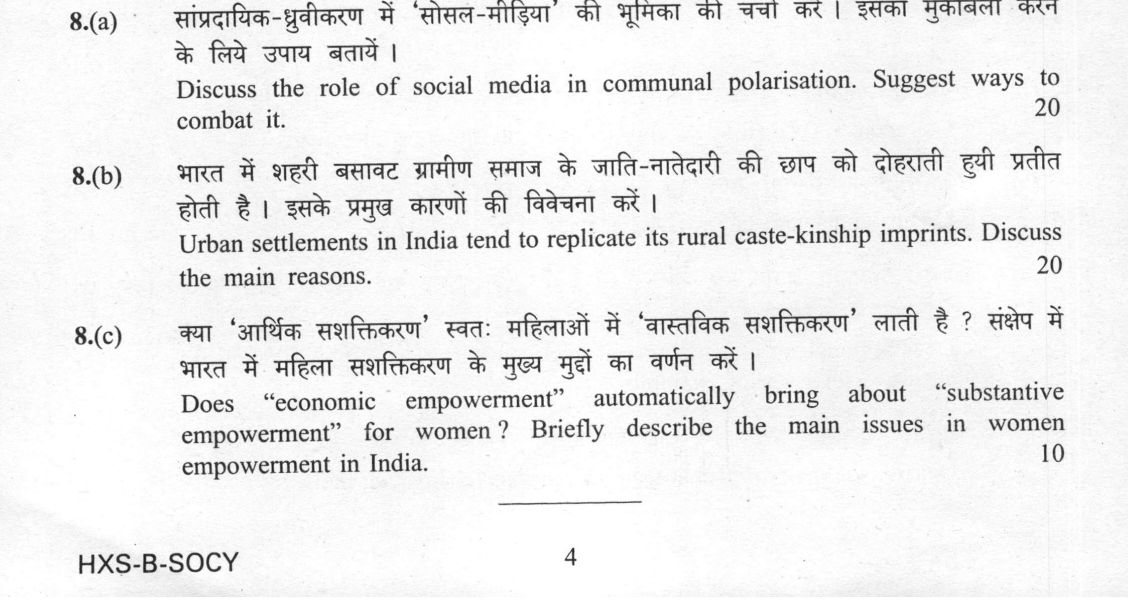
Discuss the role of social media in communal polarisation. Suggest ways to combat it. 20 marks
Urban settlements in India tend to replicate its rural caste-kinship imprints. Discuss the main reasons. 20 marks
Does "economic empowerment" automatically bring about "substantive empowerment" for women ? Briefly describe the main issues in women empowerment in India. 10 marks
हिंदी में प्रश्न पढ़ें
सांप्रदायिक-ध्रुवीकरण में 'सोशल-मीडिया' की भूमिका की चर्चा करें । इसका मुकाबला करने के लिये उपाय बतायें । (20 अंक)
भारत में शहरी बसावट ग्रामीण समाज के जाति-नातेदारी की छाप को दोहराती हुयी प्रतीत होती है । इसके प्रमुख कारणों की विवेचना करें । (20 अंक)
क्या 'आर्थिक सशक्तिकरण' स्वतः महिलाओं में 'वास्तविक सशक्तिकरण' लाती है ? संक्षेप में भारत में महिला सशक्तिकरण के मुख्य मुद्दों का वर्णन करें । (10 अंक)
Model answer
Written by UPSC Answer Check against this question's marking rubric, to the expected length. UPSC does not publish answers for Mains — this is one way to score well, not an official key.
Contemporary Indian society exhibits a complex interplay where primordial identities and modern institutions continuously reshape one another across digital spheres, urban geographies, and gender relations.
Social Media and Communal Polarisation
Digital communication platforms have transformed the sociology of collective violence. Social media architectures optimize algorithms for engagement and emotional arousal, driving affective polarisation. As Cass Sunstein observes, online spaces rapidly become "echo chambers," while Eli Pariser highlights how algorithmic "filter bubbles" insulate users from alternative viewpoints, reinforcing prejudices. In India, encrypted messaging ecosystems—particularly WhatsApp forwards—have circulated doctored videos and hate speech that directly precipitated mob lynchings and localized riots.
Combating this requires a multidimensional approach:
- Regulatory and legal measures: Enforcing the Information Technology (Intermediary Guidelines and Digital Media Ethics Code) Rules, 2021, to hold platforms accountable for systemic amplification of hate speech, complemented by the rigorous application of Section 153A of the Indian Penal Code against instigators.
- Fact-checking and counter-speech: Strengthening independent civil-society fact-checking networks like AltNews to debunk disinformation before it reaches viral thresholds, alongside promoting state- and citizen-led counter-speech campaigns.
- Digital literacy: Institutionalising digital media literacy in school curricula to train citizens in critical media consumption and source verification.
Caste and Kinship Imprints in Urban Settlements
Urbanisation has not dissolved caste; rather, it has reorganized it. As M.N. Srinivas demonstrated, the traditional village-level "vertical solidarity" of inter-caste interdependence has transitioned into urban "horizontal solidarity," where caste groups consolidate across urban space.
First, kinship networks function as primary migration chains and urban survival strategies, channeling rural migrants into specific informal occupations and residential enclaves. Consequently, urban labour markets mirror rural stratification, creating caste-based occupational niches—seen in the near-total Dalit concentration in sanitation work (safai karamcharis) and distinct caste segmentations within construction labour.
Second, housing segregation remains entrenched. Empirical measures like the Banerjee-Bajaj index highlight intense residential segregation in major Indian metros, where discriminatory tenancy practices and caste-exclusive housing cooperatives produce micro-ghettoisation.
Third, caste associations have adapted into modern urban interest groups, managing community halls, matrimonial networks, and electoral vote banks. As Satish Deshpande argues, caste reproduces itself within modern urban institutions: upper-caste cultural and social capital is invisibilised as "merit," while marginalized groups remain structurally excluded from prime economic and spatial resources.
Economic versus Substantive Empowerment for Women
Economic empowerment—defined by income generation, microcredit access, or formal employment—does not automatically secure substantive empowerment. Applying Naila Kabeer’s framework, "resources" (economic inputs) only produce "achievements" (well-being and equity) when mediated by "agency" (the ability to define goals and act upon them, including bodily autonomy and independent decision-making).
Key structural issues constraining women's substantive empowerment in India include:
- Patriarchal property regimes: Despite progressive amendments to the Hindu Succession Act, de facto ownership and control over land and assets remain heavily skewed toward men.
- Unpaid care burden: Women perform a disproportionate share of domestic and care work, which curtails their leisure, mobility, and career progression.
- Digital gender divide: Disparities in device access and digital literacy exclude women from emerging economic and civic spaces.
- Political under-representation: Women remain marginal in formal decision-making bodies, holding under fifteen percent of seats in Parliament.
- Cultural tenacity of son preference: Adverse child sex ratios and sex-selective practices persist even among economically prosperous and educated urban households.
Conclusion
These structural domains intersect directly. An intersectional lens reveals that urban Dalit women experience compounded vulnerabilities: segregated in urban slums, confined to precarious manual occupations, denied substantive economic agency, and subjected to targeted online harassment. A meaningful way forward demands moving beyond formal legal provisions toward structural interventions—democratizing digital algorithms, dismantling caste monopolies in urban housing and labour, and reallocating unpaid care work to realize genuine social citizenship.
What "Discuss" is asking you to do
Lay the issue out from more than one side — how it arose, what is claimed for it, what is held against it, and where it now stands. UPSC attaches discuss to broad topics with several live dimensions, so coverage of the dimensions earns more than the strength of your opinion.
Structure that answers it
Set the issue up → the case as it is made → the case against → the dimension both sides leave out → where the balance now lies
Where marks are lost
Listing facts with no thread between them, or arguing one side throughout and calling it a discussion.
How this answer will be evaluated
Approach
Framework: Sociology Paper II (HXS-B-SOCY). (a) discuss: intro > 3-4 dimensions > example > balanced close | (b) discuss: intro > 3-4 dimensions > example > balanced close | (c) comment: context > arguments both sides > judgment > close Full marks: Precise definitions, clear analytical structure, specific Indian examples, and balanced arguments.
Key points expected
- Define 'communal polarization' in the digital context
- Explain 'echo chambers' and 'algorithmic bias' as drivers
- Identify 'fake news' and 'meme warfare' as tools
- Suggest specific measures (IT Rules, digital literacy, regulation)
- Define 'caste-kinship imprints' in an urban setting
- Explain 'migration' as a carrier of rural social structures
- Analyze 'residential segregation' (e.g., caste colonies)
- Discuss 'occupational clustering' based on caste
Evaluation rubric
Each sub-part is marked on its own, against the marks and word limit printed on the paper.
- (a) Analyze the mechanism of social media in communal polarization and propose counter-measures. 20 marks
discuss— intro → 3-4 dimensions → example → balanced close
Must cover
- Define 'communal polarization' in the digital context
- Explain 'echo chambers' and 'algorithmic bias' as drivers
- Identify 'fake news' and 'meme warfare' as tools
- Suggest specific measures (IT Rules, digital literacy, regulation)
Loses marks
- Treating social media as a monolith without nuance
- Vague suggestions like 'ban social media' without analysis
- Ignoring the role of state or political actors
Earns more
- Reference to 'fake news' during 2019 elections
- Mention of 'IT Rules 2021' or 'Section 66A' (historical)
- Concept of 'digital divide' in access to information
- Role of 'influencers' in shaping public opinion
Extra mark
- Citing a specific Supreme Court judgment on hate speech
- Reference to a specific government committee on digital ethics
- (b) Explain why urban settlements in India replicate rural caste-kinship imprints. 20 marks
discuss— intro → 3-4 dimensions → example → balanced close
Must cover
- Define 'caste-kinship imprints' in an urban setting
- Explain 'migration' as a carrier of rural social structures
- Analyze 'residential segregation' (e.g., caste colonies)
- Discuss 'occupational clustering' based on caste
Loses marks
- Assuming urbanization automatically leads to caste dissolution
- Ignoring the role of the state in urban planning
- Failing to distinguish between 'urban' and 'rural' contexts
Earns more
- Reference to 'urbanization' as a process, not just a state
- Mention of 'slums' as sites of caste reproduction
- Concept of 'social capital' in urban migration
- Example of a specific city (e.g., Mumbai, Delhi)
Extra mark
- Citing a specific study on urban caste dynamics
- Reference to a specific urban planning policy
- (c) Evaluate if economic empowerment leads to substantive empowerment and list issues. 10 marks
comment— context → arguments both sides → judgment → close
Must cover
- Define 'economic empowerment' vs 'substantive empowerment'
- Argue that economic gain does not automatically equal social change
- Identify 'patriarchal control' over resources as a barrier
- Mention 'double burden' of work and domestic labor
Loses marks
- Equating 'economic empowerment' with 'substantive empowerment'
- Ignoring the role of social norms and patriarchy
- Failing to provide specific examples of barriers
Earns more
- Reference to 'NFHS' data on women's decision-making
- Mention of 'Self-Help Groups' (SHGs) as a tool
- Concept of 'agency' in women's empowerment
- Example of a specific scheme (e.g., MGNREGA)
Extra mark
- Citing a specific statistic on women's labor force participation
- Reference to a specific legal provision for women's rights
Practice this exact question
Write your answer and it is marked point by point against the model answer above — what you covered, what you missed, what you got wrong.
Evaluate my answer →More from Sociology 2021 Paper II
- Q5 Write short answers, with sociological perspective, of the following questions in about 1…
- Q6 (a) Explain the sociological significance of the New Education Policy and its thrust on v…
- Q7 (a) The problem of displacement is inherent in the idea of development. Analyze the state…
- Q8 (a) Discuss the role of social media in communal polarisation. Suggest ways to combat it.…