Paper II — Q2
(a) What is identity politics ? Discuss the main trends in Dalit movements in India. (20 marks) (b) Is Indian society moving…
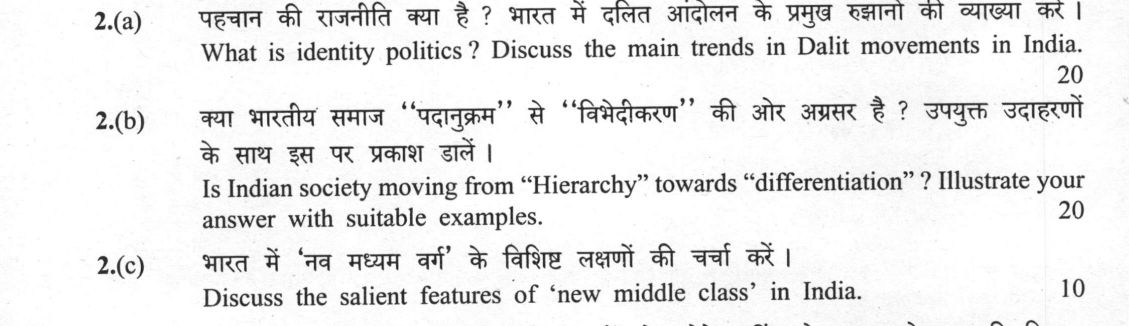
What is identity politics ? Discuss the main trends in Dalit movements in India. 20 marks
Is Indian society moving from "Hierarchy" towards "differentiation" ? Illustrate your answer with suitable examples. 20 marks
Discuss the salient features of 'new middle class' in India. 10 marks
हिंदी में प्रश्न पढ़ें
पहचान की राजनीति क्या है ? भारत में दलित आंदोलन के प्रमुख रुझानों की व्याख्या करें । (20 अंक)
क्या भारतीय समाज "पदानुक्रम" से "विभेदीकरण" की ओर अग्रसर है ? उपयुक्त उदाहरणों के साथ इस पर प्रकाश डालें । (20 अंक)
भारत में 'नव मध्यम वर्ग' के विशिष्ट लक्षणों की चर्चा करें । (10 अंक)
Model answer
Written by UPSC Answer Check against this question's marking rubric, to the expected length. UPSC does not publish answers for Mains — this is one way to score well, not an official key.
Identity politics refers to political mobilisation based on shared socio-cultural markers—such as caste, religion, language, or gender—wherein groups demand socio-political recognition, dignity, and a redistribution of power. Theorised by thinkers like Charles Taylor as a "politics of recognition" and Nancy Fraser as a struggle for status parity, in India it primarily manifests as collective claims on state resources and democratic representation.
Main Trends in Dalit Movements
Dalit mobilisation in India has evolved through distinct ideological and tactical phases. In the early and anti-colonial phase, spearheaded by B. R. Ambedkar, movements focused on civil rights, temple entry (such as the Mahad Satyagraha and Kalaram Temple entry), and radical anti-caste emancipatory goals, culminating in mass conversion to Buddhism.
In the post-independence era, especially by the 1980s, the movement shifted toward electoral assertion. Under Kanshi Ram and the Bahujan Samaj Party (BSP), the Dalit agenda transitioned from social reform to capturing state power, forging a broad "Bahujan" identity.
The post-Mandal era accelerated competitive identity politics. The movement gradually shifted from an overarching emancipatory frame seeking the annihilation of caste toward an identity-recognition frame focused on state patronage, quotas, and symbolic empowerment (such as statues and memorials).
Contemporary Dalit assertion is marked by cultural and digital politics. Youth-led groups like the Bhim Army, alongside vibrant Dalit literature, music, and social media networks, articulate globalised human rights narratives. Concurrently, internal differentiation has surfaced; sub-caste cleavages (such as Mala versus Madiga in Telangana/Andhra Pradesh, or Jatav versus non-Jatav dynamics in Uttar Pradesh) have produced demands for internal sub-categorisation within the Scheduled Caste quota, highlighting regional and structural fragmentation.
From "Hierarchy" Towards "Differentiation"
Louis Dumont characterized traditional Indian society as Homo Hierarchicus, rooted in an overarching, ritual opposition between purity and pollution that organized social groups into an immutable vertical hierarchy. In contrast, "differentiation"—drawing on Niklas Luhmann’s concept of functional differentiation and M. N. Srinivas’s analysis of horizontal mobilization—refers to a shift where autonomous secular spheres (economic, political, legal) operate independently of ritual ranking.
Evidence of differentiation is visible across modern institutions. Market expansion, urban anonymity, and the growth of private corporate employment have enabled occupational mobility decoupled from hereditary status. Caste associations now act as horizontal interest groups competing for political power, transforming caste from a ritual hierarchy into a vehicle for political differentiation.
However, this transition remains uneven. Hierarchy persists intensely in the private and relational spheres. Endogamy remains virtually intact across communities, as seen in matrimonial practices; caste-based residential segregation persists in both villages and modern urban enclaves; and ritual untouchability and caste-based atrocities continue. Indian society has therefore not fully transitioned to differentiation; rather, horizontal differentiation in public, political, and market domains coexists with persistent hierarchical structures in social and private life.
Salient Features of the 'New Middle Class'
The Indian 'new middle class' emerged prominently in the wake of the 1991 economic liberalisation and the post-Mandal assertions. Unlike the 'old middle class' of the Nehruvian era, which was anchored in public-sector employment, civil services, and state-led developmentalism, the new middle class is rooted in the private corporate sector, information technology, and transnational service industries.
First, it is heavily consumption-driven and aspirational. Its identity is defined through lifestyle choices, shopping malls, private gated communities, and private investments in elite healthcare and education.
Second, it exhibits a "caste-skipping" yet not caste-less character. Composed disproportionately of upper and dominant castes, it claims a casteless, secular identity through the discourse of "merit", thereby naturalising historical social capital while opposing affirmative action policies.
Third, it is politically ambivalent. As Leela Fernandes observes, its visual hegemony constructs a "politics of forgetting," actively excluding the urban poor and marginalised from public spaces. Arvind Rajagopal identifies a resulting "split public," where this globalised middle class dominates the English-language media sphere and champions technocratic governance, while mass democratic politics remains driven by vernacular, subaltern identity assertions.
To conclude, contemporary Indian society reflects a complex interplay between enduring caste structures and market-driven modernity. As Dalit movements navigate internal differentiation and the new middle class redefines social power through consumption and meritocratic rhetoric, the democratic process continues to mediate between traditional hierarchy and emerging forms of social differentiation.
What "Discuss" is asking you to do
Lay the issue out from more than one side — how it arose, what is claimed for it, what is held against it, and where it now stands. UPSC attaches discuss to broad topics with several live dimensions, so coverage of the dimensions earns more than the strength of your opinion.
Structure that answers it
Set the issue up → the case as it is made → the case against → the dimension both sides leave out → where the balance now lies
Where marks are lost
Listing facts with no thread between them, or arguing one side throughout and calling it a discussion.
How this answer will be evaluated
Approach
Framework: Sociology Paper II (Social Change and Development). (a) discuss: intro > 3-4 dimensions > example > balanced close | (b) comment: context > arguments both sides > judgment > close | (c) discuss: intro > 3-4 dimensions > example > balanced close Full marks: Precise definitions, clear analytical framework, strong Indian examples, and a balanced, well-argued conclusion.
Key points expected
- Define identity politics as political mobilization based on social identity
- Trace transition from caste-based to class-based or intersectional demands
- Identify specific trends: political representation, education, or economic empowerment
- Provide contemporary examples of Dalit movements (e.g., in UP or Maharashtra)
- Define 'hierarchy' (caste/rank) and 'differentiation' (functional/occupational)
- Provide evidence of hierarchy's persistence (e.g., marriage, rural power)
- Provide evidence of differentiation (e.g., urbanization, education, mobility)
- Take a clear position on the nature of the transition
Evaluation rubric
Each sub-part is marked on its own, against the marks and word limit printed on the paper.
- (a) Define identity politics and analyze the evolution of Dalit movements in India. 20 marks
discuss— intro → 3-4 dimensions → example → balanced close
Must cover
- Define identity politics as political mobilization based on social identity
- Trace transition from caste-based to class-based or intersectional demands
- Identify specific trends: political representation, education, or economic empowerment
- Provide contemporary examples of Dalit movements (e.g., in UP or Maharashtra)
Loses marks
- Treating Dalit movements as a monolithic, static entity
- Ignoring the role of the state or legal frameworks
- Confusing 'identity politics' with general 'casteism'
Earns more
- Reference to Ambedkar's philosophy of social justice
- Mention of specific organizations (e.g., Ravidas Seva Samaj)
- Discussion of the 'Dalit middle class' phenomenon
- Linkage to broader social change theories
Extra mark
- Citation of specific census data on Dalit representation
- Reference to a specific recent protest or policy change
- (b) Evaluate the shift in Indian social structure from rigid hierarchy to social differentiation. 20 marks
comment— context → arguments both sides → judgment → close
Must cover
- Define 'hierarchy' (caste/rank) and 'differentiation' (functional/occupational)
- Provide evidence of hierarchy's persistence (e.g., marriage, rural power)
- Provide evidence of differentiation (e.g., urbanization, education, mobility)
- Take a clear position on the nature of the transition
Loses marks
- Assuming hierarchy has completely disappeared
- Failing to distinguish between 'hierarchy' and 'inequality'
- Using vague examples without sociological context
Earns more
- Use of M.N. Srinivas's concept of 'Sanskritization'
- Reference to 'Westernization' or 'Modernization' as drivers
- Contrast between rural and urban social structures
- Discussion of 'new' hierarchies (e.g., based on education or wealth)
Extra mark
- Citation of NFHS or NSSO data on social mobility
- Reference to a specific sociological study on caste change
- (c) Outline the key characteristics of the emerging 'new middle class' in India. 10 marks
discuss— intro → 3-4 dimensions → example → balanced close
Must cover
- Define the 'new middle class' (e.g., salaried, educated, urban)
- Identify 3-4 salient features (e.g., consumption patterns, aspirations)
- Distinguish them from the 'old' middle class (e.g., traditional professions)
- Mention the role of IT/ITeS or service sector
Loses marks
- Defining the middle class only by income brackets
- Ignoring the cultural or aspirational dimensions
- Confusing the 'new' middle class with the general 'middle class'
Earns more
- Reference to 'aspirational' consumption (e.g., brands, lifestyle)
- Discussion of their political or social outlook
- Mention of geographic concentration (e.g., metros, Tier-2 cities)
Extra mark
- Citation of a specific report on middle-class growth
- Reference to a specific brand or lifestyle marker
Practice this exact question
Write your answer and it is marked point by point against the model answer above — what you covered, what you missed, what you got wrong.
Evaluate my answer →More from Sociology 2021 Paper II
- Q1 Write short answers, with a sociological perspective, of the following questions in about…
- Q2 (a) What is identity politics ? Discuss the main trends in Dalit movements in India. (20…
- Q3 (a) Discuss in detail the major contribution of Prof. Yogendra Singh in theorizing India'…
- Q4 (a) What are the sociological reasons and implication of "reverse migration" during the r…
- Q5 Write short answers, with sociological perspective, of the following questions in about 1…