Paper II — Q7
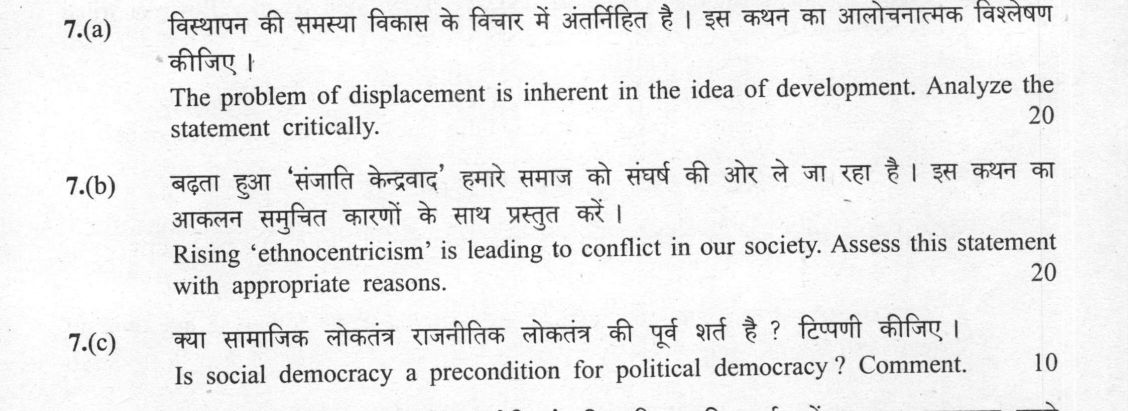
(a) The problem of displacement is inherent in the idea of development. Analyze the statement critically. (20 marks) (b) Rising…
The problem of displacement is inherent in the idea of development. Analyze the statement critically. 20 marks
Rising 'ethnocentricism' is leading to conflict in our society. Assess this statement with appropriate reasons. 20 marks
Is social democracy a precondition for political democracy ? Comment. 10 marks
हिंदी में प्रश्न पढ़ें
विस्थापन की समस्या विकास के विचार में अंतर्निहित है । इस कथन का आलोचनात्मक विश्लेषण कीजिए । (20 अंक)
बढ़ता हुआ 'संजाति केन्द्रवाद' हमारे समाज को संघर्ष की ओर ले जा रहा है । इस कथन का आकलन समुचित कारणों के साथ प्रस्तुत करें । (20 अंक)
क्या सामाजिक लोकतंत्र राजनीतिक लोकतंत्र की पूर्व शर्त है ? टिप्पणी कीजिए । (10 अंक)
Model answer
Written by UPSC Answer Check against this question's marking rubric, to the expected length. UPSC does not publish answers for Mains — this is one way to score well, not an official key.
The nexus between development, identity, and democracy forms a core structural contradiction in contemporary sociology.
Displacement and the Idea of Development
Modernisation theory conceptualises displacement as a necessary cost of progress—an unavoidable friction of structural transformation. However, critical sociology demonstrates that displacement is intrinsic to capital-centric growth. David Harvey identifies this as "accumulation by dispossession," where capital continuously privatises common lands, forests, and water. Johan Galtung terms this structural violence: the state imposes severe deprivation and spatial dislocation on marginalised populations, particularly adivasis and peasants, under the guise of public utility.
In India, projects such as the Sardar Sarovar Dam, POSCO in Odisha, and land alienations under the Special Economic Zones (SEZ) Act 2005 illustrate how developmental agendas generate severe human externalities. Historical rehabilitation failures reflect this bias. However, displacement is not an inescapable natural law. Amartya Sen’s capability approach redefines development not as commodity expansion, but as the expansion of human freedoms. Frameworks like the National Rehabilitation and Resettlement Policy 2007 and the Right to Fair Compensation and Transparency in Land Acquisition, Rehabilitation and Resettlement (RFCTLARR) Act 2013 show that displacement can be mitigated through prior informed consent, decentralised planning, and participatory, sustainable development.
Ethnocentrism and Social Conflict
Ethnocentrism, conceptualised by William Graham Sumner as an ingroup-outgroup dynamic where one’s own culture is the universal benchmark, transforms into conflict when translated into ethnic nationalism. In competitive electoral democracy, identity is actively instrumentalised. As Paul Brass and Rajni Kothari argued, political elites manipulate primordial sentiments—caste, religion, region—to consolidate power and secure scarce state resources.
This dynamic manifests in violent mobilisations, such as "sons of the soil" insurgencies in the Northeast, the Gujarat violence (2002), and the Delhi riots (2020). Ethnocentric othering creates rigid social boundaries and polarises civic life. Yet, ethnocentrism is not entirely unconstrained. Indian society demonstrates resilient institutional counter-weights, including constitutional patriotism, pragmatic inter-caste and inter-community electoral alliances, and syncretic cultural traditions (such as Bhakti-Sufi continuities), which repeatedly moderate and diffuse ethnic polarisations.
Social Democracy as a Precondition for Political Democracy
Political democracy guarantees formal universal franchise and legal equality, whereas social democracy entails substantive equality, universal welfare, and the dismantling of structural hierarchies.
On 25 November 1949, Dr. B.R. Ambedkar famously warned the Constituent Assembly that entering a life of contradictions—political equality (one person, one vote) combined with social and economic inequality (one person, one value)—would place political democracy in severe peril. Ram Manohar Lohia similarly argued that India undertook a "political revolution without a social revolution," leaving democratic institutions vulnerable to elite capture.
India's trajectory reveals an institutional paradox. Universal adult franchise has endured since 1950 despite deep-seated hierarchies, demonstrating that political democracy can maintain formal procedural stability on its own. However, sub-national variations show that social democracy determines its substantive depth: Kerala’s legacy of radical land reforms, universal literacy, and public health created an active, empowered citizenry with robust local governance. In contrast, Bihar’s historical persistence of agrarian feudalism and caste dominance severely undermined early democratic accountability and human development.
Conclusion
Development-induced displacement fuels resource competition, which in turn feeds ethnocentric mobilisation and strains democratic legitimacy. Resolving this crisis requires Nancy Fraser’s framework of combining structural redistribution (inclusive, non-displacing development) with cultural recognition (countering ethnocentrism), thereby deepening social democracy to sustain a resilient political democracy.
What "Critically analyse" is asking you to do
Break the subject into its working parts and show how they act on each other. The marks are in the interconnections — which factor drives which, and what the resulting structure explains — not in the inventory of factors. “Critically” is not a section added at the end: name the yardstick you are judging by — the evidence, the stated objective, a constitutional principle, a rival explanation — and let a verdict close each part of the body. Where the question quotes a claim, that verdict must land on the claim itself, accepted, qualified or rejected, and not on the theme in general.
Structure that answers it
Define the whole → separate it into its parts → show which part drives which → what that interaction produces → what the structure implies
Where marks are lost
Merits in one paragraph, demerits in the next, and a conclusion calling for a balanced and holistic approach. That is a survey with the judgement left out and it holds the answer in the middle band. The opposite error is reading “critically” as permission to attack — and with the odd pairings, critically describe or critically explain, the exposition still carries most of the marks, the judgement being a layer on it rather than a substitute for it.
How this answer will be evaluated
Approach
(a) analyse: intro > causes > effects > stakeholders/linkages > way forward | (b) evaluate: criteria > evidence > balanced judgment | (c) comment: context > arguments both sides > judgment > close Full marks: Comprehensive, critical, and well-structured with specific Indian examples and theoretical depth.
Key points expected
- Define development-induced displacement (DID)
- Identify specific causes (infrastructure, dams, urbanization)
- Analyze socio-economic effects on displaced persons
- Critique the 'inherent' nature of the statement
- Define ethnocentrism in a sociological context
- Explain mechanisms of conflict (identity, resources, politics)
- Provide specific Indian examples of ethno-centric conflict
- Assess the validity of the statement with reasons
Evaluation rubric
Each sub-part is marked on its own, against the marks and word limit printed on the paper.
- (a) Critical analysis of the inherent link between development and displacement. 20 marks
analyse— intro → causes → effects → stakeholders/linkages → way forward
Must cover
- Define development-induced displacement (DID)
- Identify specific causes (infrastructure, dams, urbanization)
- Analyze socio-economic effects on displaced persons
- Critique the 'inherent' nature of the statement
Loses marks
- Treating displacement as an accidental byproduct only
- Ignoring the 'inherent' aspect of the prompt
- Lack of critical evaluation of the development model
Earns more
- Reference to Rehabilitation and Resettlement (R&R) policy
- Mention of specific Indian projects (e.g., Narmada, dams)
- Discussion of 'developmental displacement' vs 'natural disaster'
Extra mark
- Citation of specific R&R Act provisions
- Reference to specific displacement statistics (e.g., World Bank data)
- (b) Assessment of the link between rising ethnocentrism and social conflict. 20 marks
evaluate— criteria → evidence → balanced judgment
Must cover
- Define ethnocentrism in a sociological context
- Explain mechanisms of conflict (identity, resources, politics)
- Provide specific Indian examples of ethno-centric conflict
- Assess the validity of the statement with reasons
Loses marks
- Confusing ethnocentrism with general intolerance
- Lack of specific Indian context
- Failing to link ethnocentrism directly to conflict
Earns more
- Reference to caste/religious/linguistic ethnocentrism
- Discussion of 'Othering' or 'Us vs Them' dynamics
- Mention of political mobilization of identity
Extra mark
- Citation of specific sociological theories (e.g., Gellner, Anderson)
- Reference to specific recent conflict events
- (c) Commentary on whether social democracy is a precondition for political democracy. 10 marks
comment— context → arguments both sides → judgment → close
Must cover
- Define social and political democracy
- Present arguments for the 'precondition' view
- Present arguments against the 'precondition' view
- Provide a balanced judgment
Loses marks
- Defining terms incorrectly
- Taking an extreme position without nuance
- Lack of clear judgment
Earns more
- Reference to Amartya Sen's 'Development as Freedom'
- Discussion of 'procedural' vs 'substantive' democracy
- Mention of Indian context (political democracy without social equality)
Extra mark
- Reference to specific scholars (e.g., Sen, Nussbaum)
- Citation of specific Indian data on social indicators
Practice this exact question
Write your answer and it is marked point by point against the model answer above — what you covered, what you missed, what you got wrong.
Evaluate my answer →More from Sociology 2021 Paper II
- Q4 (a) What are the sociological reasons and implication of "reverse migration" during the r…
- Q5 Write short answers, with sociological perspective, of the following questions in about 1…
- Q6 (a) Explain the sociological significance of the New Education Policy and its thrust on v…
- Q7 (a) The problem of displacement is inherent in the idea of development. Analyze the state…
- Q8 (a) Discuss the role of social media in communal polarisation. Suggest ways to combat it.…