Paper II — Q4
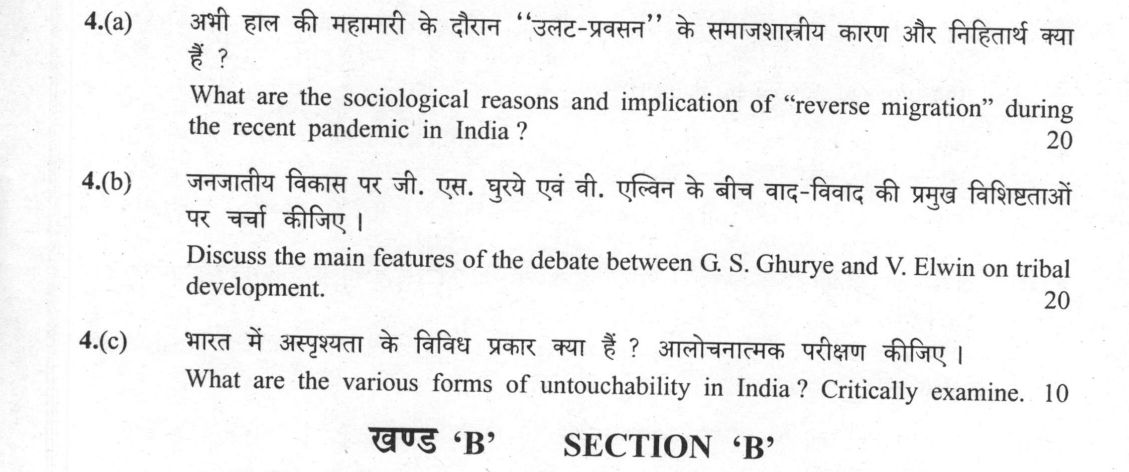
(a) What are the sociological reasons and implication of "reverse migration" during the recent pandemic in India ? (20…
What are the sociological reasons and implication of "reverse migration" during the recent pandemic in India ? 20 marks
Discuss the main features of the debate between G. S. Ghurye and V. Elwin on tribal development. 20 marks
What are the various forms of untouchability in India ? Critically examine. 10 marks
हिंदी में प्रश्न पढ़ें
अभी हाल की महामारी के दौरान "उलट-प्रवासन" के समाजशास्त्रीय कारण और निहितार्थ क्या हैं ? (20 अंक)
जनजातीय विकास पर जी. एस. घुरिये एवं वी. एल्विन के बीच वाद-विवाद की प्रमुख विशिष्टताओं पर चर्चा कीजिए । (20 अंक)
भारत में अस्पृश्यता के विविध प्रकार क्या हैं ? आलोचनात्मक परीक्षण कीजिए । (10 अंक)
Model answer
Written by UPSC Answer Check against this question's marking rubric, to the expected length. UPSC does not publish answers for Mains — this is one way to score well, not an official key.
Migration, tribal marginality, and untouchability reflect the structural axes of caste, tribe, and class that define uneven citizenship and social stratification in contemporary India.
Sociological Dimensions of Reverse Migration
The mass reverse migration during the Covid-19 pandemic exposed the structural vulnerability of India’s circular and footloose labour force. Sociologically, this exodus was driven by acute push factors: the instantaneous collapse of the urban informal economy, sudden wage theft and eviction, lack of social security, and perceived state abandonment during stringent lockdowns. Conversely, pull factors operated through traditional agrarian kinship networks and village safety nets, where ancestral land and community ties offered basic subsistence.
As scholars like Priya Deshingkar and Chinmay Tumbe observe, this vulnerability is deeply mediated by the class-caste nexus. The vast majority of circular migrants belong to Scheduled Castes (SCs), Scheduled Tribes (STs), and Other Backward Classes (OBCs), performing precarious manual work without formal contracts or urban residential rights.
The structural implications were manifold. It triggered sudden de-urbanisation pressure, shifting the burden of social reproduction to the rural hinterland and severely straining MGNREGA funds. The collapse of urban-to-rural remittances intensified agrarian indebtedness. In the post-pandemic period, this disruption reconfigured urban informal labour markets, producing initial urban labour shortages followed by segmented, distress-driven re-migration under weakened bargaining power.
The Ghurye-Elwin Debate on Tribal Development
The tribal development debate between G.S. Ghurye and Verrier Elwin represents two contrasting visions of nation-building and cultural preservation. G.S. Ghurye adopted an assimilationist perspective, arguing that tribes were not distinct aboriginals but 'backward Hindus' who shared long historical, religious, and economic continuities with mainstream Hindu society. Ghurye critiqued British colonial preservation policies as divisive and advocated for full cultural and economic integration into the national mainstream.
Verrier Elwin initially advocated for protective isolationism through his 'national park' thesis, fearing that rapid, unregulated contact with caste Hindu society and colonial capitalism would lead to cultural genocide, loss of tribal autonomy, and exploitation by landlords and moneylenders. However, Elwin later revised his stance toward a synthesis—the 'middle way'—which shaped Jawaharlal Nehru's Tribal Panchsheel, emphasizing development along the lines of indigenous genius without imposed assimilation.
Post-colonial development outcomes demonstrate that neither absolute isolation nor uncritical assimilation succeeded. Constitutional frameworks such as the Fifth and Sixth Schedules, along with legislative instruments like the Panchayats (Extension to Scheduled Areas) Act (PESA), 1996, and the Forest Rights Act (FRA), 2006, attempt an institutional synthesis. However, continuing resource alienation, state-led displacement, and cultural marginalisation show that the tension between autonomy and integration remains unresolved.
Forms and Realities of Untouchability
Untouchability in India operates across spatial, occupational, and ritual domains. Spatial segregation confines Dalits to peripheral hamlets (Dalit bastis), segregating them from village commons. Occupational segregation enforces endogamous, degrading labour such as manual scavenging, tanning, and sanitation work. Ritual untouchability continues through the denial of temple entry, the persistence of the 'two-tumbler system' in rural eateries, and restrictions at village wells. During the pandemic, it adapted into sanitary and digital forms, where Dalits faced heightened exclusion from shared water infrastructure and health facilities under the pretext of hygiene.
Critically examining this phenomenon reveals its enduring nature despite constitutional abolition under Article 17 and statutory measures like the Protection of Civil Rights Act, 1955, and the SC/ST (Prevention of Atrocities) Act, 1989. Untouchability persists by mutating from explicit ritual prohibitions to everyday micro-aggressions and informal exclusions, punctuated by spectacular atrocities against upwardly mobile Dalits. While urban anonymity weakens overt ritual pollution in public transport and formal workplaces, it reproduces itself through rental housing discrimination and private associational networks. Furthermore, untouchability intersects sharply with gender and class, rendering Dalit women disproportionately vulnerable to domestic servitude, wage suppression, and sexualized caste violence.
In conclusion, reverse migration, tribal policy dilemmas, and persisting untouchability illustrate the ongoing friction between de jure constitutional equality and de facto social hierarchies, demanding systemic economic security and structural reform alongside legal safeguards.
What "Discuss" is asking you to do
Lay the issue out from more than one side — how it arose, what is claimed for it, what is held against it, and where it now stands. UPSC attaches discuss to broad topics with several live dimensions, so coverage of the dimensions earns more than the strength of your opinion.
Structure that answers it
Set the issue up → the case as it is made → the case against → the dimension both sides leave out → where the balance now lies
Where marks are lost
Listing facts with no thread between them, or arguing one side throughout and calling it a discussion.
How this answer will be evaluated
Approach
Framework: Sociology Paper II (Indian Society). (a) explain: definition/context > points in order > small example > short close | (b) discuss: intro > 3-4 dimensions > example > balanced close | (c) critique: the claim > its strengths > its weaknesses > your judgment Full marks: Comprehensive, well-structured, with specific examples and critical analysis.
Key points expected
- Define reverse migration in the 2020 context
- Identify economic causes (lockdown, job loss)
- Identify sociological causes (social isolation, caste dynamics)
- Discuss implications (urban-rural linkages, social fabric)
- Contrast Ghurye's 'Assimilation' view with Elwin's 'Separation' view
- Explain Ghurye's 'Cultural Lag' concept
- Explain Elwin's 'Cultural Autonomy' concept
- Evaluate the impact of this debate on policy
Evaluation rubric
Each sub-part is marked on its own, against the marks and word limit printed on the paper.
- (a) Sociological causes and implications of reverse migration during the pandemic. 20 marks
explain— definition/context → points in order → small example → short close
Must cover
- Define reverse migration in the 2020 context
- Identify economic causes (lockdown, job loss)
- Identify sociological causes (social isolation, caste dynamics)
- Discuss implications (urban-rural linkages, social fabric)
Loses marks
- Treating it purely as an economic event
- Ignoring the 'sociological' aspect of the question
- Vague generalities without specific examples
Earns more
- Reference to 'Great Indian Exodus' or 'Migrant Exodus'
- Mention of specific states (UP, Bihar, MP)
- Discussion of 'return to village' vs 'return to poverty'
Extra mark
- Cite specific data on migrant worker numbers
- Reference to specific government schemes (PM-KISAN)
- (b) Main features of the debate between G.S. Ghurye and V. Elwin on tribal development. 20 marks
discuss— intro → 3-4 dimensions → example → balanced close
Must cover
- Contrast Ghurye's 'Assimilation' view with Elwin's 'Separation' view
- Explain Ghurye's 'Cultural Lag' concept
- Explain Elwin's 'Cultural Autonomy' concept
- Evaluate the impact of this debate on policy
Loses marks
- Confusing the two thinkers' positions
- Failing to link the debate to 'development' policy
- Ignoring the 'main features' of the debate
Earns more
- Mention of 'Tribal Areas' vs 'Scheduled Areas'
- Reference to the 'Fifth Schedule' or 'Sixth Schedule'
- Discussion of 'Tribal Reserves' (Elwin's proposal)
Extra mark
- Reference to specific tribal groups (e.g., Santhals, Gonds)
- Mention of the 'Ghurye-Elwin debate' in the context of the 1950s
- (c) Various forms of untouchability in India, critically examined. 10 marks
critique— the claim → its strengths → its weaknesses → your judgment
Must cover
- Define untouchability (social, ritual, economic)
- Identify forms (occupational, residential, educational)
- Critically examine the persistence of these forms
- Discuss the role of law (SC/ST Act) vs social reality
Loses marks
- Treating untouchability as a historical relic
- Ignoring the 'critical' aspect of the question
- Failing to identify 'various forms'
Earns more
- Mention of 'manual scavenging' as a form
- Reference to 'caste-based discrimination' in urban areas
- Discussion of 'social boycott' or 'excommunication'
Extra mark
- Cite specific cases of untouchability (e.g., Bhopal, 2018)
- Reference to the 'Untouchability (Offences) Act, 1950'
Practice this exact question
Write your answer and it is marked point by point against the model answer above — what you covered, what you missed, what you got wrong.
Evaluate my answer →More from Sociology 2021 Paper II
- Q1 Write short answers, with a sociological perspective, of the following questions in about…
- Q2 (a) What is identity politics ? Discuss the main trends in Dalit movements in India. (20…
- Q3 (a) Discuss in detail the major contribution of Prof. Yogendra Singh in theorizing India'…
- Q4 (a) What are the sociological reasons and implication of "reverse migration" during the r…
- Q5 Write short answers, with sociological perspective, of the following questions in about 1…
- Q6 (a) Explain the sociological significance of the New Education Policy and its thrust on v…
- Q7 (a) The problem of displacement is inherent in the idea of development. Analyze the state…