Paper I — Q1
Answer the following questions in about 150 words each: (a) Delimit the scope of Sociology in relation to other social sciences…
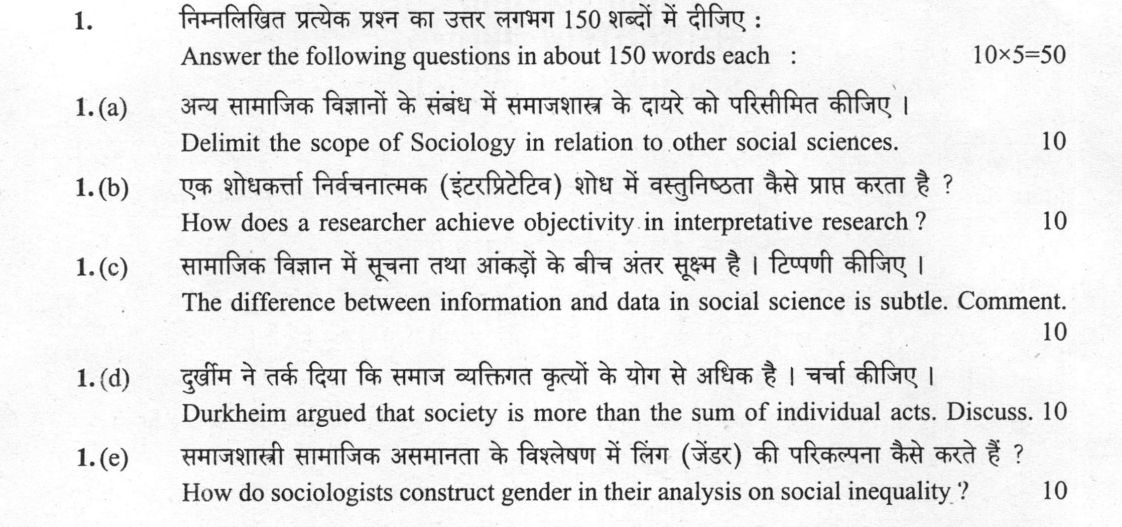
Answer the following questions in about 150 words each: Delimit the scope of Sociology in relation to other social sciences. 10 marks
How does a researcher achieve objectivity in interpretative research ? 10 marks
The difference between information and data in social science is subtle. Comment. 10 marks
Durkheim argued that society is more than the sum of individual acts. Discuss. 10 marks
How do sociologists construct gender in their analysis on social inequality ? 10 marks
हिंदी में प्रश्न पढ़ें
निम्नलिखित प्रत्येक प्रश्न का उत्तर लगभग 150 शब्दों में दीजिए : अन्य सामाजिक विज्ञानों के संबंध में समाजशास्त्र के दायरे को परिसीमित कीजिए । (10 अंक)
एक शोधकर्ता निर्वचनात्मक (इंटरप्रिटेटिव) शोध में वस्तुनिष्ठता कैसे प्राप्त करता है ? (10 अंक)
सामाजिक विज्ञान में सूचना तथा आंकड़ों के बीच अंतर सूक्ष्म है । टिप्पणी कीजिए । (10 अंक)
दुर्खीम ने तर्क दिया कि समाज व्यक्तिगत कृत्यों के योग से अधिक है । चर्चा कीजिए । (10 अंक)
समाजशास्त्री सामाजिक असमानता के विश्लेषण में लिंग (जेंडर) की परिकल्पना कैसे करते हैं ? (10 अंक)
Model answer
Written by UPSC Answer Check against this question's marking rubric, to the 150-word length. UPSC does not publish answers for Mains — this is one way to score well, not an official key.
(a) Scope of Sociology in Relation to Other Social Sciences
Sociology delimits its distinct scope as the study of social facts, emergent structures, and social action in their totality, distinguishing itself from allied disciplines. While Psychology focuses on the internal human psyche and individual cognition, Sociology examines how group dynamics and social forces shape human behaviour. Economics investigates wealth distribution and market mechanisms assuming rational choice, whereas Sociology analyses economic behaviour as embedded in cultural norms and institutional networks. Political Science concentrates on formal state institutions and power mechanisms, whereas Sociology investigates the broader societal distribution of power across informal structures. Anthropology historically studied simple, small-scale tribal cultures, whereas Sociology arose to understand complex modern industrial orders. However, these boundaries remain porous, resulting in fruitful synthetic sub-disciplines such as economic sociology, political sociology, and social psychology. Sociology thus synthesizes diverse societal dimensions into a comprehensive, holistic framework.
(b) Objectivity in Interpretative Research
Interpretative research prioritises understanding social reality through the subjective meanings and motives of actors (Verstehen), necessitating rigorous methodological techniques to ensure objectivity. Researchers achieve this first by practicing Max Weber’s value-neutrality (Wertfreiheit), ensuring that while value-relevance may dictate the choice of inquiry, personal biases do not contaminate the analysis. Methodologically, Clifford Geertz’s ‘thick description’ allows researchers to meticulously document contextual layers of meaning rather than imposing subjective interpretations. Objectivity is further fortified through Pierre Bourdieu’s epistemic reflexivity and explicit researcher positionality statements, where the scholar critically accounts for their own social location and potential biases. Additionally, scholars deploy intersubjective validation—corroborating findings with participants and academic peers—alongside methodological triangulation, which combines participant observation, interviews, and documentary evidence. Interpretative objectivity thus relies on disciplined transparency, methodological rigour, and critical self-awareness.
(c) Difference Between Information and Data in Social Science
The distinction between data and information in social science is subtle yet epistemologically decisive. Data consists of raw, uninterpreted empirical facts, observations, or quantitative counts gathered from the field. Information, conversely, is data that has been structured, contextualised, and interpreted through theoretical frameworks to yield meaningful sociological insights. Data is descriptive, whereas information is explanatory and analytical.
For instance, the raw count of maternal mortality figures from the National Family Health Survey (NFHS-5) or headcount tallies in the Census constitute data. This data transforms into sociological information only when processed through conceptual categories of caste, class, and patriarchy, revealing institutional discrimination in healthcare access. Similarly, mere household expenditure figures remain raw data until evaluated against defined poverty lines to generate actionable information on absolute deprivation. Data serves as the empirical raw material, but it requires theory-laden processing to become sociological information.
(d) Durkheim: Society as More than the Sum of Individual Acts
Emile Durkheim advanced sociological realism by arguing that society is a sui generis reality—an emergent entity possessing qualities distinct from the aggregation of individual actors. When individuals interact, their association produces emergent social facts: ways of acting, thinking, and feeling that exist external to individual consciousness and exercise coercive control over individual conduct.
For Durkheim, social life is sustained by the 'collective conscience'—the shared values and beliefs that constrain individual desires, as demonstrated in his study of suicide rates varying with levels of social integration and regulation. Conversely, methodological individualists like Max Weber and rational choice theorists critique this structural determinism, arguing that macro-structures are merely meaningful aggregations of individual social actions. Nonetheless, Durkheim’s perspective remains vital in demonstrating that social structures constrain and enable individual horizons, establishing sociology as an autonomous discipline distinct from individual psychology.
(e) Sociologists Constructing Gender in Social Inequality
Sociologists construct gender as an institutional, ideological, and interactional mechanism of social stratification rather than a biological given. Grounded in Simone de Beauvoir’s premise that "one is not born, but rather becomes, a woman," sociology demonstrates how gender roles are socially created through differential socialization. Judith Butler advances this by framing gender as performative—sustained through the continuous, stylized repetition of cultural acts.
Structurally, Sylvia Walby conceptualises patriarchy as a system of six interrelated structures (such as paid employment, household production, and the state) that institutionalise male dominance. Furthermore, Kimberlé Crenshaw’s intersectionality framework demonstrates that gender does not operate in isolation; it compounds with caste, race, and class hierarchies, creating heightened vulnerabilities for marginalised groups like Dalit women. In India, adverse child sex ratios empirically prove that female disadvantage stems from socially constructed neglect and son preference rather than biological destiny, reinforcing gender as a pervasive axis of structural inequality.
What "Discuss" is asking you to do
Lay the issue out from more than one side — how it arose, what is claimed for it, what is held against it, and where it now stands. UPSC attaches discuss to broad topics with several live dimensions, so coverage of the dimensions earns more than the strength of your opinion.
Structure that answers it
Set the issue up → the case as it is made → the case against → the dimension both sides leave out → where the balance now lies
Where marks are lost
Listing facts with no thread between them, or arguing one side throughout and calling it a discussion.
How this answer will be evaluated
Approach
Framework: Sociology Paper 1 (UPSC). (a) compare: paired headings or table > key differences > significance > conclusion | (b) explain: definition/context > points in order > small example > short close | (c) comment: context > arguments both sides > judgment > close | (d) discuss: intro > 3-4 dimensions > example > balanced close | (e) analyse: intro > causes > effects > stakeholders/linkages > way forward Full marks: Precise definitions, named thinkers, clear distinctions, Indian context.
Key points expected
- Contrast Sociology with Economics (rationality vs. social action)
- Contrast Sociology with Political Science (power vs. social structure)
- Contrast Sociology with Anthropology (industrial vs. non-industrial focus)
- Define the specific object of study for Sociology
- Define the tension between subjectivity and objectivity
- Explain 'bracketing' or 'epoché' (phenomenological reduction)
- Mention 'triangulation' or 'member checking' as tools
- Discuss the role of reflexivity in the research process
Evaluation rubric
Each sub-part is marked on its own, against the marks and word limit printed on the paper.
- (a) Delineate Sociology's unique domain relative to other social sciences. 10 marks · 150 words
compare— paired headings or table → key differences → significance → conclusion
Must cover
- Contrast Sociology with Economics (rationality vs. social action)
- Contrast Sociology with Political Science (power vs. social structure)
- Contrast Sociology with Anthropology (industrial vs. non-industrial focus)
- Define the specific object of study for Sociology
Loses marks
- Treating Sociology as a 'super-science' containing others
- Vague generalities without specific disciplinary distinctions
Earns more
- Mention overlap with Psychology (social vs. individual)
- Reference to specific thinkers (e.g., Durkheim vs. Weber)
Extra mark
- Reference to specific Indian context of discipline evolution
- (b) Explain the methodological tools for objectivity in interpretative research. 10 marks · 150 words
explain— definition/context → points in order → small example → short close
Must cover
- Define the tension between subjectivity and objectivity
- Explain 'bracketing' or 'epoché' (phenomenological reduction)
- Mention 'triangulation' or 'member checking' as tools
- Discuss the role of reflexivity in the research process
Loses marks
- Confusing interpretative objectivity with positivist neutrality
- Ignoring the researcher's role in constructing meaning
Earns more
- Reference to specific interpretative scholars (e.g., Schutz, Berger)
Extra mark
- Example of a specific interpretative study using these tools
- (c) Comment on the subtle distinction between information and data. 10 marks · 150 words
comment— context → arguments both sides → judgment → close
Must cover
- Define 'data' as raw, unprocessed facts
- Define 'information' as processed, contextualized data
- Explain the transformation process (coding/analysis)
- Discuss the role of context in converting data to information
Loses marks
- Treating the two terms as synonyms
- Focusing only on technical/computational definitions
Earns more
- Example of raw data vs. derived information
- Mention of 'knowledge' as the next stage
Extra mark
- Reference to specific social science data sources (e.g., Census)
- (d) Discuss Durkheim's argument that society is more than the sum of individual acts. 10 marks · 150 words
discuss— intro → 3-4 dimensions → example → balanced close
Must cover
- Define 'social facts' as distinct from individual acts
- Explain the concept of 'emergent properties' of society
- Discuss the coercive power of social facts over individuals
- Reference to 'The Division of Labour' or 'Suicide'
Loses marks
- Reducing society to a collection of individuals
- Ignoring the 'external' nature of social facts
Earns more
- Contrast with individualist approaches (e.g., Hobbes)
- Mention of 'collective consciousness'
Extra mark
- Reference to specific Indian social facts (e.g., caste)
- (e) Analyse how sociologists construct gender in social inequality analysis. 10 marks · 150 words
analyse— intro → causes → effects → stakeholders/linkages → way forward
Must cover
- Distinguish between sex (biological) and gender (social)
- Explain gender as a social construct/role
- Link gender construction to power relations (patriarchy)
- Discuss intersectionality (gender + class/caste)
Loses marks
- Treating gender as purely biological
- Ignoring the structural/institutional dimension of gender
Earns more
- Reference to specific feminist sociologists (e.g., Connell, Scott)
- Mention of 'doing gender' (West & Zimmerman)
Extra mark
- Reference to specific Indian data (e.g., NFHS, FLFPR)
Practice this exact question
Write your answer and it is marked point by point against the model answer above — what you covered, what you missed, what you got wrong.
Evaluate my answer →More from Sociology 2022 Paper I
- Q1 Answer the following questions in about 150 words each: (a) Delimit the scope of Sociolog…
- Q2 (a) What aspects of 'Enlightenment' do you think paved way for the emergence of sociology…
- Q3 (a) What are the shortfalls of positivist philosophy that gave rise to the non-positivist…
- Q4 (a) What characterizes degradation of work in capitalist society according to Marx ? (20…