Paper I — Q8
(a) Sociologists argue for democratization of science and technology for inclusive development. Comment. (20 marks) (b) Are…
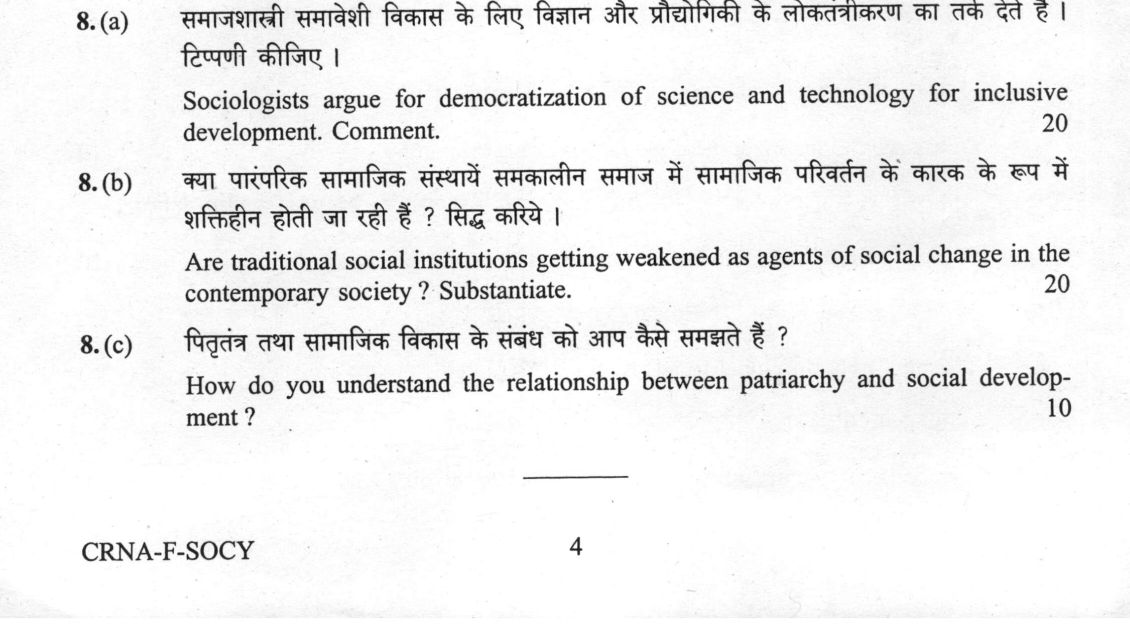
Sociologists argue for democratization of science and technology for inclusive development. Comment. 20 marks
Are traditional social institutions getting weakened as agents of social change in the contemporary society ? Substantiate. 20 marks
How do you understand the relationship between patriarchy and social development ? 10 marks
हिंदी में प्रश्न पढ़ें
समाजशास्त्री समावेशी विकास के लिए विज्ञान और प्रौद्योगिकी के लोकतंत्रीकरण का तर्क देते हैं । टिप्पणी कीजिए । (20 अंक)
क्या पारंपरिक सामाजिक संस्थाएं समकालीन समाज में सामाजिक परिवर्तन के कारक के रूप में शक्तिहीन होती जा रही हैं ? सिद्ध करिये । (20 अंक)
पितृतंत्र तथा सामाजिक विकास के संबंध को आप कैसे समझते हैं ? (10 अंक)
Model answer
Written by UPSC Answer Check against this question's marking rubric, to the expected length. UPSC does not publish answers for Mains — this is one way to score well, not an official key.
The assertion that science and technology must be democratized for inclusive development is broadly correct, but it is not a neutral technical fix; it is a political question about who defines problems, controls resources and captures benefits.
Democratization of science and technology STS critiques of technocratic elitism, sharpened by thinkers such as Feyerabend and Ravetz, show that when knowledge and innovation are concentrated in expert, corporate or state laboratories, development can become extractive, top-down and insensitive to local livelihoods. Democratization therefore means participatory technology assessment, inclusive innovation models, and community control over the design and use of technology. Indian examples show this is possible: Honey Bee Network’s farmer-to-farmer knowledge exchange and SRISTI’s support for grassroots inventions demonstrate that technology can be adapted to smallholders, women and marginal communities rather than imposed on them. Yet the claim has limits. Democratization can be hollowed out by regulatory capture, where standards, patents and subsidies serve large firms; and by the digital divide, which reproduces exclusion. NSS 78th round data on device ownership by gender and caste show that access to phones and internet remains uneven, so “smart” development can widen gaps if not paired with public provisioning, digital literacy and stronger regulation.
Traditional institutions as agents of change The question whether traditional institutions are weakening is best answered as conversion rather than simple disappearance. On one hand, the weakening thesis has empirical support: the decline of jajmani systems, migration, nuclearization and market integration have reduced the everyday authority of village kinship and caste arrangements. On the other hand, continuity is visible in adaptive forms. Caste panchayats, including khap panchayats, have not vanished; some have reformed or been pressured to accommodate inter-caste marriage, while others still police it, showing that tradition can be both conservative and renegotiated. Religious institutions also mobilize for education and welfare: madrasa modernization debates and gurukul revival show that faith-based institutions can become agents of social change when they engage with modern schooling, health and civic norms. Srinivas’s trajectory from sanskritization to competitive sanskritization helps here: what changes is not merely the surface but the competitive logic of status, where lower castes adopt upper-caste practices to contest hierarchy. Thus traditional institutions are weakened as closed hierarchies but often strengthened as contested arenas of social change.
Patriarchy and social development Patriarchy is not a background custom; it shapes development itself. Boserup showed that gendered agricultural intensification can make women’s labour indispensable, yet development statistics often render that labour invisible. Feminist critiques of GDP-centric growth show that if development ignores care work, unpaid labour and women’s agency, growth may coexist with deprivation. Molyneux and Moser’s distinction between practical and strategic needs, taken up in Kabeer’s work on empowerment, agency, resources and achievements, clarifies this: practical needs address immediate burdens, while strategic needs challenge power relations. Development is therefore not merely income growth but the expansion of women’s capacity to claim rights and reshape institutions. Indian evidence is mixed: despite growth, earlier labour-force data recorded a long-term fall in female labour force participation; later PLFS rounds show a rise, but participation remains low and uneven. NFHS-5 shows persistence of son preference, and women’s SHGs function as counter-hegemonic spaces where savings, voice and collective bargaining challenge patriarchal control.
In conclusion, inclusive development requires democratizing technology, reimagining traditional institutions as sites of reform, and dismantling patriarchal structures that convert growth into exclusion. Technology without participation, tradition without accountability, and growth without gender justice will remain incomplete.
What "Comment" is asking you to do
Take a position on the statement and support it. Comment usually attaches to a quoted line in the short slots, so the reasoning must be compressed — an opening view, a few load-bearing reasons, and the limit of the claim.
Structure that answers it
Unpack what the statement asserts → your stance → two or three supporting reasons → the qualification that limits it
Where marks are lost
Neutral summary; a comment without a stance has not answered. Equally costly is accepting the quoted line wholesale and never testing where it fails.
How this answer will be evaluated
Approach
(a) comment: context > arguments both sides > judgment > close | (b) justify: claim > 3-4 reasons > evidence > conclusion | (c) explain: definition/context > points in order > small example > short close Full marks: Precise definitions, named thinkers, strong evidence, and a clear, balanced judgment.
Key points expected
- Define democratization of science and technology
- Link S&T access to inclusive development
- Present arguments for and against the sociological view
- Conclude with a balanced judgment
- Identify key traditional institutions (family, caste, religion)
- Provide evidence of their weakening as change agents
- Discuss the rise of modern institutions (state, media)
- Substantiate with contemporary examples
Evaluation rubric
Each sub-part is marked on its own, against the marks and word limit printed on the paper.
- (a) Contextualize the argument, present both sides, and offer a judgment on S&T democratization. 20 marks
comment— context → arguments both sides → judgment → close
Must cover
- Define democratization of science and technology
- Link S&T access to inclusive development
- Present arguments for and against the sociological view
- Conclude with a balanced judgment
Loses marks
- Treating S&T as purely technical, ignoring social context
- Vague generalizations without specific examples
- Ignoring the 'inclusive' aspect of development
Earns more
- Reference thinkers like Bhabha or Kothari
- Mention digital divide or access barriers
- Discuss the role of state policy
- Use the concept of 'knowledge economy'
Extra mark
- Cite a specific statistic on internet penetration
- Reference a specific policy like Digital India
- (b) Provide evidence and reasoning to support the claim about weakening traditional institutions. 20 marks
justify— claim → 3-4 reasons → evidence → conclusion
Must cover
- Identify key traditional institutions (family, caste, religion)
- Provide evidence of their weakening as change agents
- Discuss the rise of modern institutions (state, media)
- Substantiate with contemporary examples
Loses marks
- Assuming total disappearance of traditional institutions
- Lack of specific evidence or examples
- Confusing 'weakening' with 'disappearing'
Earns more
- Discuss the persistence or adaptation of traditional institutions
- Reference thinkers like M.N. Srinivas or S.C. Dube
- Mention the role of urbanization and education
- Discuss the concept of 'Sanskritization' or 'Westernization'
Extra mark
- Cite a specific statistic on family structure
- Reference a specific social movement
- (c) Define the relationship between patriarchy and social development, showing how one affects the other. 10 marks
explain— definition/context → points in order → small example → short close
Must cover
- Define patriarchy in a sociological context
- Explain how patriarchy hinders social development
- Link gender inequality to broader development metrics
- Conclude with the necessity of gender equality
Loses marks
- Treating patriarchy as a purely cultural issue
- Lack of link to measurable development indicators
- Vague statements without analytical depth
Earns more
- Reference thinkers like Simone de Beauvoir or Amartya Sen
- Discuss the 'capability approach' to development
- Mention the impact on women's labor force participation
- Use the concept of 'social capital'
Extra mark
- Cite a specific statistic on gender disparity
- Reference a specific policy like Beti Bachao
Practice this exact question
Write your answer and it is marked point by point against the model answer above — what you covered, what you missed, what you got wrong.
Evaluate my answer →More from Sociology 2022 Paper I
- Q5 Write short answers of the following questions in about 150 words each: (a) Critically ex…
- Q6 (a) According to Mead the idea of self develops when the individual becomes self-consciou…
- Q7 (a) Critically analyse Parsons views on society as a social system. (20 marks) (b) Discus…
- Q8 (a) Sociologists argue for democratization of science and technology for inclusive develo…