Paper I — Q2
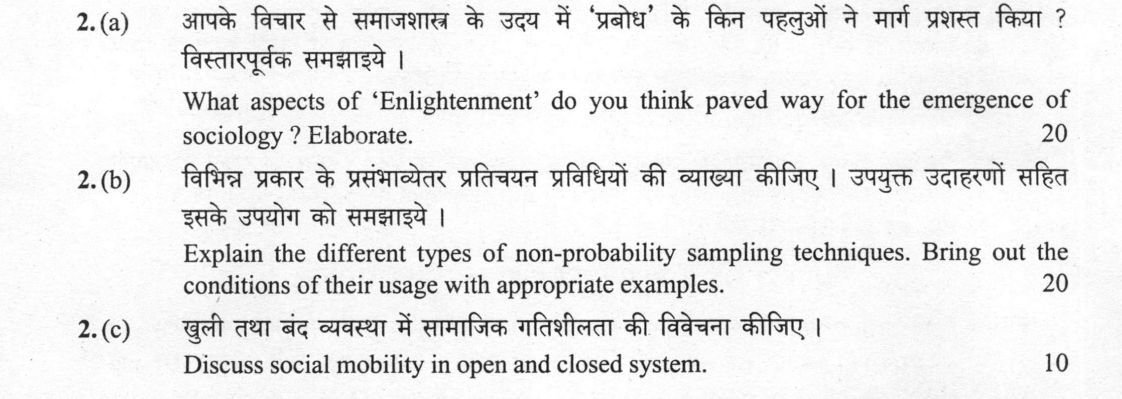
(a) What aspects of 'Enlightenment' do you think paved way for the emergence of sociology ? Elaborate. (20 marks) (b) Explain the…
What aspects of 'Enlightenment' do you think paved way for the emergence of sociology ? Elaborate. 20 marks
Explain the different types of non-probability sampling techniques. Bring out the conditions of their usage with appropriate examples. 20 marks
Discuss social mobility in open and closed system. 10 marks
हिंदी में प्रश्न पढ़ें
आपके विचार से समाजशास्त्र के उदय में 'प्रबोध' के किन पहलुओं ने मार्ग प्रशस्त किया ? विस्तारपूर्वक समझाइये । (20 अंक)
विभिन्न प्रकार के प्रासंभाव्येतर प्रतिचयन प्रविधियों की व्याख्या कीजिए । उपयुक्त उदाहरणों सहित इसके उपयोग को समझाइये । (20 अंक)
खुली तथा बंद व्यवस्था में सामाजिक गतिशीलता की विवेचना कीजिए । (10 अंक)
Model answer
Written by UPSC Answer Check against this question's marking rubric, to the expected length. UPSC does not publish answers for Mains — this is one way to score well, not an official key.
Enlightenment and the Emergence of Sociology
The eighteenth-century European Enlightenment marked a radical epistemological shift from theological determinism to human agency and secular rationality. It rested on foundational pillars: the supremacy of reason over tradition and dogma (Rene Descartes, Immanuel Kant), scientific empiricism displacing scholasticism (Francis Bacon, Isaac Newton), the secular critique of clerical authority, the doctrine of unilinear historical progress and human perfectibility (Marquis de Condorcet), and the social contract tradition (Hobbes, Locke, Rousseau), which relocated sovereignty from divine right to civil society.
These ideas directly catalyzed sociology's emergence. Auguste Comte applied Enlightenment positivism to the social realm, conceptualizing "social physics" to discover universal laws of human order and progress. Emile Durkheim institutionalized this empirical rigor by defining "social facts" as external, coercive, and objectively measurable phenomena. Karl Marx transformed Enlightenment critique through historical materialism, analyzing society via material contradictions rather than Hegelian idealism. Max Weber explored the dialectic of Enlightenment through his rationalization thesis, investigating the disenchantment of the modern world. Thus, sociology emerged as an intellectual discipline using Enlightenment reason to diagnose and navigate the disruptions of modern industrial society.
Non-Probability Sampling Techniques
Non-probability sampling selects sample elements based on non-random criteria, utilized when sampling frames are unavailable, resources are constrained, or research is qualitative and exploratory.
Convenience sampling selects readily accessible units based on proximity and ease of recruitment. It is deployed in exploratory research or pilot studies where speed and cost take precedence over generalizability. An example is conducting a pilot survey among street vendors in Delhi's Chandni Chowk to test a draft questionnaire on microfinance access.
Quota sampling ensures specific sub-groups are represented proportionally by non-randomly filling pre-set quotas across known population strata. It is used when stratified representation is required but formal random sampling is unfeasible. An example is conducting caste-wise and gender-wise opinion polling across electorates in Bihar panchayat elections.
Purposive or judgmental sampling relies on the researcher’s deliberate judgment to select units that possess unique characteristics or specialized expertise. It is suited for in-depth studies of specific, information-rich phenomena. An example is purposively selecting village elders and local administrators in Naxal-affected districts of Bastar, Chhattisgarh, for conflict research.
Snowball sampling relies on initial informants identifying and referring subsequent participants through social networks. It is essential for studying hidden, stigmatized, or hard-to-reach populations lacking standard sampling frames. An example is accessing transgender networks in Mumbai for public health research on HIV prevalence.
Social Mobility: Open and Closed Systems
Social mobility denotes the movement of individuals or groups across socio-economic strata. Pitirim Sorokin categorized social structures into open and closed systems based on the permeability of their stratification boundaries.
An open system operates on universalistic criteria and achieved status. Stratification is fluid, driven by individual talent, meritocracy, and industrialization, resulting in high circulation mobility. In contemporary India, the expansion of the knowledge economy and the IT sector exemplifies this, facilitating intergenerational upward mobility for first-generation rural engineers entering the urban corporate middle class.
Conversely, a closed system relies on particularistic criteria and ascriptive status, permitting virtually zero structural mobility. Traditional caste stratification, reinforced through ritual purity, endogamy, and the Jajmani system, historically exemplified an impermeable hierarchy.
Contemporary societies, however, exhibit structural hybridity. In India, state-mediated interventions like affirmative action (constitutional reservations under Articles 15 and 16) enable significant upward mobility within historically closed caste hierarchies, demonstrating how institutional intervention can transform traditional ascriptive boundaries into avenues of merit-based socio-political advancement.
What "Elaborate" is asking you to do
Give the full detailed account the question has compressed into a line — every dimension of it, with specifics. Elaborate rewards completeness and detail rather than clarification or argument: the examiner is checking whether you can fill out a topic without being told what its parts are.
Structure that answers it
State the proposition → first dimension in detail → second dimension in detail → the part the statement leaves implicit → the consolidated picture
Where marks are lost
Repeating the statement at greater length instead of adding substance. Elaborate also punishes narrowness: omitting a whole dimension costs more here than anywhere else in this family.
How this answer will be evaluated
Approach
(a) discuss: intro > 3-4 dimensions > example > balanced close | (b) explain: definition/context > points in order > small example > short close | (c) discuss: intro > 3-4 dimensions > example > balanced close Full marks: Comprehensive, well-structured, with specific examples and clear reasoning.
Key points expected
- Rationalism and empiricism (Locke/Hume)
- Secularization and critique of religious authority
- Belief in social progress and reform
- Application of scientific method to society
- Convenience sampling definition and example
- Purposive/Judgmental sampling definition and example
- Snowball sampling definition and example
- Quota sampling definition and example
Evaluation rubric
Each sub-part is marked on its own, against the marks and word limit printed on the paper.
- (a) Link specific Enlightenment ideas to the birth of sociology. 20 marks
discuss— intro → 3-4 dimensions → example → balanced close
Must cover
- Rationalism and empiricism (Locke/Hume)
- Secularization and critique of religious authority
- Belief in social progress and reform
- Application of scientific method to society
Loses marks
- General history of the 18th century
- Name-dropping without explaining the link
- Ignoring the 'paved way' causal link
Earns more
- Mention of specific thinkers (Voltaire, Rousseau)
- Link to Comte's positivism
- Reference to the French Revolution context
Extra mark
- Reference to specific Enlightenment texts
- Comparison with pre-Enlightenment thought
- (b) Define non-probability sampling types and their usage conditions. 20 marks
explain— definition/context → points in order → small example → short close
Must cover
- Convenience sampling definition and example
- Purposive/Judgmental sampling definition and example
- Snowball sampling definition and example
- Quota sampling definition and example
Loses marks
- Confusing with probability sampling
- Lack of examples
- Vague definitions
Earns more
- Clear distinction from probability sampling
- Specific conditions for usage (e.g., hidden populations)
- Appropriate examples for each type
Extra mark
- Mention of specific research studies
- Discussion of bias in non-probability sampling
- (c) Compare social mobility in open and closed systems. 10 marks
discuss— intro → 3-4 dimensions → example → balanced close
Must cover
- Definition of open system (meritocracy)
- Definition of closed system (ascription)
- Key differences in mobility mechanisms
- Examples of each system
Loses marks
- Confusing the two systems
- Lack of examples
- Vague definitions
Earns more
- Reference to specific societies
- Discussion of structural vs. individual mobility
- Link to social stratification
Extra mark
- Reference to specific sociological theories
- Contemporary examples of mobility
Practice this exact question
Write your answer and it is marked point by point against the model answer above — what you covered, what you missed, what you got wrong.
Evaluate my answer →More from Sociology 2022 Paper I
- Q1 Answer the following questions in about 150 words each: (a) Delimit the scope of Sociolog…
- Q2 (a) What aspects of 'Enlightenment' do you think paved way for the emergence of sociology…
- Q3 (a) What are the shortfalls of positivist philosophy that gave rise to the non-positivist…
- Q4 (a) What characterizes degradation of work in capitalist society according to Marx ? (20…
- Q5 Write short answers of the following questions in about 150 words each: (a) Critically ex…