Paper I — Q7
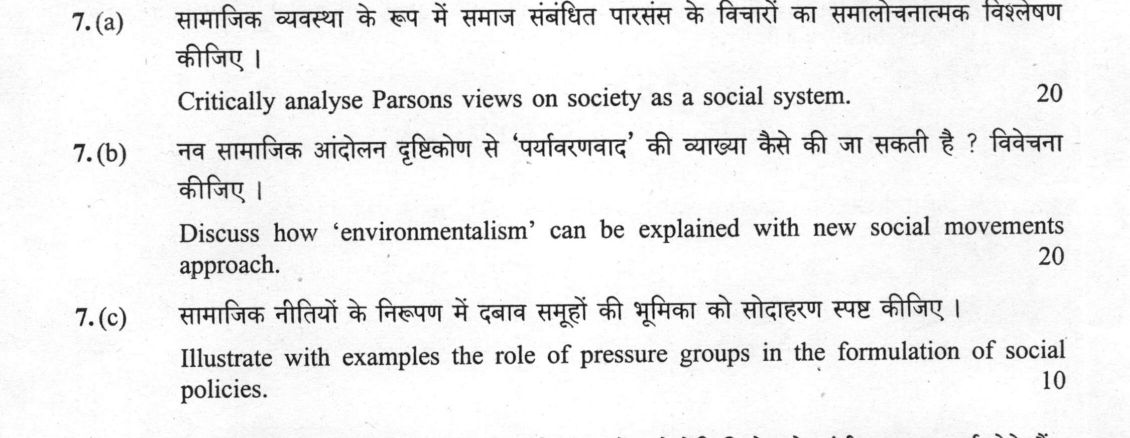
(a) Critically analyse Parsons views on society as a social system. (20 marks) (b) Discuss how 'environmentalism' can be…
Critically analyse Parsons views on society as a social system. 20 marks
Discuss how 'environmentalism' can be explained with new social movements approach. 20 marks
Illustrate with examples the role of pressure groups in the formulation of social policies. 10 marks
हिंदी में प्रश्न पढ़ें
सामाजिक व्यवस्था के रूप में समाज संबंधित पारसन्स के विचारों का समालोचनात्मक विश्लेषण कीजिए । (20 अंक)
नव सामाजिक आंदोलन दृष्टिकोण से 'पर्यावरणवाद' की व्याख्या कैसे की जा सकती है ? विवेचना कीजिए । (20 अंक)
सामाजिक नीतियों के निरूपण में दबाव समूहों की भूमिका को सौदाहरण स्पष्ट कीजिए । (10 अंक)
Model answer
Written by UPSC Answer Check against this question's marking rubric, to the expected length. UPSC does not publish answers for Mains — this is one way to score well, not an official key.
Talcott Parsons conceptualised society as a self-regulating social system maintained through structural differentiation and normative consensus. Within his AGIL paradigm, every social system must satisfy four functional prerequisites: Adaptation (economy), Goal Attainment (polity), Integration (legal and community institutions), and Latency or pattern maintenance (family, education, and religion). These functions are mediated through pattern variables—such as universalism versus particularism and achievement versus ascription—which structure role expectations and social action.
Critical Analysis of Parsons’ Social System
While Parsons provided an overarching analytical framework, his model suffers from severe theoretical and empirical limitations. Internally, David Lockwood demonstrated that Parsons conflated 'system integration' (functional compatibility between institutional parts) with 'social integration' (harmonious relations between actors), thereby ignoring institutional contradictions. Alvin Gouldner, in The Coming Crisis of Western Sociology, exposed Parsons’ functionalism as an ideological defence of post-war American capitalism that naturalised equilibrium and treated social change as mere boundary-maintenance or deviance.
Externally, conflict theorists like Ralf Dahrendorf criticized Parsons’ utopian obsession with consensus, arguing that power, coercion, and structural conflict are the true bases of social order. C. Wright Mills rejected Parsons’ grand theory as an exercise in reification and conceptual obscurity that masked class domination and the power elite. Symbolic interactionists, notably Erving Goffman, argued that Parsons posited an 'over-socialized' view of human agency, neglecting how actors actively construct, negotiate, and subvert social roles. Consequently, while Parsons accurately mapped systemic interdependence, his framework remains inherently conservative and inadequate for analysing power struggles and transformative change.
Environmentalism through the New Social Movements (NSM) Approach
The New Social Movements (NSM) perspective, articulated by Alain Touraine, Alberto Melucci, and Jürgen Habermas, explains collective action in post-industrial societies. Unlike 'old' social movements that mobilized around class cleavages, economic redistribution, and the capture of state power, NSMs focus on post-material values, identity, cultural autonomy, and symbolic contestation.
Environmentalism represents a quintessential NSM. Habermas interprets ecological protests as resistance against the 'colonization of the lifeworld' by bureaucratic and market rationalities. Melucci views environmental groups as networks of 'nomads of the present' who challenge dominant cultural codes through everyday practices. In Ulrich Beck’s 'risk society', environmentalism emerges from manufactured uncertainties that transcend class boundaries, while Anthony Giddens characterizes it as 'life politics'—a reflexive struggle over how humans should live in a globalized world.
Empirically, movements like Chipko and the Narmada Bachao Andolan in India blended ecological survival with cultural identities, questioning technocratic definitions of development. Similarly, contemporary youth-led climate strikes exhibit decentralized, non-hierarchical networking focused on planetary ethics and generational justice rather than state power, exemplifying the NSM paradigm.
Role of Pressure Groups in Social Policy Formulation
Pressure groups act as essential conduits between civil society and the state, utilizing distinct strategies to shape social legislation:
- Insider Strategies: Formal business associations like the Confederation of Indian Industry (CII) and FICCI utilize lobbying, pre-budget consultations, and statutory advisory bodies to influence corporate and labour policies.
- Outsider Strategies: Grassroots collectives employ mass mobilization, public interest litigation, and media campaigns to force policy responsiveness. The Mazdoor Kisan Shakti Sangathan (MKSS) pioneered jan sunwais (public hearings) that directly resulted in the Right to Information (RTI) Act 2005. The Right to Food Campaign similarly mobilized judicial and civil pressure to realize the National Food Security Act 2013 and MGNREGA. Furthermore, coalitions like the Campaign for Survival and Dignity were instrumental in securing the Scheduled Tribes and Other Traditional Forest Dwellers (Forest Rights) Act 2006.
However, the efficacy of pressure groups is frequently constrained by elite capture, corporate resource asymmetry, and tendencies toward state corporatism, which institutionalise select civil society actors while marginalising radical voices.
Conclusion
Parsons’ equilibrium-centred model fails to capture the dynamic contestations that drive modern societies. Contemporary social systems are continually reshaped through the reflexive struggles of new social movements and the organized policy advocacy of pressure groups, proving that social order is not a static functional consensus, but an ongoing, negotiated political process.
What "Critically analyse" is asking you to do
Break the subject into its working parts and show how they act on each other. The marks are in the interconnections — which factor drives which, and what the resulting structure explains — not in the inventory of factors. “Critically” is not a section added at the end: name the yardstick you are judging by — the evidence, the stated objective, a constitutional principle, a rival explanation — and let a verdict close each part of the body. Where the question quotes a claim, that verdict must land on the claim itself, accepted, qualified or rejected, and not on the theme in general.
Structure that answers it
Define the whole → separate it into its parts → show which part drives which → what that interaction produces → what the structure implies
Where marks are lost
Merits in one paragraph, demerits in the next, and a conclusion calling for a balanced and holistic approach. That is a survey with the judgement left out and it holds the answer in the middle band. The opposite error is reading “critically” as permission to attack — and with the odd pairings, critically describe or critically explain, the exposition still carries most of the marks, the judgement being a layer on it rather than a substitute for it.
How this answer will be evaluated
Approach
Framework: Sociology Paper 1 (General Sociology). (a) critique: the claim > its strengths > its weaknesses > your judgment | (b) discuss: intro > 3-4 dimensions > example > balanced close | (c) highlight: name the salient points > one line of substance each > close Full marks: Comprehensive, critical, and well-structured with specific examples and theoretical depth.
Key points expected
- Define AGIL scheme (Adaptation, Goal-attainment, Integration, Latency)
- Explain social system as pattern-maintenance and equilibrium
- Critique: Parson's neglect of conflict and power (Marxist view)
- Critique: Parson's neglect of agency and change (Weberian view)
- Define NSM (Hoffman, Melucci, Touraine) vs. Old Social Movements
- Explain 'Identity Politics' and 'Lifestyle Politics' in environmentalism
- Discuss 'Sub-politics' or 'Post-politics' (Hoffman) in environmental context
- Explain 'Cultural Capital' or 'Moral Capital' in environmental activism
Evaluation rubric
Each sub-part is marked on its own, against the marks and word limit printed on the paper.
- (a) Critical analysis of Parsons' structural functionalism regarding society as a system. 20 marks
critique— the claim → its strengths → its weaknesses → your judgment
Must cover
- Define AGIL scheme (Adaptation, Goal-attainment, Integration, Latency)
- Explain social system as pattern-maintenance and equilibrium
- Critique: Parson's neglect of conflict and power (Marxist view)
- Critique: Parson's neglect of agency and change (Weberian view)
Loses marks
- Describing AGIL without critical evaluation
- Confusing Parsons with Durkheim or Weber
- Treating society as a static entity without discussing dynamics
Earns more
- Mention 'Value Consensus' as a core mechanism
- Reference to 'The Social System' (1951) or 'Structure and Function'
- Contrast with Merton's manifest/latent functions
- Mention 'Anomie' as a system failure
Extra mark
- Reference to 'Parsons vs. Merton' debate
- Mention 'Sick Role' as an application of the theory
- (b) Explanation of environmentalism through the lens of New Social Movements (NSM). 20 marks
discuss— intro → 3-4 dimensions → example → balanced close
Must cover
- Define NSM (Hoffman, Melucci, Touraine) vs. Old Social Movements
- Explain 'Identity Politics' and 'Lifestyle Politics' in environmentalism
- Discuss 'Sub-politics' or 'Post-politics' (Hoffman) in environmental context
- Explain 'Cultural Capital' or 'Moral Capital' in environmental activism
Loses marks
- Treating environmentalism as a traditional labor movement
- Ignoring the 'identity' aspect of NSM
- Failing to distinguish NSM from Old Social Movements
Earns more
- Reference to 'Global Environmental Justice' or 'Climate Justice'
- Mention 'Green New Deal' as a policy outcome
- Reference to 'Greta Thunberg' or 'Fridays for Future' as examples
- Mention 'Sustainable Development Goals' (SDGs) as a framework
Extra mark
- Reference to 'Paris Agreement' (2015) as a policy outcome
- Mention 'Bharatpur Bird Sanctuary' or 'Ongle Bird Sanctuary' as Indian examples
- (c) Illustration of pressure groups' role in social policy formulation with examples. 10 marks
highlight— name the salient points → one line of substance each → close
Must cover
- Define 'Pressure Groups' (Interest Groups) and their role in policy
- Explain 'Lobbying' and 'Agenda Setting' as mechanisms
- Provide one example of a pressure group influencing social policy
- Explain the 'Iron Triangle' or 'Policy Community' concept
Loses marks
- Confusing pressure groups with political parties
- Failing to provide a specific example of policy influence
- Treating pressure groups as purely negative or corrupt
Earns more
- Mention 'NITI Aayog' or 'Planning Commission' as policy bodies
- Reference to 'Right to Information Act' (RTI) as a policy outcome
- Mention 'National Human Rights Commission' (NHRC) as a pressure group
- Reference to 'Consumer Protection Act' as a policy outcome
Extra mark
- Mention 'Narmada Bachao Andolan' as a pressure group
- Reference to 'Right to Education Act' (RTE) as a policy outcome
Practice this exact question
Write your answer and it is marked point by point against the model answer above — what you covered, what you missed, what you got wrong.
Evaluate my answer →More from Sociology 2022 Paper I
- Q4 (a) What characterizes degradation of work in capitalist society according to Marx ? (20…
- Q5 Write short answers of the following questions in about 150 words each: (a) Critically ex…
- Q6 (a) According to Mead the idea of self develops when the individual becomes self-consciou…
- Q7 (a) Critically analyse Parsons views on society as a social system. (20 marks) (b) Discus…
- Q8 (a) Sociologists argue for democratization of science and technology for inclusive develo…