Paper I — Q3
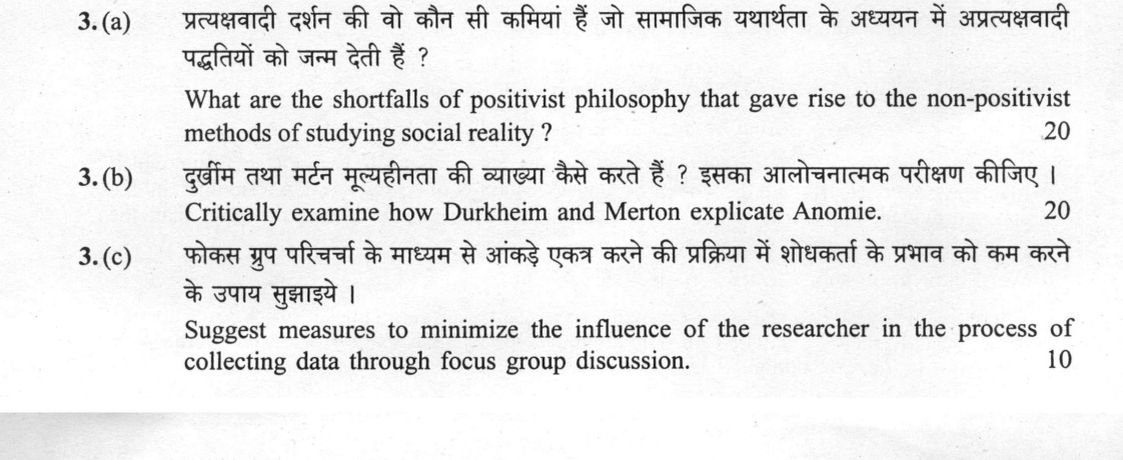
(a) What are the shortfalls of positivist philosophy that gave rise to the non-positivist methods of studying social reality ?…
What are the shortfalls of positivist philosophy that gave rise to the non-positivist methods of studying social reality ? 20 marks
Critically examine how Durkheim and Merton explicate Anomie. 20 marks
Suggest measures to minimize the influence of the researcher in the process of collecting data through focus group discussion. 10 marks
हिंदी में प्रश्न पढ़ें
प्रत्यक्षवादी दर्शन की वो कौन सी कमियां हैं जो सामाजिक यथार्थता के अध्ययन में अप्रत्यक्षवादी पद्धतियों को जन्म देती हैं ? (20 अंक)
दुर्खीम तथा मर्टन मूल्यहीनता की व्याख्या कैसे करते हैं ? इसका आलोचनात्मक परीक्षण कीजिए । (20 अंक)
फोकस ग्रुप परिचर्चा के माध्यम से आंकड़े एकत्र करने की प्रक्रिया में शोधकर्ता के प्रभाव को कम करने के उपाय सुझाइये । (10 अंक)
Model answer
Written by UPSC Answer Check against this question's marking rubric, to the expected length. UPSC does not publish answers for Mains — this is one way to score well, not an official key.
Shortfalls of Positivist Philosophy and the Rise of Non-Positivist Methods
Positivist sociology, pioneered by Auguste Comte and Émile Durkheim, sought to model the study of society on the natural sciences by treating "social facts as things" through quantitative measurement, statistical determinism, and an insistence on value-neutrality. However, this orthodoxy revealed severe epistemological shortfalls. By reifying social structures, positivism reduced human actors to passive recipients of external structural forces, completely ignoring human agency, internal consciousness, and the subjective meanings individuals attach to their actions. Furthermore, post-positivist philosophers of science like Thomas Kuhn and Paul Feyerabend demonstrated that even natural science is not purely objective or value-free, undermining positivism’s foundational claim of detached neutrality.
These limitations catalyzed non-positivist traditions. Max Weber introduced interpretivism (Verstehen), arguing that sociology must comprehend the subjective motives and cultural significance of social action. Alfred Schutz developed phenomenological sociology, shifting inquiry toward the intersubjective construction of the everyday "lifeworld" (Lebenswelt) and multiple social realities. Concurrently, the Frankfurt School's critical theory (Adorno, Habermas) critiqued positivism as an instrument of technocratic domination that legitimizes the status quo, demanding instead an emancipatory, reflexive science. Consequently, non-positivist methodologies established qualitative techniques—such as participant observation, in-depth interviews, and hermeneutics—as indispensable for capturing reflexivity and the negotiated nature of social life.
Critical Examination of Anomie: Durkheim and Merton
Émile Durkheim conceptualized anomie as a state of normlessness resulting from the deregulation of individual desires. In The Division of Labour in Society and Suicide, he argued that during rapid economic transitions from mechanical to organic solidarity, the collective conscience weakens before new regulatory norms crystallize. Because human passions are inherently limitless, the breakdown of moral regulation plunges individuals into chronic dissatisfaction, leading to pathologies such as anomic suicide. Durkheim’s formulation is an ontological, macro-moral critique: anomie represents an inadequate societal control over biological and psychological impulses.
Robert K. Merton transformed anomie from a moral pathology into a middle-range structural strain theory in Social Structure and Anomie. Departing from Durkheim’s emphasis on insatiable desires, Merton argued that desires are culturally induced. Anomie emerges from an acute disjunction between culturally defined goals (such as the American Dream of monetary success) and the socially structured, institutionalized means available to achieve them. Merton mapped five individual adaptations to this strain based on acceptance or rejection of goals and means: conformity, innovation, ritualism, retreatism, and rebellion.
Critically, while Durkheim viewed anomie as a temporary, transitional breakdown curable through occupational corporatism—reflecting a conservative optimism—Merton revealed that anomie is a permanent, institutionalized contradiction embedded in unequal capitalist social structures. Merton’s innovation lies in demonstrating how society itself generates deviance. However, both thinkers remain tethered to functionalist assumptions: Durkheim overstates the necessity of moral consensus, while Merton presupposes a universal internalization of dominant cultural goals, underestimating subcultural autonomy, differential value systems, and the role of power in defining deviance. Ultimately, Merton provides a superior sociological framework by locating anomie in structural stratification rather than in a deficit of moral hygiene.
Minimizing Researcher Influence in Focus Group Discussions
To safeguard data integrity in Focus Group Discussions (FGDs), researchers must implement systematic procedural and reflexivity controls:
First, moderator neutrality must be enforced through specialized training to prevent leading questions, confirmatory verbal cues, or biasing body language. The facilitator should adhere to a pre-tested, semi-structured discussion guide featuring neutral, open-ended prompts.
Second, group composition requires deliberate stratification; balancing intra-group homogeneity (to ensure participants feel safe to speak without intimidation) with inter-group heterogeneity captures diverse viewpoints while curbing social desirability bias and groupthink.
Third, separating the roles of moderation and data recording by utilizing independent third-party note-takers and multi-angle audio-visual recording minimizes selective observational filtering.
Finally, post-collection safeguards—including reflexive journaling to audit the researcher's own subjectivities, member-checking (returning summary transcripts to participants to verify accurate interpretation), and methodological triangulation with participant observation or structured surveys—ensure that findings reflect participant realities rather than researcher imposition.
What "Critically examine" is asking you to do
Test the proposition the question puts to you and return a finding on how far it holds. Examine stems carry a claim, or ask whether something has happened, and expect evidence weighed both ways before the extent is stated — often with remedial measures attached. “Critically” is not a section added at the end: name the yardstick you are judging by — the evidence, the stated objective, a constitutional principle, a rival explanation — and let a verdict close each part of the body. Where the question quotes a claim, that verdict must land on the claim itself, accepted, qualified or rejected, and not on the theme in general.
Structure that answers it
Restate the claim as the question frames it → evidence that supports it → evidence that undercuts it → the conditions under which it holds → verdict on how far it stands
Where marks are lost
Merits in one paragraph, demerits in the next, and a conclusion calling for a balanced and holistic approach. That is a survey with the judgement left out and it holds the answer in the middle band. The opposite error is reading “critically” as permission to attack — and with the odd pairings, critically describe or critically explain, the exposition still carries most of the marks, the judgement being a layer on it rather than a substitute for it.
How this answer will be evaluated
Approach
Framework: Sociology Paper 1: Define > Thinker > Argument > Indian illustration. (a) discuss: intro > 3-4 dimensions > example > balanced close | (b) critically evaluate: positives > negatives/limits > conditions/safeguards > conclusion | (c) suggest: the problem in one line > implementable measures > who acts > conclusion Full marks: Precise conceptual distinctions, named thinkers, critical analysis, and specific methodological measures.
Key points expected
- Critique of value-neutrality and objectivity
- Limitations of quantitative/empirical data
- Neglect of subjective meaning and interpretation
- Rise of interpretive/qualitative approaches
- Durkheim: Anomie as normlessness/absence of rules
- Merton: Anomie as structural strain/goal-means gap
- Critical comparison of their definitions
- Evaluation of their explanatory power
Evaluation rubric
Each sub-part is marked on its own, against the marks and word limit printed on the paper.
- (a) Identify specific limitations of positivism that necessitated non-positivist methods. 20 marks
discuss— intro → 3-4 dimensions → example → balanced close
Must cover
- Critique of value-neutrality and objectivity
- Limitations of quantitative/empirical data
- Neglect of subjective meaning and interpretation
- Rise of interpretive/qualitative approaches
Loses marks
- General description of positivism without critique
- Confusing positivism with realism
Earns more
- Reference to Weber's Verstehen
- Mention of phenomenology or hermeneutics
- Contrast between nomothetic and idiographic
Extra mark
- Specific critique of Comte or Durkheim
- Reference to Berger and Luckmann
- (b) Compare Durkheim's and Merton's conceptualizations of Anomie. 20 marks
critically evaluate— positives → negatives/limits → conditions/safeguards → conclusion
Must cover
- Durkheim: Anomie as normlessness/absence of rules
- Merton: Anomie as structural strain/goal-means gap
- Critical comparison of their definitions
- Evaluation of their explanatory power
Loses marks
- Treating both concepts as identical
- Lack of critical evaluation/comparison
Earns more
- Merton's five modes of adaptation
- Durkheim's context of rapid social change
- Reference to 'Suicide' or 'Social Theory and Social Structure'
Extra mark
- Application to Indian social context
- Reference to contemporary examples of anomie
- (c) List measures to reduce researcher bias in Focus Group Discussions. 10 marks
suggest— the problem in one line → implementable measures → who acts → conclusion
Must cover
- Use of neutral/moderator script
- Selection of trained, neutral moderator
- Standardized question order and phrasing
- Recording and transcription for verification
Loses marks
- Vague suggestions without implementation details
- Ignoring the role of the moderator
Earns more
- Pilot testing of discussion guide
- Debriefing participants after session
- Use of multiple moderators
Extra mark
- Reference to specific FGD guidelines
- Mention of triangulation with other methods
Practice this exact question
Write your answer and it is marked point by point against the model answer above — what you covered, what you missed, what you got wrong.
Evaluate my answer →More from Sociology 2022 Paper I
- Q1 Answer the following questions in about 150 words each: (a) Delimit the scope of Sociolog…
- Q2 (a) What aspects of 'Enlightenment' do you think paved way for the emergence of sociology…
- Q3 (a) What are the shortfalls of positivist philosophy that gave rise to the non-positivist…
- Q4 (a) What characterizes degradation of work in capitalist society according to Marx ? (20…
- Q5 Write short answers of the following questions in about 150 words each: (a) Critically ex…
- Q6 (a) According to Mead the idea of self develops when the individual becomes self-consciou…