Paper I — Q5
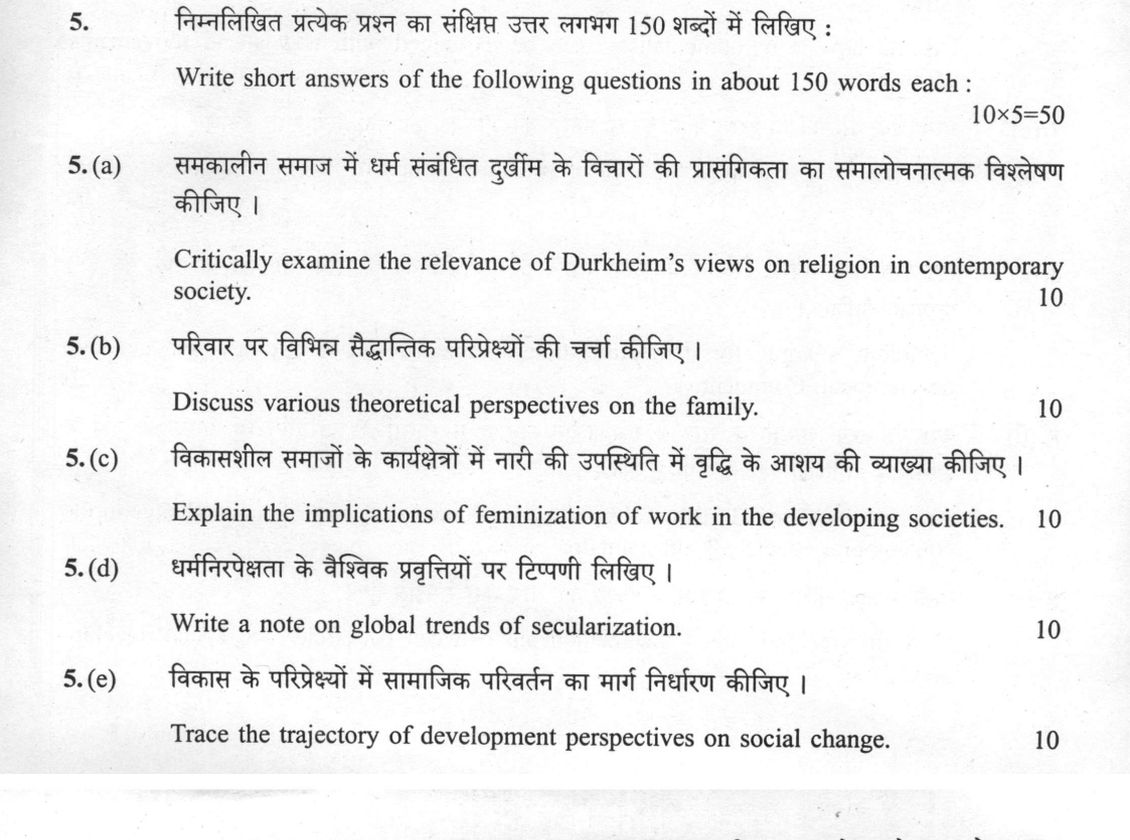
Write short answers of the following questions in about 150 words each: (a) Critically examine the relevance of Durkheim's views…
Write short answers of the following questions in about 150 words each: Critically examine the relevance of Durkheim's views on religion in contemporary society. 10 marks
Discuss various theoretical perspectives on the family. 10 marks
Explain the implications of feminization of work in the developing societies. 10 marks
Write a note on global trends of secularization. 10 marks
Trace the trajectory of development perspectives on social change. 10 marks
हिंदी में प्रश्न पढ़ें
निम्नलिखित प्रत्येक प्रश्न का संक्षिप्त उत्तर लगभग 150 शब्दों में लिखिए : समकालीन समाज में धर्म संबंधित दुर्खीम के विचारों की प्रासंगिकता का समालोचनात्मक विश्लेषण कीजिए । (10 अंक)
परिवार पर विभिन्न सैद्धांतिक परिप्रेक्ष्यों की चर्चा कीजिए । (10 अंक)
विकासशील समाजों के कार्यक्षेत्रों में नारी की उपस्थिति में वृद्धि के आशय की व्याख्या कीजिए । (10 अंक)
धर्मनिरपेक्षता के वैश्विक प्रवृत्तियों पर टिप्पणी लिखिए । (10 अंक)
विकास के परिप्रेक्ष्यों में सामाजिक परिवर्तन का मार्ग निर्धारण कीजिए । (10 अंक)
Model answer
Written by UPSC Answer Check against this question's marking rubric, to the 150-word length. UPSC does not publish answers for Mains — this is one way to score well, not an official key.
(a) Relevance of Durkheim's Views on Religion in Contemporary Society
Emile Durkheim conceptualised religion as an eminently social phenomenon, wherein society worships its own collective conscience through the totemic principle, producing functional integration and social solidarity. While this explains how communal rituals reinforce social cohesion—evident in contemporary mass rituals and India’s burgeoning temple economies—it inadequately addresses religious fragmentation and conflict. Rational choice theorists such as Rodney Stark argue that religious vitality flourishes through pluralistic competition rather than unified collective representations. Furthermore, Meredith McGuire’s concept of "lived religion" demonstrates that modern spirituality is fluid, individualized, and detached from rigid institutional totems. The post-9/11 resurgence of religious fundamentalism and the use of religion for competitive electoral mobilization in India show that religion often acts as a source of violent polarization rather than normative consensus. Therefore, while Durkheim correctly identified the enduring need for collective effervescence, his assumption of religion as an unproblematic agent of social integration is outdated in plural, conflict-ridden modern societies.
(b) Theoretical Perspectives on the Family
Sociological conceptualizations of the family span diverse paradigms. Talcott Parsons offered a structural-functionalist view, arguing that industrialization creates a "functional fit" for the isolated nuclear family with structurally segregated instrumental and expressive roles. William J. Goode extended this through modernization convergence theory, positing that global industrial development inexorably moves extended kin systems toward Western-style conjugal units. In sharp contrast, conflict and Marxist-feminist theorists reject functional harmony. Friedrich Engels linked the monogamous nuclear family to private property transmission, while Christine Delphy showed that the family is an economic system where women’s domestic labour is systematically appropriated by patriarchal heads. Postmodern theorists, notably Judith Stacey and Jeffrey Weeks, reject universalistic models altogether, highlighting the emergence of "postmodern family diversity," fluid kinship forms, and chosen families. Thus, family theory has transitioned from viewing the institution as a stable, functional universal to analyzing it as a contested, dynamic site of power, economic negotiation, and lived diversity.
(c) Implications of Feminization of Work in Developing Societies
The feminization of work in developing societies reflects dual, contradictory trajectories. On the one hand, globalization has integrated women into global care chains (Arlie Hochschild) and export-oriented manufacturing, but this is characterized by structural precarity, informalization, wage suppression, and deskilling. In India, data from the Self Employed Women's Association (SEWA) indicates that over 90% of working women remain in informal, unprotected sectors lacking social security, enduring an intensified "double burden" of wage work and unremunerated care work. On the other hand, feminization has fractured patriarchal domestic monopolies by enhancing women's economic agency and intra-household bargaining power. Grassroots institutional models, such as Kerala’s Kudumbashree mission, demonstrate how collective economic participation and state-supported microcredit foster civic leadership, capability expansion, and structural empowerment. Consequently, while the feminization of work often signifies the informalization and exploitation of female labour, collective institutional frameworks can convert economic participation into substantive gender empowerment.
(d) Global Trends of Secularization
The trajectory of global secularization reveals profound divergence across regions. The classic secularization thesis, formulated by Bryan Wilson and early Peter Berger, equated modernization with institutional differentiation, rationalization, and the inevitable decline of religious authority in the public sphere. However, the supply-side model of Rodney Stark and Laurence Iannaccone challenged this Eurocentric model, demonstrating that in unregulated religious markets like the United States, religious pluralism stimulates religious vitality. Furthermore, José Casanova documented the global "deprivatization" of religion, where religious traditions actively re-enter political and civil spheres. In the Global South, particularly India, secularization did not follow the Western trajectory of strict church-state separation. Scholars like T.N. Madan and Ashis Nandy emphasize Indian exceptionalism, where secularism was conceived as sarva dharma sambhava (equal respect for all religions), though it remains perpetually contested by majoritarian resurgence. Global trends thus indicate desecularization and public religion rather than universal secular convergence.
(e) Trajectory of Development Perspectives on Social Change
The sociology of development has shifted from teleological universalism to critical pluralism. Early modernization theories, epitomised by W.W. Rostow’s stages of economic growth and Daniel Lerner’s urbanization-media empathy nexus, viewed social change as an evolutionary, linear transition from traditional stagnation to Western-style modernity. In the 1960s–70s, Dependency theorists like Andre Gunder Frank challenged this paradigm, demonstrating that metropolitan capitalism systematically produces the "development of underdevelopment" in the periphery, a structural asymmetry refined by Immanuel Wallerstein’s World-Systems analysis into core, semi-periphery, and periphery dynamics. By the 1990s, ecological crises compelled the mainstreaming of sustainable development, balancing industrial expansion with inter-generational equity. Most recently, post-development theorists such as Arturo Escobar deconstructed "development" as an imperial discourse of Western cultural hegemony, paving the way for decolonial alternatives based on indigenous epistemologies, the pluriverse, and Buen Vivir. Development is thus no longer theorized as linear modernization, but as a contested arena of social and ecological transformation.
What "Critically examine" is asking you to do
Test the proposition the question puts to you and return a finding on how far it holds. Examine stems carry a claim, or ask whether something has happened, and expect evidence weighed both ways before the extent is stated — often with remedial measures attached. “Critically” is not a section added at the end: name the yardstick you are judging by — the evidence, the stated objective, a constitutional principle, a rival explanation — and let a verdict close each part of the body. Where the question quotes a claim, that verdict must land on the claim itself, accepted, qualified or rejected, and not on the theme in general.
Structure that answers it
Restate the claim as the question frames it → evidence that supports it → evidence that undercuts it → the conditions under which it holds → verdict on how far it stands
Where marks are lost
Merits in one paragraph, demerits in the next, and a conclusion calling for a balanced and holistic approach. That is a survey with the judgement left out and it holds the answer in the middle band. The opposite error is reading “critically” as permission to attack — and with the odd pairings, critically describe or critically explain, the exposition still carries most of the marks, the judgement being a layer on it rather than a substitute for it.
How this answer will be evaluated
Approach
Framework: Sociology Paper 1 (UPSC). (a) critique: the claim > its strengths > its weaknesses > your judgment | (b) discuss: intro > 3-4 dimensions > example > balanced close | (c) explain: definition/context > points in order > small example > short close | (d) write short notes: define > 3-4 key features > one example > one-line significance | (e) trace: start point > the stages in sequence > end point > what changed Full marks: Precise definitions, clear distinction between thinkers, and specific application to the 'contemporary' or 'developing' context.
Key points expected
- Define 'collective consciousness' and 'sacred/profane' distinction
- Explain religion as social glue (social cohesion)
- Critique: Relevance in secular/individualistic modernity
- Critique: Limitations of 'religion' definition (e.g., excludes non-theistic)
- Functionalism: Family as stabilizing unit (Parsons)
- Conflict Theory: Family as site of inequality/power (Marxist/Feminist)
- Symbolic Interactionism: Family as constructed through interaction
- Feminist perspective: Patriarchy and domestic labor
Evaluation rubric
Each sub-part is marked on its own, against the marks and word limit printed on the paper.
- (a) Assess Durkheim's theory of religion against modern secular/individualistic society. 10 marks · 150 words
critique— the claim → its strengths → its weaknesses → your judgment
Must cover
- Define 'collective consciousness' and 'sacred/profane' distinction
- Explain religion as social glue (social cohesion)
- Critique: Relevance in secular/individualistic modernity
- Critique: Limitations of 'religion' definition (e.g., excludes non-theistic)
Loses marks
- Treating religion only as 'belief in God'
- Ignoring the 'social' aspect of Durkheim's argument
Earns more
- Reference to 'Elementary Forms of Religious Life'
- Mention of 'anomie' or 'ritual' in modern context
- Comparison with Weber or Marx on religion
Extra mark
- Reference to 'civic religion' or 'secular rituals' (e.g., Republic Day)
- (b) Outline major sociological theories explaining family structure and function. 10 marks · 150 words
discuss— intro → 3-4 dimensions → example → balanced close
Must cover
- Functionalism: Family as stabilizing unit (Parsons)
- Conflict Theory: Family as site of inequality/power (Marxist/Feminist)
- Symbolic Interactionism: Family as constructed through interaction
- Feminist perspective: Patriarchy and domestic labor
Loses marks
- Listing theories without explaining their view of the family
- Confusing 'family' with 'marriage' exclusively
Earns more
- Mention of 'nuclear vs joint' family debate
- Reference to 'socialization' function
- Reference to 'emotional support' function
Extra mark
- Reference to 'New Right' critique of family breakdown
- (c) Analyze the consequences of women's increasing participation in the workforce in developing nations. 10 marks · 150 words
explain— definition/context → points in order → small example → short close
Must cover
- Define 'feminization of work' (shift to service/low-wage sectors)
- Economic implication: Increased household income/GDP
- Social implication: Delayed marriage/childbearing
- Negative implication: 'Double burden' or exploitation in informal sector
Loses marks
- Assuming all work is formal/white-collar
- Ignoring the 'developing society' context (e.g., lack of childcare)
Earns more
- Reference to 'labor force participation rate' (LFPR)
- Mention of 'informal sector' dominance
- Reference to 'empowerment' vs 'exploitation' debate
Extra mark
- Specific data point (e.g., NFHS or World Bank stats on female workforce)
- (d) Summarize the global shift away from religious authority and belief. 10 marks · 150 words
write short notes— define → 3-4 key features → one example → one-line significance
Must cover
- Define secularization (privatization of religion)
- Trend: Decline of institutional authority (church/state)
- Trend: Rise of 'spiritual but not religious' (SBNR)
- Counter-trend: Resurgence of fundamentalism in some regions
Loses marks
- Equating secularization with 'atheism' only
- Ignoring the 'global' aspect (treating it as only a Western phenomenon)
Earns more
- Reference to 'differentiation' (sociology separate from religion)
- Mention of 'rationalization' (Weber)
- Distinction between 'secularization' and 'secularism'
Extra mark
- Reference to 'New Atheism' or specific country data (e.g., Europe vs US)
- (e) Map the evolution of development theories from modernization to post-development. 10 marks · 150 words
trace— start point → the stages in sequence → end point → what changed
Must cover
- Stage 1: Modernization Theory (Rostow/West-led)
- Stage 2: Dependency Theory (Frank/Amin - core/periphery)
- Stage 3: World-Systems Theory (Wallerstein)
- Stage 4: Post-Development/Alternative (Sen/Gupta - capability approach)
Loses marks
- Treating development as only 'economic growth' (GDP)
- Skipping the shift from Western-centric to Global South perspectives
Earns more
- Mention of 'Green Revolution' as a modernization tool
- Reference to 'structural adjustment' (IMF/World Bank)
- Mention of 'sustainable development' (Brundtland)
Extra mark
- Reference to 'Amartya Sen's Capability Approach' specifically
Practice this exact question
Write your answer and it is marked point by point against the model answer above — what you covered, what you missed, what you got wrong.
Evaluate my answer →More from Sociology 2022 Paper I
- Q2 (a) What aspects of 'Enlightenment' do you think paved way for the emergence of sociology…
- Q3 (a) What are the shortfalls of positivist philosophy that gave rise to the non-positivist…
- Q4 (a) What characterizes degradation of work in capitalist society according to Marx ? (20…
- Q5 Write short answers of the following questions in about 150 words each: (a) Critically ex…
- Q6 (a) According to Mead the idea of self develops when the individual becomes self-consciou…
- Q7 (a) Critically analyse Parsons views on society as a social system. (20 marks) (b) Discus…
- Q8 (a) Sociologists argue for democratization of science and technology for inclusive develo…