Paper I — Q4
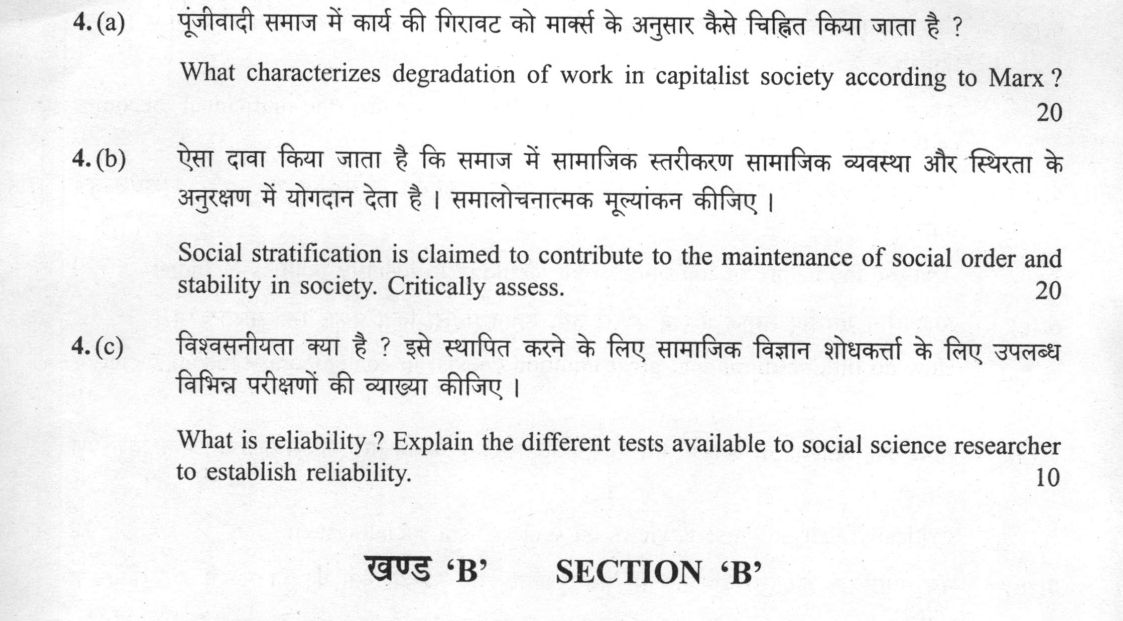
(a) What characterizes degradation of work in capitalist society according to Marx ? (20 marks) (b) Social stratification is…
What characterizes degradation of work in capitalist society according to Marx ? 20 marks
Social stratification is claimed to contribute to the maintenance of social order and stability in society. Critically assess. 20 marks
What is reliability ? Explain the different tests available to social science researcher to establish reliability. 10 marks
हिंदी में प्रश्न पढ़ें
पूंजीवादी समाज में कार्य की गिरावट को मार्क्स के अनुसार कैसे चिह्नित किया जाता है ? (20 अंक)
ऐसा दावा किया जाता है कि समाज में सामाजिक स्तरीकरण सामाजिक व्यवस्था और स्थिरता के अनुक्षण में योगदान देता है । समालोचनात्मक मूल्यांकन कीजिए । (20 अंक)
विश्वसनीयता क्या है ? इसे स्थापित करने के लिए सामाजिक विज्ञान शोधकर्ता के लिए उपलब्ध विभिन्न परीक्षणों की व्याख्या कीजिए । (10 अंक)
Model answer
Written by UPSC Answer Check against this question's marking rubric, to the expected length. UPSC does not publish answers for Mains — this is one way to score well, not an official key.
Sociology examines how macro-structural processes—from the organisation of capitalist production to systems of stratification—shape human existence, requiring rigorous methodological tools like reliability to generate objective empirical knowledge.
Marx and the Degradation of Work in Capitalist Society
Karl Marx posits that capitalism fundamentally degrades work by converting it from a creative, self-realising activity (praxis) into an alienating commodity. Under the capitalist mode of production, degradation occurs through four distinct dimensions of alienation: alienation from the product (which confronts the producer as an alien, hostile power), alienation from the act of production (labour becomes external, forced drudgery), alienation from species-being (Gattungswesen, extinguishing human creative potential), and alienation from fellow workers (transforming social solidarity into competitive antagonism).
This degradation operates through the real subsumption of labour under capital, wherein technical processes subordinate the worker to the rhythm of the machine. Applying the Babbage principle, capital fragments complex production into simplified, repetitive tasks to cheapen labour power. This deskilling process—institutionalised historically through Taylorist scientific management and Fordist assembly lines—divorces mental conception from manual execution. Furthermore, the perpetual maintenance of an industrial reserve army of labour institutionalises casualisation and precarity, stripping work of intrinsic meaning and reducing the labourer to an appendage of a machine.
Stratification and Social Order: A Critical Assessment
Functionalist theorists claim that social stratification is an integrative mechanism essential for social equilibrium. Kingsley Davis and Wilbert Moore argue that differential rewards ensure meritocratic role allocation, motivating talented individuals to undergo sacrifice for functionally critical positions. Talcott Parsons similarly maintains that stratification reflects shared value consensus, ranking individuals according to societal pattern variables to preserve institutional order.
However, a critical assessment reveals that stratification generates deep structural instability. Karl Marx demonstrates that stratification rests on class exploitation, creating inherent contradictions that culminate in class struggle and revolutionary upheaval. Max Weber illustrates how stratification fosters social closure, whereby privileged strata monopolise economic and social opportunities, generating resentment and usurpationary counter-actions by excluded groups. Ralf Dahrendorf identifies unequal distributions of authority as the primary source of institutional conflict. In reality, stratification often preserves order not through consensus, but through coercion and ideological hegemony. Pervasive stratification—evidenced by caste-based marginalisation or extreme economic disparity—acts as a primary driver of social unrest and systemic friction rather than stable integration.
Reliability in Social Science Research
Reliability denotes the consistency, stability, and replicability of a research instrument across repeated measurements under identical conditions. To establish reliability, social researchers employ four primary tests: the test-retest method (administering the same test over time to check temporal stability), parallel-forms reliability (administering equivalent versions of an instrument), the split-half method (dividing an instrument into two parts to measure internal consistency), and inter-rater reliability (assessing the degree of agreement across different observers or coders). In diverse societies like India, reliability is frequently threatened by linguistic diversity, dialectal nuances in survey translation, and high interviewer variability, which introduce non-sampling errors and distort empirical standardization.
Conclusion
While structural-functional models view stratification as an indispensable pillar of social reproduction, critical sociological perspectives demonstrate that institutionalised hierarchies and the degradation of labour inherently generate structural strain, necessitating reliable methodological inquiry to expose and evaluate these underlying power dynamics.
What "Critically assess" is asking you to do
Size something up where no pass-or-fail standard exists — how far a role matters, how large an impact runs, how serious a problem is. Evaluate and assess are marked on the same scale; the working difference is that evaluate answers whether it worked, assess answers how much it weighs. “Critically” is not a section added at the end: name the yardstick you are judging by — the evidence, the stated objective, a constitutional principle, a rival explanation — and let a verdict close each part of the body. Where the question quotes a claim, that verdict must land on the claim itself, accepted, qualified or rejected, and not on the theme in general.
Structure that answers it
What is being sized up and on what evidence → evidence of reach → limits and counter-evidence → a stated degree, considerable or partial or marginal, with reasons
Where marks are lost
Merits in one paragraph, demerits in the next, and a conclusion calling for a balanced and holistic approach. That is a survey with the judgement left out and it holds the answer in the middle band. The opposite error is reading “critically” as permission to attack — and with the odd pairings, critically describe or critically explain, the exposition still carries most of the marks, the judgement being a layer on it rather than a substitute for it.
How this answer will be evaluated
Approach
Framework: Sociology Paper 1 (UPSC). (a) examine: intro > how/why with reasoning > evidence > conclusion | (b) critique: the claim > its strengths > its weaknesses > your judgment | (c) explain: definition/context > points in order > small example > short close Full marks: Precise definitions, clear distinction between thinkers, and specific methodological details.
Key points expected
- Define alienation (Entfremdung) as the core concept
- Explain separation of worker from product of labor
- Explain separation from the labor process (fragmentation)
- Explain separation from human species-being (creative potential)
- Present the Functionalist view (Durkheim/Parsons) on stability
- Present the Conflict view (Marx) on coercion and exploitation
- Discuss the 'Meritocratic' argument for social mobility
- Provide a balanced judgment on the 'stability' claim
Evaluation rubric
Each sub-part is marked on its own, against the marks and word limit printed on the paper.
- (a) Explain the specific features of work degradation in capitalism as per Marx. 20 marks
examine— intro → how/why with reasoning → evidence → conclusion
Must cover
- Define alienation (Entfremdung) as the core concept
- Explain separation of worker from product of labor
- Explain separation from the labor process (fragmentation)
- Explain separation from human species-being (creative potential)
Loses marks
- Confusing alienation with general 'hard work'
- Ignoring the 'species-being' aspect
- Treating it as a modern HR issue rather than structural
Earns more
- Mention commodity fetishism
- Reference to 'Capital' or 'Economic Manuscripts'
- Contrast with pre-capitalist craft production
- Link to exploitation of surplus value
Extra mark
- Reference to 'The Eighteenth Brumaire' or 'Communist Manifesto'
- Mention of 'deskilling' (Braverman) as a modern extension
- (b) Critically assess the claim that stratification maintains social order and stability. 20 marks
critique— the claim → its strengths → its weaknesses → your judgment
Must cover
- Present the Functionalist view (Durkheim/Parsons) on stability
- Present the Conflict view (Marx) on coercion and exploitation
- Discuss the 'Meritocratic' argument for social mobility
- Provide a balanced judgment on the 'stability' claim
Loses marks
- One-sided presentation (only Functionalist or only Marxist)
- Failing to define 'social order' or 'stability'
- Ignoring the 'critical' aspect of the command word
Earns more
- Mention Merton's 'social glue' argument
- Reference to 'false consciousness' (Marx)
- Use of Indian context (Caste vs Class)
- Mention of 'social stratification' vs 'social inequality'
Extra mark
- Reference to 'Caste in Modern India' (M.N. Srinivas)
- Mention of 'Social Mobility' data (NFHS/PLFS)
- (c) Define reliability and explain the tests used to establish it. 10 marks
explain— definition/context → points in order → small example → short close
Must cover
- Define reliability as consistency/replicability of results
- Explain Test-Retest method (temporal stability)
- Explain Inter-rater reliability (observer consistency)
- Explain Internal consistency (Cronbach's alpha)
Loses marks
- Confusing reliability with validity
- Listing tests without explaining how they work
- Ignoring the 'social science' context (e.g., using physics examples)
Earns more
- Mention 'Split-half' method
- Distinguish reliability from validity
- Mention 'Parallel forms' method
- Brief example of a survey instrument
Extra mark
- Mention of 'Kuder-Richardson' formula
- Reference to 'Standard Error of Measurement'
Practice this exact question
Write your answer and it is marked point by point against the model answer above — what you covered, what you missed, what you got wrong.
Evaluate my answer →More from Sociology 2022 Paper I
- Q1 Answer the following questions in about 150 words each: (a) Delimit the scope of Sociolog…
- Q2 (a) What aspects of 'Enlightenment' do you think paved way for the emergence of sociology…
- Q3 (a) What are the shortfalls of positivist philosophy that gave rise to the non-positivist…
- Q4 (a) What characterizes degradation of work in capitalist society according to Marx ? (20…
- Q5 Write short answers of the following questions in about 150 words each: (a) Critically ex…
- Q6 (a) According to Mead the idea of self develops when the individual becomes self-consciou…
- Q7 (a) Critically analyse Parsons views on society as a social system. (20 marks) (b) Discus…