Paper I — Q6
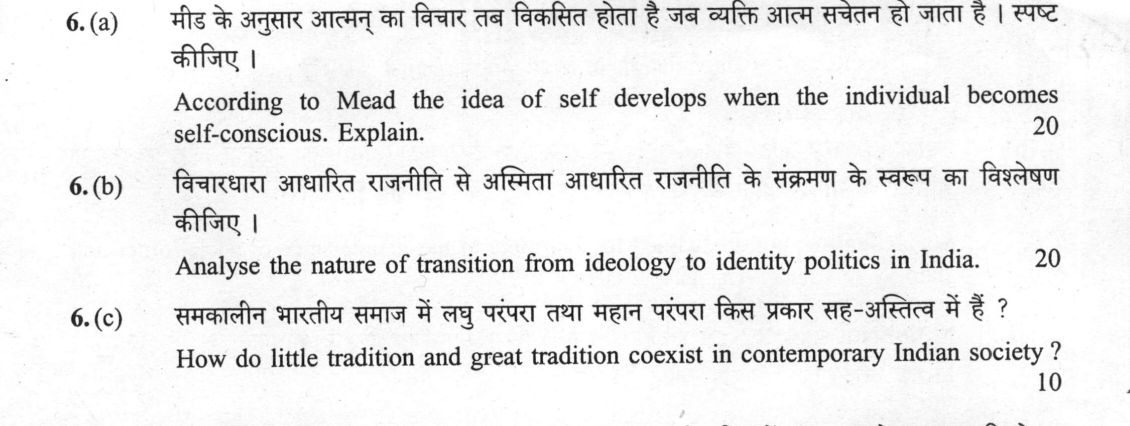
(a) According to Mead the idea of self develops when the individual becomes self-conscious. Explain. (20 marks) (b) Analyse the…
According to Mead the idea of self develops when the individual becomes self-conscious. Explain. 20 marks
Analyse the nature of transition from ideology to identity politics in India. 20 marks
How do little tradition and great tradition coexist in contemporary Indian society ? 10 marks
हिंदी में प्रश्न पढ़ें
मीड के अनुसार आत्मन का विचार तब विकसित होता है जब व्यक्ति आत्म सचेतन हो जाता है । स्पष्ट कीजिए । (20 अंक)
विचारधारा आधारित राजनीति से अस्मिता आधारित राजनीति के संक्रमण के स्वरूप का विश्लेषण कीजिए । (20 अंक)
समकालीन भारतीय समाज में लघु परंपरा तथा महान परंपरा किस प्रकार सह-अस्तित्व में हैं ? (10 अंक)
Model answer
Written by UPSC Answer Check against this question's marking rubric, to the expected length. UPSC does not publish answers for Mains — this is one way to score well, not an official key.
Development of Self and Self-Consciousness in Mead
George Herbert Mead posited that the human self is not an innate biological substance, but a reflexive social process that emerges through social interaction and communication. While Charles Horton Cooley’s concept of the "looking-glass self" explained self-conception through imagined perceptions of others, Mead provided the precise cognitive and behavioral mechanism: the deployment of "significant symbols" (gestures and language with shared meaning) that allow an individual to take the role of the other and become an object to oneself.
Mead outlined this evolution through three sequential stages: The preparatory stage involves mindless imitation of adult behavior without symbolic comprehension. The play stage marks the beginning of true role-taking, where the child adopts the roles of specific, significant others (such as a parent or teacher) one at a time. The game stage requires the child to internalize the roles of all other participants simultaneously under generalized rules, culminating in the formation of the "generalized other"—the organized community’s collective values and expectations.
Self-consciousness is sustained through the internal dialectic between the "Me" and the "I". The "Me" is the socialized self containing the internalized attitudes of the generalized other, while the "I" is the spontaneous, active, and creative response to those expectations. The self develops precisely when the biological organism internalizes this social dialogue, achieving self-consciousness through continuous role-taking.
Transition from Ideology to Identity Politics in India
Post-independence Indian politics has witnessed a structural shift from programmatic, ideology-based competition to ascriptive identity politics. During the 1950s to 1970s, political contestation was organized primarily around universalist secular-nationalist, socialist, and communist ideologies. The dominant "Congress system" conceptualized by Rajni Kothari, along with ideological alternatives like the CPI and socialist parties, framed governance around modernization, planned development, and class-based redistribution.
From the late 1980s onward, this ideological consensus yielded to identity mobilization based on caste, religion, and ethnicity. Key drivers of this transition included: The implementation of the Mandal Commission recommendations, which catalyzed backward-caste (OBC) political consciousness and spawned caste-based parties like the SP, BSP, and RJD; The rise of the Ram Janmabhoomi movement (Mandir politics), which mobilized religious majoritarianism as an electoral force; The organizational decline of the Congress party, creating a vacuum filled by regional and caste assertions; Economic liberalization, which generated cultural anxieties while shrinking state employment, turning electoral politics into competitive populism for reservations and symbolic recognition over structural class reforms.
Coexistence of Little and Great Traditions in Contemporary India
Robert Redfield conceptualized the Great Tradition as reflective, textual, and Sanskritic, and the Little Tradition as oral, localized, and unwritten. In India, as Milton Singer and McKim Marriott demonstrated, these traditions do not exist in binary isolation but in continuous mutual interaction through parochialization and universalization. Singer highlighted "compartmentalization" and modern "cultural performances" as mechanisms through which contemporary Indians maintain traditional identities alongside modern urban life.
In contemporary Indian society, this coexistence is visible in pilgrimage centers like Tirupati and Sabarimala, where local folk myths, indigenous votive practices, and non-Brahminical rites operate within Sanskritic temple rituals. Popular culture and cinema regularly syncretize folk melodies and vernacular themes with pan-Indian classical motifs. Similarly, regional and tribal festivals, such as Telangana’s Medaram Jatara and Nagaland’s Hornbill Festival, receive formal state patronage and national visibility, seamlessly integrating local sacred traditions into the broader institutional fabric of modern India.
These socio-political dynamics underscore the continuous tension between agency and structure: from Mead’s active self negotiating internalized social norms, to identity politics using ascriptive structures for political agency, to cultural traditions continually renegotiating modernity through syncretic accommodation.
What "Explain" is asking you to do
Make the working of something clear — what sets it off, what follows from what, and what it produces. Explain is the Commission's mechanism word: it dominates the technical papers and the “explain why” stems, where the marks sit in the causal chain and not in the label.
Structure that answers it
State what it is → the initiating condition → the chain of cause, step by step → an instance where it plays out → what the chain produces
Where marks are lost
Describing what something looks like instead of why it works that way. Naming the stages without linking them reads as description too.
How this answer will be evaluated
Approach
Framework: Sociology Paper 1: Define > Thinker > Argument > Indian illustration. (a) explain: definition/context > points in order > small example > short close | (b) analyse: intro > causes > effects > stakeholders/linkages > way forward | (c) explain: definition/context > points in order > small example > short close Full marks: Precise definitions, clear thinker attribution, specific Indian examples, and analytical depth.
Key points expected
- Define 'self' and 'self-consciousness' in Mead's terms
- Explain the 'I' and 'Me' distinction
- Describe the role of the 'generalized other'
- Link self-consciousness to the development of the self
- Define ideology and identity politics
- Explain causes of the transition
- Identify key stakeholders in this shift
- Assess the effects on Indian politics
Evaluation rubric
Each sub-part is marked on its own, against the marks and word limit printed on the paper.
- (a) Explain Mead's theory of self-development through self-consciousness. 20 marks
explain— definition/context → points in order → small example → short close
Must cover
- Define 'self' and 'self-consciousness' in Mead's terms
- Explain the 'I' and 'Me' distinction
- Describe the role of the 'generalized other'
- Link self-consciousness to the development of the self
Loses marks
- Name-dropping Mead without explaining the mechanism
- Confusing 'self' with 'ego' or 'soul'
- Common-sense opinion on self-awareness
Earns more
- Reference to 'significant symbols' or 'symbolic interactionism'
- Contrast with Cooley's 'looking-glass self'
- Mention stages of self-development (play, game, generalized other)
Extra mark
- Cite a specific example from Mead's 'Mind, Self and Society'
- (b) Analyse the transition from ideology to identity politics in India. 20 marks
analyse— intro → causes → effects → stakeholders/linkages → way forward
Must cover
- Define ideology and identity politics
- Explain causes of the transition
- Identify key stakeholders in this shift
- Assess the effects on Indian politics
Loses marks
- Vague generalizations without specific examples
- Ignoring the role of caste or religion
- Presenting identity politics as purely negative
Earns more
- Reference to caste, religion, or regional identity
- Mention specific political parties or movements
- Link to globalization or economic changes
Extra mark
- Cite a specific election result or survey data
- Reference to a specific scholar on Indian identity politics
- (c) Explain the coexistence of little and great traditions in India. 10 marks
explain— definition/context → points in order → small example → short close
Must cover
- Define 'little tradition' and 'great tradition'
- Explain how they coexist in contemporary society
- Provide one specific example of coexistence
Loses marks
- Confusing 'little' with 'inferior' tradition
- Ignoring the dynamic interaction between the two
- No specific examples provided
Earns more
- Reference to Radhakrishnan's concept
- Mention specific festivals or practices
- Link to social change or modernization
Extra mark
- Cite a specific study or example of syncretism
Practice this exact question
Write your answer and it is marked point by point against the model answer above — what you covered, what you missed, what you got wrong.
Evaluate my answer →More from Sociology 2022 Paper I
- Q3 (a) What are the shortfalls of positivist philosophy that gave rise to the non-positivist…
- Q4 (a) What characterizes degradation of work in capitalist society according to Marx ? (20…
- Q5 Write short answers of the following questions in about 150 words each: (a) Critically ex…
- Q6 (a) According to Mead the idea of self develops when the individual becomes self-consciou…
- Q7 (a) Critically analyse Parsons views on society as a social system. (20 marks) (b) Discus…
- Q8 (a) Sociologists argue for democratization of science and technology for inclusive develo…