Paper II — Q1
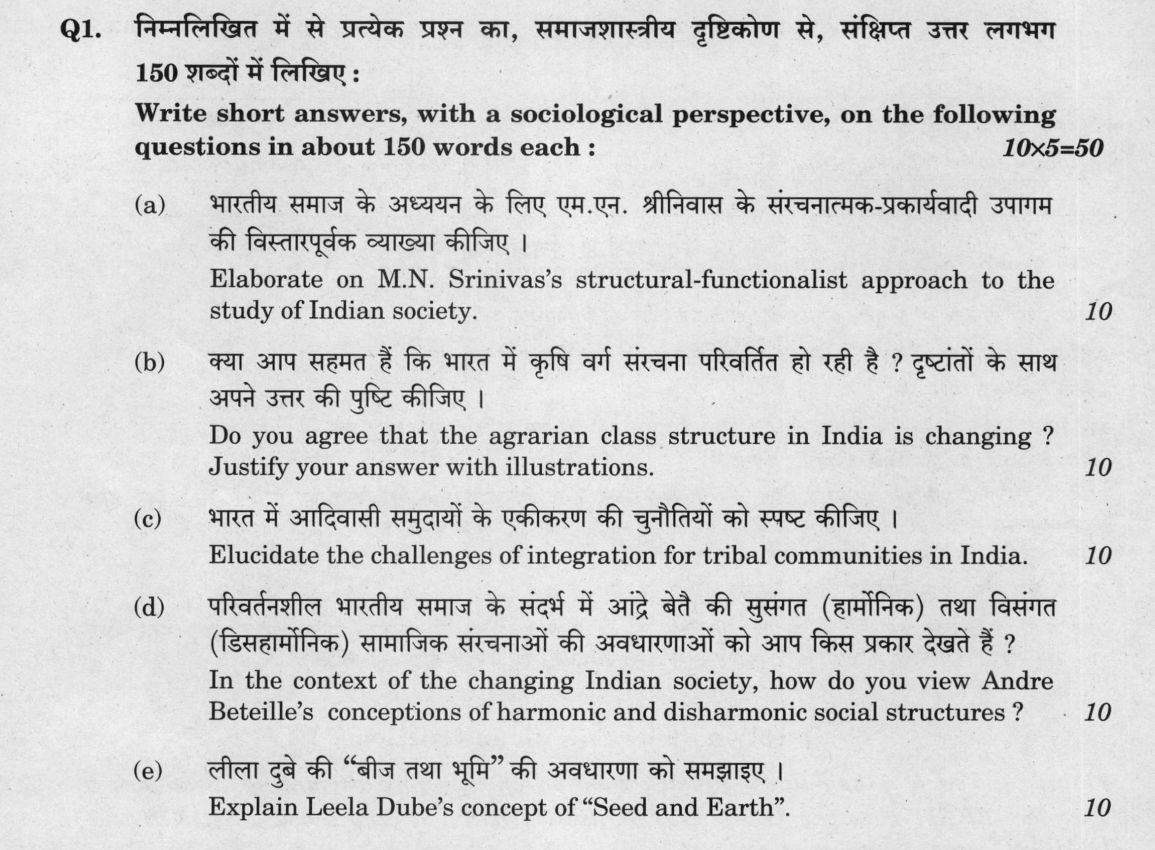
Write short answers, with a sociological perspective, on the following questions in about 150 words each: (a) Elaborate on M.N…
Write short answers, with a sociological perspective, on the following questions in about 150 words each:
Elaborate on M.N. Srinivas's structural-functionalist approach to the study of Indian society. 10 marks
Do you agree that the agrarian class structure in India is changing? Justify your answer with illustrations. 10 marks
Elucidate the challenges of integration for tribal communities in India. 10 marks
In the context of the changing Indian society, how do you view Andre Beteille's conceptions of harmonic and disharmonic social structures? 10 marks
Explain Leela Dube's concept of "Seed and Earth". 10 marks
हिंदी में प्रश्न पढ़ें
निम्नलिखित में से प्रत्येक प्रश्न का, समाजशास्त्रीय दृष्टिकोण से, संक्षिप्त उत्तर लगभग 150 शब्दों में लिखिए :
भारतीय समाज के अध्ययन के लिए एम.एन. श्रीनिवास के संरचनात्मक-प्रकार्यवादी उपागम की विस्तारपूर्वक व्याख्या कीजिए । (10 अंक)
क्या आप सहमत हैं कि भारत में कृषि वर्ग संरचना परिवर्तित हो रही है ? दृष्टांतों के साथ अपने उत्तर की पुष्टि कीजिए । (10 अंक)
भारत में आदिवासी समुदायों के एकीकरण की चुनौतियों को स्पष्ट कीजिए । (10 अंक)
परिवर्तनशील भारतीय समाज के संदर्भ में आंद्रे बेते की सुसंगत (हार्मोनिक) तथा विसंगत (डिसहार्मोनिक) सामाजिक संरचनाओं की अवधारणाओं को आप किस प्रकार देखते हैं ? (10 अंक)
लीला दुबे की "बीज तथा भूमि" की अवधारणा को समझाइए । (10 अंक)
Model answer
Written by UPSC Answer Check against this question's marking rubric, to the 150-word length. UPSC does not publish answers for Mains — this is one way to score well, not an official key.
(a) M.N. Srinivas’s Structural-Functionalist Approach
M.N. Srinivas pioneered the empirical "field-view" in Indian sociology, departing from Indological "book-view" frameworks by utilizing Radcliffe-Brown’s structural-functionalist method. In his ethnography of Rampura (The Remembered Village), Srinivas conceptualized the Indian village not as an isolated, static entity, but as an integrated social ecosystem sustained through functional interdependence, division of labour, and ritual reciprocity.
A central contribution of his approach is the analytical distinction between ritual status and secular power. Through the concept of the "dominant caste," Srinivas demonstrated that a caste holding numerical preponderance, economic landownership, and political muscle often commands local social hegemony irrespective of its traditional varna ranking. His concepts of Sanskritization and Westernization captured horizontal and vertical mobility within this functioning structure. This empirical, dynamic view directly contested Louis Dumont’s structuralist thesis in Homo Hierarchicus, which reduced Indian society to a static, universal binary of pure and impure. Srinivas revealed that ritual hierarchy is perpetually negotiated against material power on the ground.
(b) Changing Agrarian Class Structure
The agrarian class structure in India is undergoing profound structural differentiation, moving beyond Daniel Thorner’s classic triadic division of malik, kisan, and mazdoor. Post-Green Revolution capitalist penetration, commercialization, and state policies have catalyzed significant depeasantisation and rural diversification.
The agrarian structure increasingly features a powerful class of capitalist farmers operating market-oriented enterprises, contrasted with a swelling, fragmented agrarian proletariat. Jan Breman’s empirical studies in Gujarat demonstrate how traditional patron-client ties (such as Halipratha) have dissolved into monetized, exploitative relations characterized by "neo-bondage" and the creation of a "footloose" migrant labour force. Furthermore, the expansion of corporate contract farming—such as potato cultivation in Punjab and sugarcane in Maharashtra—has subordinated smallholders to agribusiness monopolies. Combined with the feminisation of agricultural labour and the diversification into non-farm rural livelihoods, agrarian class positions are no longer solely defined by hereditary land ownership, but by integration into volatile capitalist market circuits and access to institutional credit.
(c) Challenges of Tribal Integration
The integration of tribal communities (Adivasis) remains one of post-independence India’s most complex sociological dilemmas, framed historically by the tension between Verrier Elwin’s isolationist "National Park" approach and G.S. Ghurye’s assimilationist stance. Jawaharlal Nehru formulated the Tribal Panchsheel to balance development with cultural autonomy; however, actual state policy has frequently resulted in forced assimilation and developmental exclusion.
While institutional mechanisms under the Sixth Schedule have fostered self-governance and the preservation of ethnic identity in states like Mizoram, Fifth Schedule areas in central India face severe structural alienation. Large-scale mineral extraction, dam construction, and industrialization have caused massive involuntary displacement from ancestral jal, jungle, and jameen (water, forest, and land) in states like Jharkhand and Odisha. Weak implementation of the Panchayat (Extension to Scheduled Areas) Act (PESA) and Forest Rights Act has led to cultural identity erosion, land alienation, and the reduction of self-sufficient tribal producers into marginalized, informal urban-migrant labour.
(d) Beteille's Harmonic and Disharmonic Social Structures
Andre Beteille introduced the conceptual categories of "harmonic" and "disharmonic" social structures to examine the relationship between the normative order (the realm of values and ideology) and the existential order (the actual distribution of power and resources) in changing societies.
A harmonic structure is one in which the normative system legitimizes existential inequalities. Traditional Indian caste society was harmonic: the ideology of hierarchy sanctioned the cumulative overlap of high ritual status, economic wealth, and political power. Conversely, modern Indian society is fundamentally disharmonic. The Constitution institutionalizes an egalitarian normative framework, yet structural inequalities of caste, class, and gender persist existentially. In Caste, Class and Power, studying Sripuram village, Beteille demonstrated how class and power have decoupled from caste, producing cross-cutting cleavages. In contemporary India, this disharmony manifests in heightened political contestation, where lower castes mobilize democratic power and reservation policies to challenge entrenched socio-economic hierarchies, turning structural disharmony into an engine of continuous social transformation.
(e) Leela Dube’s "Seed and Earth"
Leela Dube’s seminal concept of "Seed and Earth" (Beej aur Dharti) offers a critical feminist analysis of kinship and gender symbolism in patrilineal South Asia. Dube examines how cultural metaphors of human reproduction serve as ideological instruments to naturalize and perpetuate asymmetric gender relations.
In this cultural matrix, the male is conceptualized as the "seed"—the active, generative principle that determines the child's identity, caste, lineage, and clan membership. The female is constructed merely as the "earth" or field—a passive, nurturing receptacle that provides the soil for the seed to grow. Dube deconstructs this biological determinism by showing that the metaphor is a social construct used to legitimize patrilineal property inheritance, justify the absolute control of men over female sexuality, and deny women rights over their offspring. Contrasting North Indian patriliny with matrilineal systems (such as the Lakshadweep islanders), Dube proved that biological reproduction is culturally encoded to sustain distinct structural forms of patriarchal dominance.
What "Elaborate" is asking you to do
Give the full detailed account the question has compressed into a line — every dimension of it, with specifics. Elaborate rewards completeness and detail rather than clarification or argument: the examiner is checking whether you can fill out a topic without being told what its parts are.
Structure that answers it
State the proposition → first dimension in detail → second dimension in detail → the part the statement leaves implicit → the consolidated picture
Where marks are lost
Repeating the statement at greater length instead of adding substance. Elaborate also punishes narrowness: omitting a whole dimension costs more here than anywhere else in this family.
How this answer will be evaluated
Approach
Framework: Sociological Theory & Indian Society. (a) explain: definition/context > points in order > small example > short close | (b) justify: claim > 3-4 reasons > evidence > conclusion | (c) challenges: 3-4 challenges > solutions mapped to them > conclusion | (d) comment: context > arguments both sides > judgment > close | (e) explain: definition/context > points in order > small example > short close Full marks: Precise definitions, clear arguments, specific Indian examples, and balanced judgments.
Key points expected
- Define structural-functionalism in Srinivas's context
- Explain 'Sanskritization' as a mechanism of change
- Mention 'Dominant Caste' concept
- Link approach to Indian social structure
- State a clear position (agree/disagree)
- Identify at least two drivers of change (e.g., land reforms, green revolution)
- Provide specific illustrations of class shifts
- Conclude with a balanced judgment
Evaluation rubric
Each sub-part is marked on its own, against the marks and word limit printed on the paper.
- (a) Define Srinivas's structural-functionalist approach and its application to Indian society. 10 marks · 150 words
explain— definition/context → points in order → small example → short close
Must cover
- Define structural-functionalism in Srinivas's context
- Explain 'Sanskritization' as a mechanism of change
- Mention 'Dominant Caste' concept
- Link approach to Indian social structure
Loses marks
- Confusing Srinivas with M.S. Aney or others
- Describing Sanskritization without the functionalist framework
- Vague generalities without specific concepts
Earns more
- Reference to 'The Remembered Village'
- Mention of 'Westernization' alongside Sanskritization
- Critique of the approach (e.g., static nature)
Extra mark
- Specific example of Sanskritization (e.g., Lingayat movement)
- (b) Argue for/against changes in agrarian class structure with evidence. 10 marks · 150 words
justify— claim → 3-4 reasons → evidence → conclusion
Must cover
- State a clear position (agree/disagree)
- Identify at least two drivers of change (e.g., land reforms, green revolution)
- Provide specific illustrations of class shifts
- Conclude with a balanced judgment
Loses marks
- Failing to take a clear position
- Listing changes without linking to class structure
- Ignoring the 'agrarian' context (focusing on urban classes)
Earns more
- Mention of 'land ceiling' implementation
- Reference to 'agricultural laborers' status
- Discussion of 'capitalist farming' emergence
Extra mark
- Citing specific state data (e.g., Punjab vs. Bihar)
- (c) List and explain the main obstacles to tribal integration. 10 marks · 150 words
challenges— 3-4 challenges → solutions mapped to them → conclusion
Must cover
- Identify 3-4 distinct challenges (e.g., economic, cultural, political)
- Explain the nature of each challenge
- Map solutions or policy responses to challenges
- Conclude on the path forward
Loses marks
- Treating 'integration' as 'assimilation' without distinction
- Listing challenges without explaining their impact
- Ignoring the political dimension (e.g., PESA Act)
Earns more
- Mention of 'Fifth Schedule' areas
- Reference to 'displacement' due to development
- Discussion of 'cultural erosion' vs. 'preservation'
Extra mark
- Specific example of a tribal group (e.g., Santhal, Gond)
- (d) Evaluate Beteille's harmonic/disharmonic structures in modern India. 10 marks · 150 words
comment— context → arguments both sides → judgment → close
Must cover
- Define 'harmonic' and 'disharmonic' structures
- Contextualize within 'changing Indian society'
- Present arguments for both perspectives
- Offer a clear judgment on their relevance
Loses marks
- Confusing Beteille with other structuralists
- Failing to link the concepts to contemporary change
- Presenting only one side of the argument
Earns more
- Reference to 'caste' as a harmonic element
- Discussion of 'modernization' as a disharmonic force
- Mention of 'social mobility' disrupting traditional harmony
Extra mark
- Citing Beteille's specific work (e.g., 'Caste, Class and the State')
- (e) Define and explain Leela Dube's 'Seed and Earth' concept. 10 marks · 150 words
explain— definition/context → points in order → small example → short close
Must cover
- Define 'Seed' (cultural core) and 'Earth' (social context)
- Explain the relationship between the two
- Provide a small example of the concept in action
- Conclude with its significance in sociological analysis
Loses marks
- Confusing the metaphor with literal agriculture
- Failing to explain the dynamic interaction
- Vague description without specific sociological application
Earns more
- Linking to 'cultural continuity' vs. 'change'
- Mention of 'regional variations' in Indian culture
- Reference to Dube's work on 'Hinduism' or 'caste'
Extra mark
- Specific example of a cultural practice adapting to new 'earth'
Practice this exact question
Write your answer and it is marked point by point against the model answer above — what you covered, what you missed, what you got wrong.
Evaluate my answer →More from Sociology 2022 Paper II
- Q1 Write short answers, with a sociological perspective, on the following questions in about…
- Q2 (a) Critically examine G.S. Ghurye's Indological approach to the understanding of Indian…
- Q3 (a) Critically examine Yogendra Singh's thesis on 'Modernisation of Indian Tradition'. (2…
- Q4 (a) Examine the social background of growth of Indian nationalism. (20 marks) (b) Explain…