Paper II — Q3
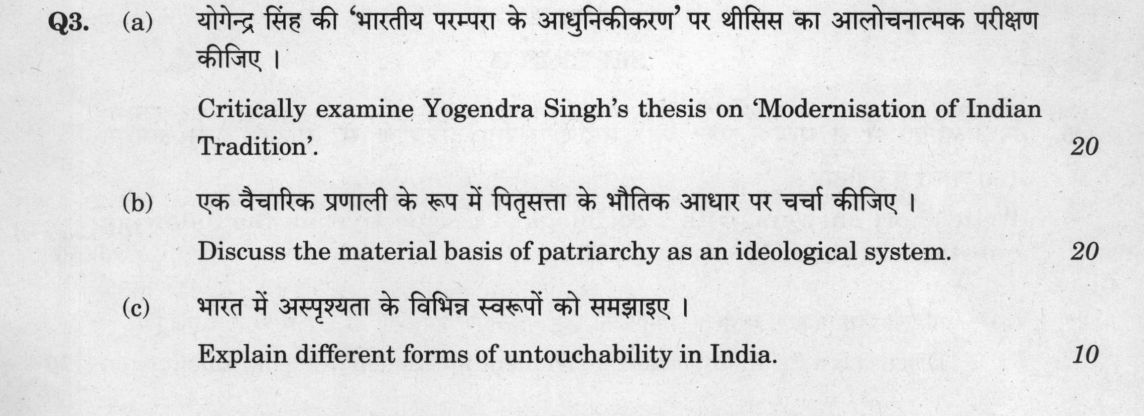
(a) Critically examine Yogendra Singh's thesis on 'Modernisation of Indian Tradition'. (20 marks) (b) Discuss the material basis…
Critically examine Yogendra Singh's thesis on 'Modernisation of Indian Tradition'. 20 marks
Discuss the material basis of patriarchy as an ideological system. 20 marks
Explain different forms of untouchability in India. 10 marks
हिंदी में प्रश्न पढ़ें
योगेन्द्र सिंह की 'भारतीय परम्परा के आधुनिकीकरण' पर थीसिस का आलोचनात्मक परीक्षण कीजिए । (20 अंक)
एक वैचारिक प्रणाली के रूप में पितृसत्ता के भौतिक आधार पर चर्चा कीजिए । (20 अंक)
भारत में अस्पृश्यता के विभिन्न स्वरूपों को समझाइए । (10 अंक)
Model answer
Written by UPSC Answer Check against this question's marking rubric, to the expected length. UPSC does not publish answers for Mains — this is one way to score well, not an official key.
The structural transformation of Indian society is defined by the intersection of caste hierarchy, gender subordination, and institutional modernization. The dialectic between tradition and modernity determines whether these axes of stratification dissolve or reconstitute themselves.
Critique of Yogendra Singh’s Modernisation of Indian Tradition
Yogendra Singh conceptualizes social change in India through an integrated evolutionary framework, categorizing it across ortho-genetic sources (Sanskritisation of Little and Great traditions) and hetero-genetic sources (Westernisation and Modernisation). Singh posits an "adaptive modernisation" thesis, asserting that Indian society selectively absorbs structural modern elements—such as a rational-legal bureaucracy, universalistic law, and democratic institutions—without causing systemic breakdown or the wholesale destruction of traditional cultural values.
However, this structural-functional synthesis faces significant theoretical and empirical limitations. Dipankar Gupta critiques the equation of institutional transfer with modernity, arguing that genuine modernity resides in the institutionalization of universalistic norms, individual rights, and an inter-subjective sphere of reason, rather than the mechanical adoption of modern technology or bureaucratic frameworks. Ashis Nandy questions Singh's linear teleology, emphasizing the resilience of "alternative modernities" and warning against the uncritical validation of Western rationalism that colonizes indigenous consciousness.
Empirically, the trajectory of change deviates from Singh’s harmonious synthesis. In Green Revolution Punjab, rapid technological and agrarian modernization did not weaken traditional stratification; instead, it reinforced the caste-class nexus by entrenching the economic and political dominance of Jat landholders over landless Dalit labourers. Conversely, the Kerala model demonstrates that institutional modernism could decouple caste monopoly from social power only due to sustained redistributive struggles and social democratic mobilization. Singh’s thesis ultimately exhibits an over-optimistic functionalist bias: rather than modernizing tradition democratically, dominant castes and classes have modernized their strategies to reproduce traditional hierarchies within modern spaces.
Material Basis of Patriarchy as an Ideological System
Patriarchy operates as an ideological superstructure anchored in concrete material relations of production and reproduction. Friedrich Engels in The Origin of the Family, Private Property and the State established that the institutionalization of private property necessitated the subordination of women to guarantee legitimate patrilineal inheritance. Ester Boserup demonstrated that agricultural modernization and technological shifts systematically marginalize female labour, reducing women from independent productive agents to dependent domestic labourers. In contemporary India, this material disempowerment is reflected in persistently depressed Female Labour Force Participation Rates (PLFS 2022–23), where female economic contributions remain heavily concentrated in unpaid, precarious household labour despite sustained GDP growth.
This economic foundation is sustained by patriarchy acting as false consciousness. Uma Chakravarti’s formulation of "Brahmanical Patriarchy" reveals that the material closure of caste boundaries and the transmission of land are contingent upon the total regulation of female sexuality. Ideological mechanisms—enforced through patrilocal residence, the economic extraction of dowry, endogamous marriage rules, and violent honour codes—naturalize this subjugation. Material dispossession and cultural ideology thus function in tandem: material dependency compels ideological compliance, which in turn legitimizes economic exclusion.
Forms and Transformations of Untouchability
Untouchability persists across three interdependent forms:
Spatial and Exclusionary: Manifested in the physical segregation of Dalit settlements (cheris, bastis) on village peripheries, denial of access to public commons, and prohibition from entering village temples.
Occupational and Pollution-based: The forced hereditary assignment of Dalits to tasks designated as ritually polluting, such as manual scavenging, dry latrine cleaning, and carcass skinning and tanning.
Ritual and Commensal: Prohibitions governing inter-dining, shared drinking water sources, and strict sanctions against inter-caste marital alliances.
Surinder Jodhka’s village studies indicate that while overt ritual untouchability has declined due to market expansion and Dalit political assertion, spatial segregation and discriminatory exclusion within the rural agrarian economy remain entrenched. Regional manifestations highlight this resilience: Tamil Nadu’s rural tea stalls continue to practice the discriminatory "two-tumbler system", while in Maharashtra, the historical legacy of the exploitative "Mahar watan" bonded labour lingers in structural forms of landlessness. The continued necessity and statutory strengthening of the Scheduled Castes and the Scheduled Tribes (Prevention of Atrocities) Act, 1989, affirms that untouchability is not a fading ritual anachronism, but an actively enforced mechanism of social dominance.
Modernization in India has neither eradicated caste untouchability nor dismantled material patriarchy; instead, traditional hierarchies have adapted modern economic, technological, and political instruments to ensure their own structural survival.
What "Critically examine" is asking you to do
Test the proposition the question puts to you and return a finding on how far it holds. Examine stems carry a claim, or ask whether something has happened, and expect evidence weighed both ways before the extent is stated — often with remedial measures attached. “Critically” is not a section added at the end: name the yardstick you are judging by — the evidence, the stated objective, a constitutional principle, a rival explanation — and let a verdict close each part of the body. Where the question quotes a claim, that verdict must land on the claim itself, accepted, qualified or rejected, and not on the theme in general.
Structure that answers it
Restate the claim as the question frames it → evidence that supports it → evidence that undercuts it → the conditions under which it holds → verdict on how far it stands
Where marks are lost
Merits in one paragraph, demerits in the next, and a conclusion calling for a balanced and holistic approach. That is a survey with the judgement left out and it holds the answer in the middle band. The opposite error is reading “critically” as permission to attack — and with the odd pairings, critically describe or critically explain, the exposition still carries most of the marks, the judgement being a layer on it rather than a substitute for it.
How this answer will be evaluated
Approach
Framework: Sociology Paper II (Social Change and Development). (a) critique: the claim > its strengths > its weaknesses > your judgment | (b) discuss: intro > 3-4 dimensions > example > balanced close | (c) explain: definition/context > points in order > small example > short close Full marks: Comprehensive, well-structured answers with strong critical analysis, specific Indian examples, and relevant data/statistics.
Key points expected
- Define Yogendra Singh's concept of 'Modernisation of Indian Tradition'
- Explain the 'continuity and change' argument in his thesis
- Critique the thesis using counter-arguments or alternative perspectives
- Provide Indian examples illustrating the modernisation of tradition
- Define patriarchy as an ideological system
- Identify the material basis (e.g., property, labor, inheritance)
- Explain how material conditions reinforce patriarchal ideology
- Provide Indian examples of material basis of patriarchy
Evaluation rubric
Each sub-part is marked on its own, against the marks and word limit printed on the paper.
- (a) Assess the validity and limitations of Yogendra Singh's thesis on the modernisation of Indian tradition. 20 marks
critique— the claim → its strengths → its weaknesses → your judgment
Must cover
- Define Yogendra Singh's concept of 'Modernisation of Indian Tradition'
- Explain the 'continuity and change' argument in his thesis
- Critique the thesis using counter-arguments or alternative perspectives
- Provide Indian examples illustrating the modernisation of tradition
Loses marks
- Name-dropping Yogendra Singh without explaining his core argument
- Presenting only the thesis without critical examination
- Using vague, common-sense opinions instead of sociological concepts
Earns more
- Mention specific works by Yogendra Singh (e.g., 'The Bureaucratic Mind')
- Contrast with other sociologists like M.N. Srinivas or S.C. Dube
- Discuss the concept of 'Sanskritisation' in relation to modernisation
- Reference contemporary examples of tradition adapting to modernity
Extra mark
- Cite a specific statistic or survey data supporting the argument
- Reference a recent academic debate or publication on this topic
- (b) Analyze the material and economic foundations that sustain patriarchy as an ideological system. 20 marks
discuss— intro → 3-4 dimensions → example → balanced close
Must cover
- Define patriarchy as an ideological system
- Identify the material basis (e.g., property, labor, inheritance)
- Explain how material conditions reinforce patriarchal ideology
- Provide Indian examples of material basis of patriarchy
Loses marks
- Focusing only on cultural or religious aspects without material analysis
- Presenting patriarchy as a static, unchanging system
- Lack of specific Indian examples or data
Earns more
- Reference Marxist or feminist perspectives on patriarchy
- Discuss the role of the state and legal systems in maintaining patriarchy
- Mention specific Indian laws or policies affecting women's property rights
- Use data from NFHS or other surveys on gender inequality
Extra mark
- Cite a specific court judgment or legal case related to women's rights
- Reference a contemporary debate on gender and economic participation
- (c) Describe the various forms and manifestations of untouchability in contemporary India. 10 marks
explain— definition/context → points in order → small example → short close
Must cover
- Define untouchability in the Indian context
- List and explain different forms of untouchability (social, economic, political)
- Provide examples of how untouchability persists in modern India
- Mention legal provisions against untouchability
Loses marks
- Presenting untouchability as a historical phenomenon without contemporary relevance
- Lack of specific examples or forms of untouchability
- Ignoring the legal and institutional mechanisms to combat untouchability
Earns more
- Reference the Scheduled Castes (Prevention of Atrocities) Act
- Discuss the role of caste in contemporary social and economic life
- Mention specific incidents or cases of untouchability
- Discuss the impact of untouchability on education and employment
Extra mark
- Cite a specific statistic on caste-based discrimination
- Reference a recent government report or study on untouchability
Practice this exact question
Write your answer and it is marked point by point against the model answer above — what you covered, what you missed, what you got wrong.
Evaluate my answer →More from Sociology 2022 Paper II
- Q1 Write short answers, with a sociological perspective, on the following questions in about…
- Q2 (a) Critically examine G.S. Ghurye's Indological approach to the understanding of Indian…
- Q3 (a) Critically examine Yogendra Singh's thesis on 'Modernisation of Indian Tradition'. (2…
- Q4 (a) Examine the social background of growth of Indian nationalism. (20 marks) (b) Explain…
- Q5 Write short answers, with a sociological perspective, on the following questions in about…
- Q6 (a) Examine whether rural bondage still continues to be a social reality. Give your argum…