Paper II — Q2
(a) Critically examine G.S. Ghurye's Indological approach to the understanding of Indian society. (20 marks) (b) Elaborate on…
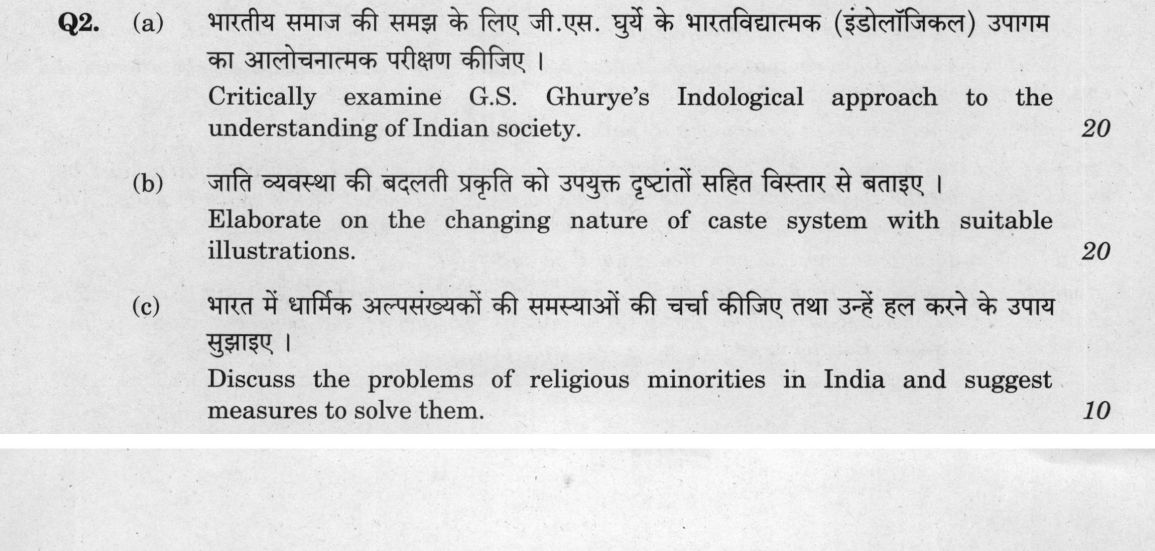
Critically examine G.S. Ghurye's Indological approach to the understanding of Indian society. 20 marks
Elaborate on the changing nature of caste system with suitable illustrations. 20 marks
Discuss the problems of religious minorities in India and suggest measures to solve them. 10 marks
हिंदी में प्रश्न पढ़ें
भारतीय समाज की समझ के लिए जी.एस. घु्रये के भारतविद्यात्मक (इंडोलॉजिकल) उपागम का आलोचनात्मक परीक्षण कीजिए । (20 अंक)
जाति व्यवस्था की बदलती प्रकृति को उपयुक्त दृष्टांतों सहित विस्तार से बताइए । (20 अंक)
भारत में धार्मिक अल्पसंख्यकों की समस्याओं की चर्चा कीजिए तथा उन्हें हल करने के उपाय सुझाइए । (10 अंक)
Model answer
Written by UPSC Answer Check against this question's marking rubric, to the expected length. UPSC does not publish answers for Mains — this is one way to score well, not an official key.
Ghurye’s Indological approach Ghurye’s Indological approach sought to explain Indian society through Sanskrit texts, lawgivers, epics and a historical-comparative method, treating Indian society as a civilisational whole. In Caste in Modern India and Caste and Race in India he gave caste a classical pedigree, presenting it as an ancient, stable, hierarchical order with racial overtones, especially in his thesis that caste had racial origins. Its strength is textual rigour and historical depth: it locates caste in long-term cultural continuity and gives a coherent account of purity, pollution and varna. But the approach is limited. Its Brahmanical lens privileges Brahmanical literature, marginalises tribal, village and Dalit experiences, and tends to freeze caste as a timeless hierarchy. M.N. Srinivas’s field-based sociology and “book view” critique showed that caste is also a field phenomenon, shaped by local power, land, ritual status and mobility. Ghurye’s overemphasis on racial origins is especially weak; his later self-correction in Social Tensions in India moved away from racial determinism and acknowledged modern political and economic tensions. Dumont’s own Indological reading of Brahmanical ideology, though not a direct critique of Ghurye, is often invoked in debates over textual bias; critics of Dumont for idealising hierarchy show the danger of such a lens. Thus Ghurye remains foundational, but his method must be corrected by field sociology and subaltern perspectives.
Changing caste Caste’s changing nature is visible in ritual, political and economic transformations. Srinivas’s sanskritisation shows lower castes adopting upper-caste rituals, dress and diet to improve status, as in the rise of Vanniyar, Reddy or Yadava claims to Kshatriya/Brahminical honour. The Rudolfs’ dominant caste concept shows that village power often rests with a single caste controlling land, markets and local politics, not merely ritual rank. Post-Mandal OBC assertion, reservation politics and caste-based parties have turned caste into a language of rights and patronage; Kanchan Chandra’s patronage democracy captures how caste networks mediate state benefits. Yet economic modernisation has not erased caste. C.J. Fuller’s work on caste in the IT sector shows caste identities reorganised around education, migration and professional networks. Urban anonymity coexists with caste-based housing discrimination, marriage markets and workplace exclusion. Diaspora caste associations preserve caste in new forms, while digital caste networks mobilise for status, marriage and political support. The system is therefore neither static nor disappearing; post-liberal transformations are reshaping it through ritual emulation, political mobilisation, market access and spatial segregation.
Minority problems and remedies Religious minorities face problems of identity, security and representation. The 2006 Sachar Committee documented Muslim deprivation in education, employment, health and social indicators, showing that minority disadvantage is structural, not merely cultural. Anti-conversion laws in several states, though framed as protecting freedom of religion, can restrict voluntary conversion and create a chilling effect on religious choice. Christian tribal communities in the Northeast and central India sometimes face tension between tribal identity and religious affiliation, while Ahmadiyya Muslims have experienced exclusion from mainstream Muslim identity and, in some contexts, legal or social marginalisation. Measures must combine constitutional safeguards with substantive inclusion. Articles 29–30 protect language, culture and educational institutions; minority educational institutions should be supported without becoming segregated enclaves. The Sachar follow-up, including the Prime Minister’s New 15-Point Programme, should be implemented with monitoring, while the uniform civil code debate, linked to Article 44, must be handled carefully so that it does not reduce minority personal law to a majoritarian template. Ultimately, inclusive citizenship beyond tokenism requires security, equitable development, political representation and a public culture that treats religious difference as part of constitutional diversity rather than a threat.
What "Critically examine" is asking you to do
Test the proposition the question puts to you and return a finding on how far it holds. Examine stems carry a claim, or ask whether something has happened, and expect evidence weighed both ways before the extent is stated — often with remedial measures attached. “Critically” is not a section added at the end: name the yardstick you are judging by — the evidence, the stated objective, a constitutional principle, a rival explanation — and let a verdict close each part of the body. Where the question quotes a claim, that verdict must land on the claim itself, accepted, qualified or rejected, and not on the theme in general.
Structure that answers it
Restate the claim as the question frames it → evidence that supports it → evidence that undercuts it → the conditions under which it holds → verdict on how far it stands
Where marks are lost
Merits in one paragraph, demerits in the next, and a conclusion calling for a balanced and holistic approach. That is a survey with the judgement left out and it holds the answer in the middle band. The opposite error is reading “critically” as permission to attack — and with the odd pairings, critically describe or critically explain, the exposition still carries most of the marks, the judgement being a layer on it rather than a substitute for it.
How this answer will be evaluated
Approach
Framework: Sociology Paper II (Indian Society). (a) critically evaluate: positives > negatives/limits > conditions/safeguards > conclusion | (b) discuss: intro > 3-4 dimensions > example > balanced close | (c) suggest: the problem in one line > implementable measures > who acts > conclusion Full marks: Comprehensive, critical, and well-illustrated; uses specific concepts and data; clear structure and argument.
Key points expected
- Define Indological approach (cultural continuity, Sanskritization)
- Contrast with Western/Colonial approach (Ghurye vs. Western scholars)
- Critique: Indological bias, neglect of class/economic factors
- Mention Ghurye's key concepts (e.g., Sanskritization, caste as status)
- Identify key changes (e.g., political mobilization, economic mobility)
- Provide suitable illustrations (e.g., Dalit politics, caste in urban areas)
- Discuss the role of modernization, education, and reservation
- Balance: persistence of caste vs. its changing nature
Evaluation rubric
Each sub-part is marked on its own, against the marks and word limit printed on the paper.
- (a) Assess the validity and limitations of Ghurye's Indological approach to Indian society. 20 marks
critically evaluate— positives → negatives/limits → conditions/safeguards → conclusion
Must cover
- Define Indological approach (cultural continuity, Sanskritization)
- Contrast with Western/Colonial approach (Ghurye vs. Western scholars)
- Critique: Indological bias, neglect of class/economic factors
- Mention Ghurye's key concepts (e.g., Sanskritization, caste as status)
Loses marks
- Treating Indological approach as purely 'traditional' without nuance
- Confusing Ghurye with other Indological thinkers (e.g., Radhakrishnan)
- Failing to provide a critical evaluation (only description)
Earns more
- Reference to Ghurye's 'Caste in Modern India'
- Mention of M.N. Srinivas as a counter-point
- Discussion of 'Indological' vs 'Western' schools of thought
Extra mark
- Reference to specific Ghurye arguments on caste rigidity
- Mention of Ghurye's view on 'Hinduism' as a social force
- (b) Explain the transformation of the caste system in contemporary India with examples. 20 marks
discuss— intro → 3-4 dimensions → example → balanced close
Must cover
- Identify key changes (e.g., political mobilization, economic mobility)
- Provide suitable illustrations (e.g., Dalit politics, caste in urban areas)
- Discuss the role of modernization, education, and reservation
- Balance: persistence of caste vs. its changing nature
Loses marks
- Presenting caste as static or purely 'traditional'
- Ignoring the political dimension of caste change
- Lack of specific illustrations or examples
Earns more
- Reference to 'Sanskritization' (Srinivas) as a mechanism of change
- Mention of caste-based political parties (e.g., BSP, RJD)
- Discussion of caste in the context of urbanization and migration
Extra mark
- Reference to specific data (e.g., NFHS on caste discrimination)
- Mention of 'Caste Census' debates
- (c) Identify problems of religious minorities and propose solutions. 10 marks
suggest— the problem in one line → implementable measures → who acts → conclusion
Must cover
- Identify 2-3 key problems (e.g., discrimination, economic disparity)
- Suggest 2-3 implementable measures (e.g., policy, legal, social)
- Link measures to specific problems
- Brief conclusion on the importance of minority rights
Loses marks
- Vague or generic suggestions (e.g., 'promote harmony')
- Ignoring the legal/policy framework
- Failing to link problems to specific solutions
Earns more
- Reference to specific laws (e.g., Protection of Civil Rights Act)
- Mention of 'Minority Rights' in the Constitution (Art. 29, 30)
- Discussion of economic empowerment schemes
Extra mark
- Reference to specific data on minority economic status
- Mention of 'National Commission for Minorities'
Practice this exact question
Write your answer and it is marked point by point against the model answer above — what you covered, what you missed, what you got wrong.
Evaluate my answer →More from Sociology 2022 Paper II
- Q1 Write short answers, with a sociological perspective, on the following questions in about…
- Q2 (a) Critically examine G.S. Ghurye's Indological approach to the understanding of Indian…
- Q3 (a) Critically examine Yogendra Singh's thesis on 'Modernisation of Indian Tradition'. (2…
- Q4 (a) Examine the social background of growth of Indian nationalism. (20 marks) (b) Explain…
- Q5 Write short answers, with a sociological perspective, on the following questions in about…