Paper II — Q8
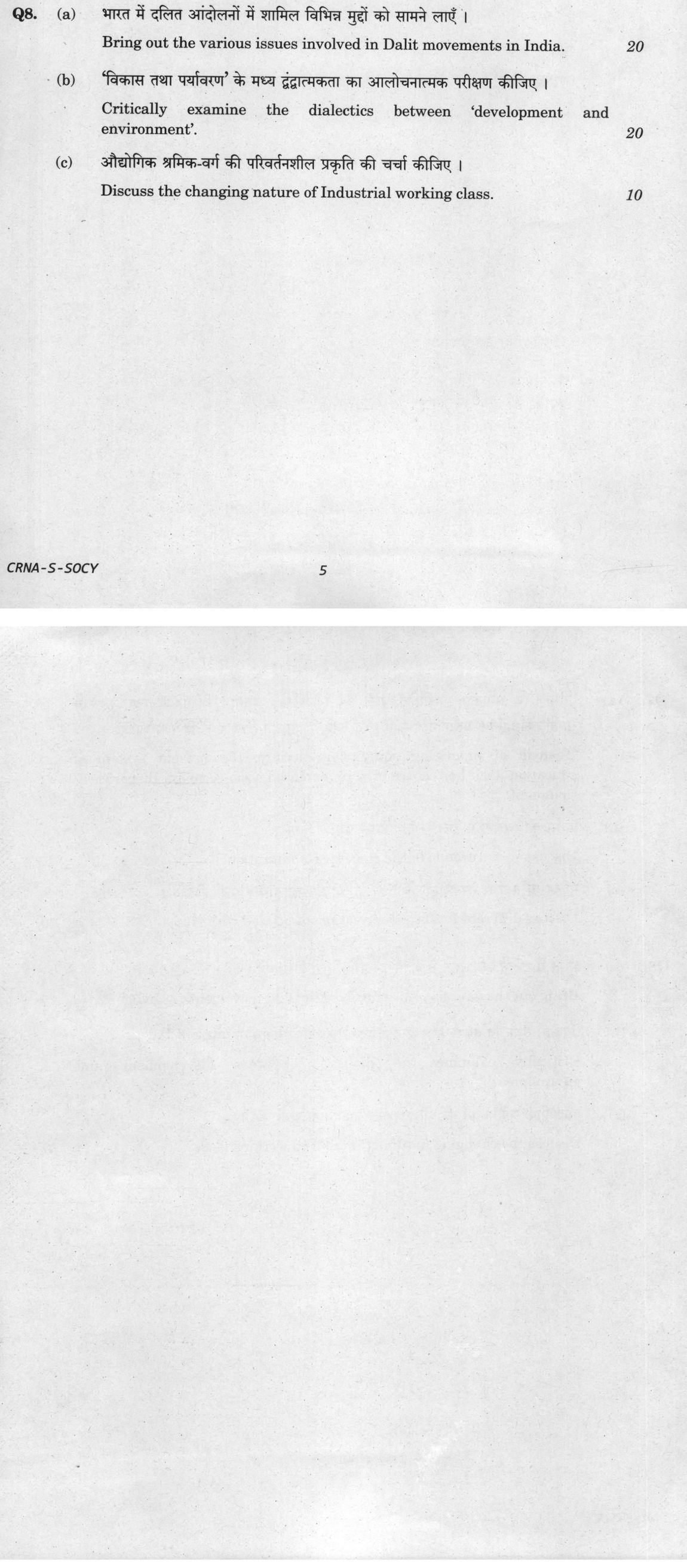
(a) Bring out the various issues involved in Dalit movements in India. (20 marks) (b) Critically examine the dialectics between…
Bring out the various issues involved in Dalit movements in India. 20 marks
Critically examine the dialectics between 'development' and 'environment'. 20 marks
Discuss the changing nature of Industrial working class. 10 marks
हिंदी में प्रश्न पढ़ें
भारत में दलित आंदोलनों में शामिल विभिन्न मुद्दों को सामने लाएं । (20 अंक)
'विकास तथा पर्यावरण' के मध्य द्वंद्वात्मकता का आलोचनात्मक परीक्षण कीजिए । (20 अंक)
औद्योगिक श्रमिक-वर्ग की परिवर्तनशील प्रकृति की चर्चा कीजिए । (10 अंक)
Model answer
Written by UPSC Answer Check against this question's marking rubric, to the expected length. UPSC does not publish answers for Mains — this is one way to score well, not an official key.
India’s modernity is contested in three linked arenas: caste assertion, developmentalism, and labour transformation. Dalit movements, the development-environment dialectic, and the changing industrial working class show how inclusion, growth and livelihood are negotiated in a society still shaped by hierarchy, extraction and precarity.
Dalit movements Dalit politics began before independence through temple-entry struggles, water-rights campaigns and anti-untouchability agitation. After 1947 it moved from constitutional citizenship to organised assertion: the Republican Party, the Dalit Panthers, and later Ambedkarite cultural and political mobilisation. The central issue is the caste-class debate: Ambedkar insisted caste was a moral and social hierarchy requiring identity-based politics, while Marxist approaches stressed class exploitation and often subsumed caste under labour. This produced tension between identity demands—dignity, representation, symbols—and material demands—land, jobs, education. Fragmentation followed: BSP-led electoral politics in the 1990s, when Dalits entered power, coexisted with autonomous movements that rejected party capture. Gender intersectionality remains unresolved, as Dalit women face caste, class and patriarchal violence. Reservation has expanded access but faces limits: creamy-layer disputes, implementation gaps, and the argument that it does not alter caste markets. Atrocity prevention also fails: the SC/ST (Prevention of Atrocities) Act, 1989 is under-implemented, with low FIRs, delayed trials and local bias. Contemporary assertion is visible in Rohith Vemula’s death and the Una flogging protests, where Dalit youth linked university exclusion, police violence and caste humiliation.
Development and environment The dialectic between development and environment pits GDP expansion against ecological limits, as in the Gadgil-McNeill framing. Sustainable development, from Brundtland to the SDGs, tries to reconcile the two, but critics say it often converts ecology into a technical constraint on growth. Environmental degradation in turn undermines development by eroding health, water security and agricultural productivity. Environmental justice exposes who bears costs: shrimp farming in coastal Andhra and Karnataka displaced fishing communities, while the Narmada Bachao Andolan opposed the Sardar Sarovar Dam on the Narmada. Climate change deepens vulnerability for small farmers, fisherfolk and urban poor. Theoretical positions divide between ecological modernisation, associated with Beck, which trusts markets, technology and governance to “green” capitalism, and degrowth/post-development thinkers such as Escobar and Shiva, who question growth itself. Chipko’s forest defence in Uttarakhand and the separate Tehri Dam movement in the Bhagirathi basin contrast forest-based livelihoods with dam-induced displacement. Recent farmer protests against environmental clearances for industrial and infrastructure projects indicate that environmental conflict is now also a livelihood issue. A critical verdict is that development cannot be equated with GDP; it must be redefined through ecological limits, distributional justice and climate resilience, without reverting to anti-development.
Industrial working class The industrial working class is no longer a stable factory proletariat. NSSO’s 68th round shows about 90 per cent of workers in the informal sector. Contract and casualisation, gig and platform work, and feminisation in EPZs have fragmented the class. Trade-union density has declined, weakening collective bargaining, while new solidarities appear in Zomato/Swiggy rider strikes. Theoretically, this marks a shift from Marx’s proletarian consciousness to Standing’s precariat, and from the organised factory to global value chains analysed in Silver’s Forces of Labor. The class is now dispersed, mobile, and often platform-mediated, yet still organised around wages, safety and dignity.
Together, these trends show India’s contested modernity: Dalit assertion demands constitutional equality, environmental critique demands limits on extractive growth, and labour transformation demands rights beyond formal employment. The verdict is that inclusion, ecology and work must be treated as one political problem, not separate policy domains.
What "Critically examine" is asking you to do
Test the proposition the question puts to you and return a finding on how far it holds. Examine stems carry a claim, or ask whether something has happened, and expect evidence weighed both ways before the extent is stated — often with remedial measures attached. “Critically” is not a section added at the end: name the yardstick you are judging by — the evidence, the stated objective, a constitutional principle, a rival explanation — and let a verdict close each part of the body. Where the question quotes a claim, that verdict must land on the claim itself, accepted, qualified or rejected, and not on the theme in general.
Structure that answers it
Restate the claim as the question frames it → evidence that supports it → evidence that undercuts it → the conditions under which it holds → verdict on how far it stands
Where marks are lost
Merits in one paragraph, demerits in the next, and a conclusion calling for a balanced and holistic approach. That is a survey with the judgement left out and it holds the answer in the middle band. The opposite error is reading “critically” as permission to attack — and with the odd pairings, critically describe or critically explain, the exposition still carries most of the marks, the judgement being a layer on it rather than a substitute for it.
How this answer will be evaluated
Approach
(a) highlight: name the salient points > one line of substance each > close | (b) critique: the claim > its strengths > its weaknesses > your judgment | (c) discuss: intro > 3-4 dimensions > example > balanced close Full marks: Comprehensive, well-structured, with specific examples and critical analysis.
Key points expected
- Caste discrimination and social exclusion
- Economic exploitation and land rights
- Political representation and reservation
- Cultural identity and religious conversion
- Definition of sustainable development
- The conflict between growth and ecology
- Environmental degradation as a cost of development
- The need for a balanced approach
Evaluation rubric
Each sub-part is marked on its own, against the marks and word limit printed on the paper.
- (a) Identify and explain the core issues in Indian Dalit movements. 20 marks
highlight— name the salient points → one line of substance each → close
Must cover
- Caste discrimination and social exclusion
- Economic exploitation and land rights
- Political representation and reservation
- Cultural identity and religious conversion
Loses marks
- Vague generalities without specific issues
- Ignoring the economic dimension
- Treating it as a purely religious issue
Earns more
- Reference to Ambedkar or Phule
- Mention of specific movements (e.g., Satyashodhak)
- Link to constitutional provisions
- Contemporary issues like manual scavenging
Extra mark
- Specific statistic on Dalit literacy or income
- Reference to a specific Supreme Court judgment
- (b) Critically examine the relationship between development and environment. 20 marks
critique— the claim → its strengths → its weaknesses → your judgment
Must cover
- Definition of sustainable development
- The conflict between growth and ecology
- Environmental degradation as a cost of development
- The need for a balanced approach
Loses marks
- One-sided view (only pro-development or pro-environment)
- Lack of critical analysis
- Ignoring the social dimension of environmental issues
Earns more
- Reference to Brundtland Report
- Mention of specific environmental laws
- Example of a development project's impact
- Discussion of the 'tragedy of the commons'
Extra mark
- Specific data on carbon emissions or deforestation
- Reference to a specific environmental movement
- (c) Discuss the changing nature of the industrial working class. 10 marks
discuss— intro → 3-4 dimensions → example → balanced close
Must cover
- Decline of traditional industrial jobs
- Rise of the service sector and gig economy
- Changing nature of labor relations
- Impact of technology and automation
Loses marks
- Focusing only on the past state of the working class
- Ignoring the impact of technology
- Vague generalities without specific examples
Earns more
- Reference to the 'precariat' concept
- Mention of specific industries (e.g., IT, manufacturing)
- Discussion of labor unions' changing role
- Example of a specific change in working conditions
Extra mark
- Specific statistic on employment in the gig economy
- Reference to a specific labor law or policy
Practice this exact question
Write your answer and it is marked point by point against the model answer above — what you covered, what you missed, what you got wrong.
Evaluate my answer →More from Sociology 2022 Paper II
- Q5 Write short answers, with a sociological perspective, on the following questions in about…
- Q6 (a) Examine whether rural bondage still continues to be a social reality. Give your argum…
- Q7 (a) "Instead of promoting equality in society, the present system of education itself has…
- Q8 (a) Bring out the various issues involved in Dalit movements in India. (20 marks) (b) Cri…