Paper II — Q7
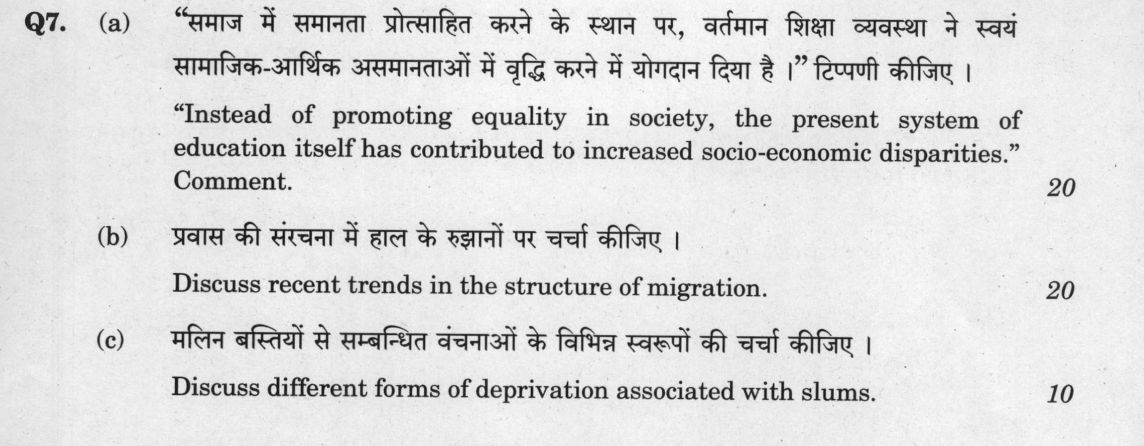
(a) "Instead of promoting equality in society, the present system of education itself has contributed to increased socio-economic…
"Instead of promoting equality in society, the present system of education itself has contributed to increased socio-economic disparities." Comment. 20 marks
Discuss recent trends in the structure of migration. 20 marks
Discuss different forms of deprivation associated with slums. 10 marks
हिंदी में प्रश्न पढ़ें
"समाज में समानता प्रोत्साहित करने के स्थान पर, वर्तमान शिक्षा व्यवस्था ने स्वयं सामाजिक-आर्थिक असमानताओं में वृद्धि करने में योगदान दिया है।" टिप्पणी कीजिए । (20 अंक)
प्रवास की संरचना में हाल के रुझानों पर चर्चा कीजिए । (20 अंक)
मलिन बस्तियों से संबंधित वंचनाओं के विभिन्न स्वरूपों की चर्चा कीजिए । (10 अंक)
Model answer
Written by UPSC Answer Check against this question's marking rubric, to the expected length. UPSC does not publish answers for Mains — this is one way to score well, not an official key.
Contemporary socio-economic transformations in India reflect an intertwined continuum of educational stratification, evolving migration patterns, and rapid yet exclusionary urbanisation.
Education and Socio-Economic Disparities
Sociologists like Bowles and Gintis demonstrate through the correspondence principle that education often reproduces structural class inequalities rather than dismantling them. In India, a deeply stratified multi-track schooling system sustains elite reproduction. Credential inflation has necessitated commercialised competitive coaching ecosystems, as seen in hubs like Kota and Deeksha, making entry into premier professional institutes contingent on family economic capital. Annual Status of Education Report (ASER) findings consistently reveal stark learning deficits among government school students compared to their private school peers. Furthermore, the digital divide during online learning and National Education Policy (NEP) rollouts disproportionately disadvantages rural and lower-income students, turning educational credentials into markers of privilege.
Conversely, the education system also operates as a structural leveller. The Right to Education (RTE) Act, 2009—mandating a 25 percent quota for Economically Weaker Sections—and the PM-POSHAN (Mid-Day Meal) scheme have significantly improved retention and social integration across castes. Constitutional affirmative action through SC, ST, and OBC reservations in public higher education has nurtured an upwardly mobile middle class among historically marginalised groups, while Skill India programmes provide alternative pathways to livelihood mobility.
Recent Trends in the Structure of Migration
Migration patterns in India have undergone notable structural realignments. A prominent trend is the feminisation of migration, visible in independent female migration for employment, such as nurses and domestic workers from Kerala and young women entering the garment sector in Bengaluru. Concurrently, circular and cyclical migration has intensified among seasonal workers, typified by distress migration from rural Odisha to brick kilns across state borders.
Structurally, migration has shifted from permanent relocation toward temporary, livelihood-hedging mobility, alongside an increase in urban-to-urban migration surpassing traditional rural-to-urban streams. Crisis-driven migration has also emerged sharply, demonstrated by the massive COVID-19 reverse migration and climate-induced displacement from ecologically fragile zones like the Sundarbans. Internationally, patterns have bifurcated between short-term contract labour migration to the Gulf corridor and surging middle-class student emigration and high-skilled family migration to countries like Canada.
Deprivation Associated with Slums
Slums embody multidimensional, overlapping deprivations. Economic deprivation is characterised by concentration in low-paying, hazardous informal work and deep asset poverty. Spatial deprivation is evident in hyper-dense settlements like Dharavi, where severe overcrowding compromises basic physical connectivity. Environmental deprivation exposes residents to contaminated water, chronic waterlogging, and toxic proximity to open drains and industrial waste. Political deprivation manifests in insecure land tenure, threat of arbitrary eviction, and reduction to patron-client vote banks without substantive civic rights. Social deprivation creates persistent stigma and barriers to formal urban services. These deprivations intersect along caste, gender, and regional axes: Dalit migrants and women in slums across Mumbai and Delhi experience compounded vulnerabilities regarding safety, wage parity, and access to sanitation.
Unequal educational access restricts rural social mobility, triggering distress-driven circular migration into precarious informal economies and perpetuating spatial and social exclusion within urban slums. Addressing this socio-economic nexus requires equitable public education infrastructure, portable social safety nets for migrant labour, and tenure-secure in-situ slum upgradation.
What "Discuss" is asking you to do
Lay the issue out from more than one side — how it arose, what is claimed for it, what is held against it, and where it now stands. UPSC attaches discuss to broad topics with several live dimensions, so coverage of the dimensions earns more than the strength of your opinion.
Structure that answers it
Set the issue up → the case as it is made → the case against → the dimension both sides leave out → where the balance now lies
Where marks are lost
Listing facts with no thread between them, or arguing one side throughout and calling it a discussion.
How this answer will be evaluated
Approach
Framework: Sociology Paper II (Social Change and Development). (a) comment: context > arguments both sides > judgment > close | (b) discuss: intro > 3-4 dimensions > example > balanced close | (c) discuss: intro > 3-4 dimensions > example > balanced close Full marks: Sophisticated sociological analysis with named thinkers, specific Indian data, and balanced judgment.
Key points expected
- Contextualize education's role in social mobility vs. reproduction
- Arguments supporting the claim (e.g., elite capture, cost barriers)
- Arguments against the claim (e.g., RTE, scholarships, meritocracy)
- Balanced judgment on the system's net impact
- Shift from rural-urban to urban-urban migration
- Role of IT/Service sector in changing migrant profiles
- Impact of globalization and informal economy on migration
- Changing gender dynamics in migration (female migration)
Evaluation rubric
Each sub-part is marked on its own, against the marks and word limit printed on the paper.
- (a) Contextualize the claim, present arguments for/against, and offer a judgment on education's role in inequality. 20 marks
comment— context → arguments both sides → judgment → close
Must cover
- Contextualize education's role in social mobility vs. reproduction
- Arguments supporting the claim (e.g., elite capture, cost barriers)
- Arguments against the claim (e.g., RTE, scholarships, meritocracy)
- Balanced judgment on the system's net impact
Loses marks
- Treating education as purely meritocratic without structural critique
- Ignoring the role of private education in widening gaps
- Vague generalizations without specific sociological concepts
Earns more
- Reference to Bourdieu's cultural capital or social reproduction
- Reference to Amartya Sen's capability approach
- Mention of specific schemes (RTE, Mid-Day Meal) as counter-arguments
- Distinction between access to education and quality of education
Extra mark
- Citing specific ASER or UDISE data on learning outcomes
- Reference to a specific Supreme Court judgment on education rights
- (b) Analyze recent shifts in migration patterns, including direction, drivers, and composition. 20 marks
discuss— intro → 3-4 dimensions → example → balanced close
Must cover
- Shift from rural-urban to urban-urban migration
- Role of IT/Service sector in changing migrant profiles
- Impact of globalization and informal economy on migration
- Changing gender dynamics in migration (female migration)
Loses marks
- Focusing only on rural-urban migration as the sole trend
- Ignoring the economic drivers (wage differentials, job availability)
- Treating migration as a static phenomenon rather than a process
Earns more
- Reference to 'return migration' trends post-pandemic
- Discussion of 'brain drain' vs. 'brain gain'
- Mention of specific states (e.g., Kerala, Maharashtra) as case studies
- Link to 'Right to the City' or urbanization theories
Extra mark
- Citing specific Census 2011 or Migrant Workers Survey data
- Reference to specific policy (e.g., National Urban Policy) impacts
- (c) Identify and explain the various dimensions of deprivation in slum areas. 10 marks
discuss— intro → 3-4 dimensions → example → balanced close
Must cover
- Physical deprivation (housing, sanitation, water)
- Social deprivation (stigma, exclusion, lack of identity)
- Economic deprivation (informal work, low wages, debt)
- Political deprivation (lack of representation, rights)
Loses marks
- Focusing only on physical infrastructure (ignoring social/political)
- Treating slums as purely 'illegal' settlements without nuance
- Vague descriptions without specific examples of deprivation
Earns more
- Reference to 'slum' definition under JNNURM or Slum Act
- Mention of 'slum dwellers' as a distinct social group
- Link to 'urban poverty' vs. 'rural poverty' distinctions
- Reference to specific slum areas (e.g., Dharavi, Mathura)
Extra mark
- Citing specific NFHS data on slum sanitation/water access
- Reference to specific NGO or government intervention (e.g., PMAY-U)
Practice this exact question
Write your answer and it is marked point by point against the model answer above — what you covered, what you missed, what you got wrong.
Evaluate my answer →More from Sociology 2022 Paper II
- Q4 (a) Examine the social background of growth of Indian nationalism. (20 marks) (b) Explain…
- Q5 Write short answers, with a sociological perspective, on the following questions in about…
- Q6 (a) Examine whether rural bondage still continues to be a social reality. Give your argum…
- Q7 (a) "Instead of promoting equality in society, the present system of education itself has…
- Q8 (a) Bring out the various issues involved in Dalit movements in India. (20 marks) (b) Cri…