Paper II — Q6
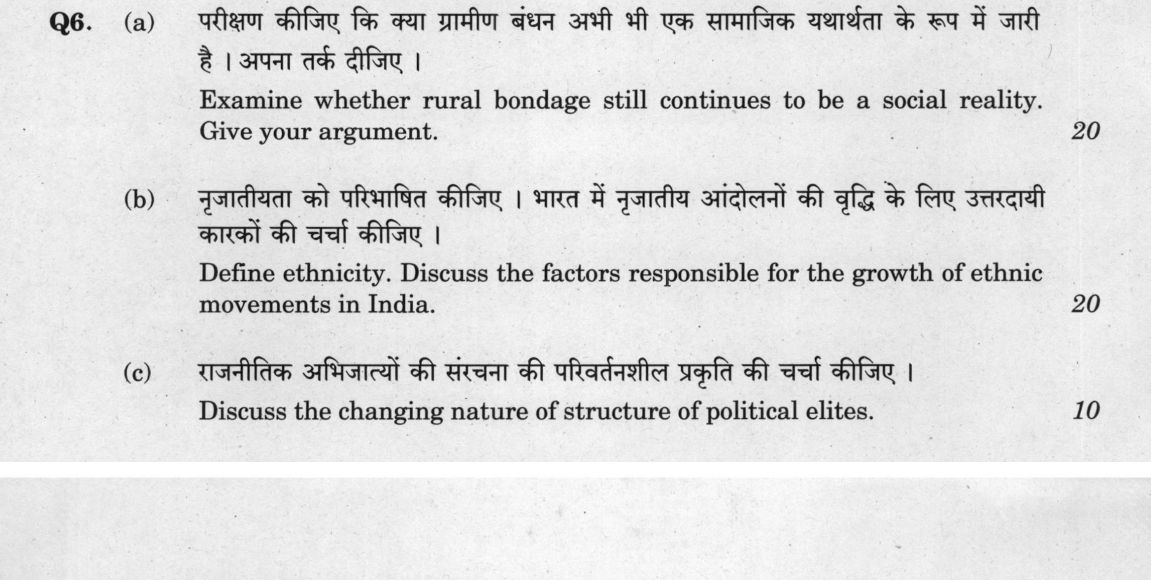
(a) Examine whether rural bondage still continues to be a social reality. Give your argument. (20 marks) (b) Define ethnicity…
Examine whether rural bondage still continues to be a social reality. Give your argument. 20 marks
Define ethnicity. Discuss the factors responsible for the growth of ethnic movements in India. 20 marks
Discuss the changing nature of structure of political elites. 10 marks
हिंदी में प्रश्न पढ़ें
परीक्षण कीजिए कि क्या ग्रामीण बंधन अभी भी एक सामाजिक यथार्थता के रूप में जारी है । अपना तर्क दीजिए । (20 अंक)
नुजातीयता को परिभाषित कीजिए । भारत में नुजातीय आंदोलनों की वृद्धि के लिए उत्तरदायी कारकों की चर्चा कीजिए । (20 अंक)
राजनीतिक अभिजात्यों की संरचना की परिवर्तनशील प्रकृति की चर्चा कीजिए । (10 अंक)
Model answer
Written by UPSC Answer Check against this question's marking rubric, to the expected length. UPSC does not publish answers for Mains — this is one way to score well, not an official key.
Power in rural India operates through an interlocking matrix of material extraction, identity-based mobilization, and evolving elite configurations. Examining the persistence of rural bondage, ethnic assertions, and political elite transitions reveals how structural inequalities adapt rather than disappear under democratic modernization.
Rural Bondage as a Contemporary Reality
Rural bondage refers to institutionalized relations of unfree labour, primarily manifested as debt peonage and attached labour (kamiyuti, jeetha), wherein an advance of cash or kind severely curtails a labourer's freedom of movement, wage negotiation, and employment choice. Unlike historical feudal serfdom rooted in customary land tenure, modern bondage operates dynamically within capitalist agrarian and informal commodity circuits.
Empirical evidence confirms its continued prevalence despite the Bonded Labour System (Abolition) Act, 1976 and Article 23 of the Constitution. National Human Rights Commission (NHRC) reports and ILO studies document widespread unfree labour: inter-generational debt-peonage in the brick kilns of Andhra Pradesh and Telangana, captive advance-tied labour in Tamil Nadu's rice mills, and attached agricultural labour among Mahadalits in Bihar.
Continuity coexists with transformation. While traditional patron-client (jajmani) relations have weakened, bondage has reconstituted into neo-bondage characterized by labour trafficking, seasonal migration mediated by thekedars (contractors), and informal piece-rate agro-industrial contracts. The legal abolition remains compromised by an implementation gap rooted in local administrative apathy and dominant-caste agrarian dominance. Thus, rural bondage continues to be an undeniable, though structurally mutated, social reality.
Ethnicity and the Growth of Ethnic Movements
Ethnicity is sociologically conceptualized as a subjective belief in shared descent, language, or culture that fosters collective solidarity and "cultural honour" (Max Weber), sustained through active boundary maintenance (Fredrik Barth) or political construction as "imagined communities" (Benedict Anderson).
Ethnic movements in India emerge from distinct structural pressures: Regional underdevelopment and perceived internal colonialism, which fuelled tribal assertions such as the Jharkhand movement and the Bodo agitation in Assam. Migration-induced demographic anxieties and competition over scarce public resources, generating "sons of the soil" movements seen in the historical Assam agitation and Maharashtra Navnirman Sena (MNS) mobilizations. Linguistic, cultural, and religious boundary mobilizations seeking territorial autonomy or self-determination, historically exemplified by the Gorkhaland movement in West Bengal and the Khalistan movement in Punjab. Electoral incentives, wherein democratic competition encourages elites to mobilize caste, tribal, and linguistic identities into vote-banks to capture state resources and patronage.
Changing Structure of Political Elites
The Indian political elite has undergone a significant democratization and reconfiguration. The post-Independence era was dominated by a colonial-inherited nexus of upper-caste, English-educated urban bureaucrats and traditional landed zamindars within the "Congress system." The Green Revolution and democratic decentralization enabled the rise of intermediate agrarian castes (OBC assertion and bullock capitalists), ushering in regionalized elite formations. Today, the elite structure is characterized by multi-party subaltern and Dalit assertion, the rise of powerful corporate-business lobbies shaping policy, and localized factional elites mediating welfare delivery through Panchayati Raj institutions.
Synthesis
These three dimensions intersect systematically. Newly ascendant intermediate and local political elites frequently utilize ethnic and caste mobilizations to build electoral coalitions, while simultaneously acting as employers and contractors who perpetuate neo-bondage and informal labour subjugation at the grassroots. Consequently, while elite recruitment has broadened and ethnic consciousness has democratized political space, the underlying economic mechanisms of rural bondage continue to reproduce structural unfreedom in contemporary India.
What "Examine" is asking you to do
Test the proposition the question puts to you and return a finding on how far it holds. Examine stems carry a claim, or ask whether something has happened, and expect evidence weighed both ways before the extent is stated — often with remedial measures attached.
Structure that answers it
Restate the claim as the question frames it → evidence that supports it → evidence that undercuts it → the conditions under which it holds → verdict on how far it stands
Where marks are lost
Stopping at description. An examination has to reach a finding, and “examine with justification” means the extent must be stated, not implied.
How this answer will be evaluated
Approach
Framework: Sociology Paper II (UPSC). (a) examine: intro > how/why with reasoning > evidence > conclusion | (b) discuss: intro > 3-4 dimensions > example > balanced close | (c) discuss: intro > 3-4 dimensions > example > balanced close Full marks: Precise definitions, strong theoretical grounding, specific Indian data/examples, and a clear, reasoned argument.
Key points expected
- Define 'rural bondage' (e.g., bonded labor, caste hierarchy).
- Cite evidence of persistence (e.g., FLFPR, NFHS, or specific state data).
- Analyze structural causes (landlessness, caste, informal credit).
- Provide a reasoned conclusion on its status as a social reality.
- Provide a sociological definition of ethnicity (e.g., Anderson, Gellner).
- Identify key factors (e.g., resource control, political representation, identity).
- Link factors to specific Indian movements (e.g., Naga, Gorkha, Mizo).
- Discuss the role of the state or constitutional provisions.
Evaluation rubric
Each sub-part is marked on its own, against the marks and word limit printed on the paper.
- (a) Assess the persistence of rural social hierarchies and debt bondage in contemporary India. 20 marks
examine— intro → how/why with reasoning → evidence → conclusion
Must cover
- Define 'rural bondage' (e.g., bonded labor, caste hierarchy).
- Cite evidence of persistence (e.g., FLFPR, NFHS, or specific state data).
- Analyze structural causes (landlessness, caste, informal credit).
- Provide a reasoned conclusion on its status as a social reality.
Loses marks
- Treating it as a purely economic issue without social context.
- Vague generalizations without specific Indian examples.
Earns more
- Reference to specific schemes (e.g., NALSA, MGNREGA) and their limits.
- Mention of specific regional examples (e.g., Jharkhand, Bihar).
Extra mark
- Citing a specific recent Supreme Court judgment on bonded labor.
- Using specific FLFPR 2017-18 data on bonded labor.
- (b) Define ethnicity and analyze the drivers of ethnic movements in India. 20 marks
discuss— intro → 3-4 dimensions → example → balanced close
Must cover
- Provide a sociological definition of ethnicity (e.g., Anderson, Gellner).
- Identify key factors (e.g., resource control, political representation, identity).
- Link factors to specific Indian movements (e.g., Naga, Gorkha, Mizo).
- Discuss the role of the state or constitutional provisions.
Loses marks
- Confusing ethnicity with religion or caste without distinction.
- Listing movements without analyzing the underlying factors.
Earns more
- Contrasting 'ethnicity' with 'tribalism' or 'caste'.
- Mentioning the role of media or globalization in identity construction.
Extra mark
- Citing a specific constitutional article (e.g., Art 244, 275).
- Referencing a specific scholar like M.N. Srinivas or A. Appadurai.
- (c) Analyze the shifting composition and nature of political elites in India. 10 marks
discuss— intro → 3-4 dimensions → example → balanced close
Must cover
- Define 'political elite' (e.g., M.L. Smith, Mills).
- Identify changes (e.g., caste, class, gender, education).
- Provide examples of changing elite profiles (e.g., rise of non-Brahmin leaders).
- Conclude on the nature of this change (e.g., democratization vs. dynasticism).
Loses marks
- Focusing only on one dimension (e.g., only caste).
- Failing to link the change to broader social transformations.
Earns more
- Mentioning the role of political parties in elite recruitment.
- Discussing the impact of reservation policies on elite composition.
Extra mark
- Citing specific data on caste composition of MPs/MLAs.
- Referencing a specific study on political dynasties.
Practice this exact question
Write your answer and it is marked point by point against the model answer above — what you covered, what you missed, what you got wrong.
Evaluate my answer →More from Sociology 2022 Paper II
- Q3 (a) Critically examine Yogendra Singh's thesis on 'Modernisation of Indian Tradition'. (2…
- Q4 (a) Examine the social background of growth of Indian nationalism. (20 marks) (b) Explain…
- Q5 Write short answers, with a sociological perspective, on the following questions in about…
- Q6 (a) Examine whether rural bondage still continues to be a social reality. Give your argum…
- Q7 (a) "Instead of promoting equality in society, the present system of education itself has…
- Q8 (a) Bring out the various issues involved in Dalit movements in India. (20 marks) (b) Cri…